
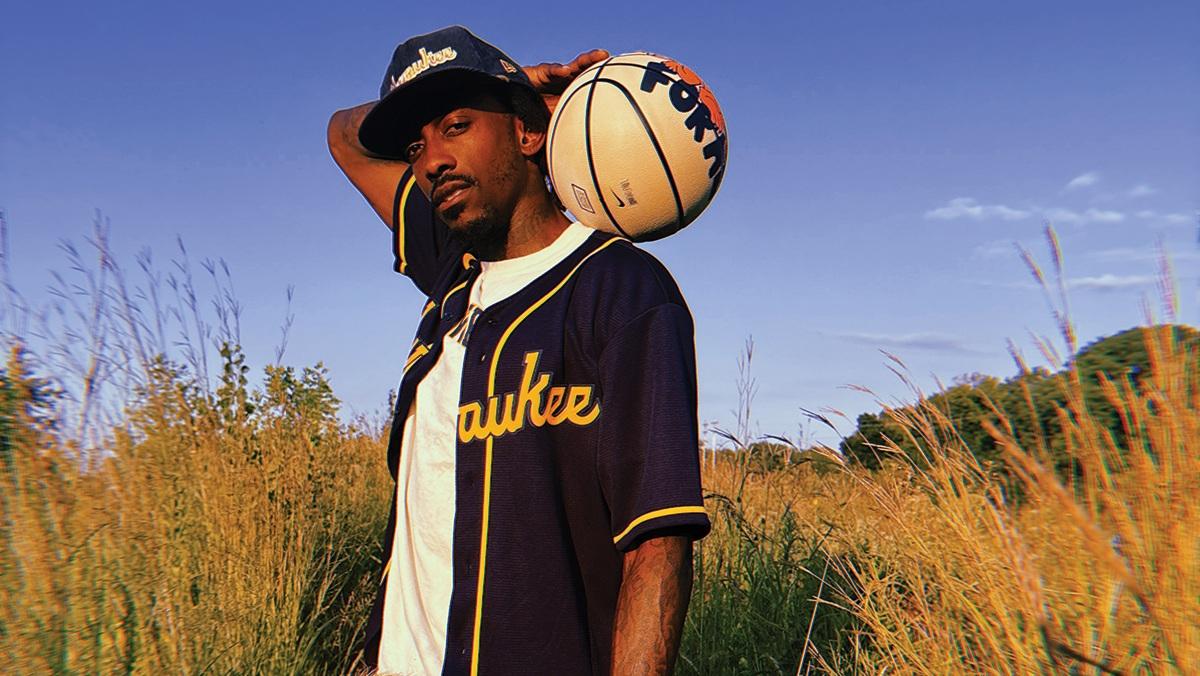
From the playgrounds and parks of Milwaukee, Mike Taylor became an international basketball player known by insiders for his brilliance on the court. He’s played professionally in 12 different countries, spanning four continents, winning seven championships across Korea, Lebanon, Libya, Poland, and Qatar.
As a writer and community historian who claims the beauty and brutality of Milwaukee as my own, I see Mike Taylor as an embodiment of my city.
Growing up on Milwaukee’s northwest side in the early 90s, Taylor was shaped by his elementary and middle-school years, biking with friends to a constellation of public basketball courts around McGovern Park (affectionately known by locals as ‘McGov’). On a Saturday, young Mike would spend the day playing at Carmen Playfield, Westlawn, Kluge Elementary — and any other local spot — letting everyone know “the championship” would take place at McGov at 5 pm. Then, on the hour, they’d show up.
I’ve found important lessons from a blue-collar point guard who’s lived a unique, uniquely Milwaukee, life. We spent time together after the historic flooding in August, unpacking the highlights and lowpoints of his remarkable international playing career while also talking about the city we both love. Together, we reckoned with the challenges of settling into one’s story and community as fathers.
During his season in the D League (now G League) with the Idaho Stampede, he won a championship, then became the first player ever drafted to the NBA from its developmental league. It’s a perfect spot in the record book for Taylor, a tried and true trailblazer. He went on to play in the NBA with the LA Clippers for the 2008-2009 season. Approaching forty years old, he still plays in the BIG3, a nationally televised 3v3 league co-founded by rapper and businessman Ice Cube.
While Taylor’s cosmopolitan sports career is fascinating, its full reality has not been glamorous. He’s been a working-class basketball player, making a living far from the incomprehensible wealth of his counterparts in the NBA.
Over the course of our interviews, I noted that his career was more akin to that of a man working a series of factory jobs than the life of an athlete living in a bubble of celebrity. Mike Taylor’s longevity and success come from that which might look to outsiders as an undying ability to summon irrational confidence. “That’s Milwaukee,” he said with pride.
Transforming On The Court
Whether planned or produced, a good point guard creates opportunity in the moment. Taylor has commanded a long-playing career, and with the next chapters approaching, he’s prepared.
This summer was busy for Taylor. On Saturdays, he traveled to cities around the country and performed with NBA legends for national audiences. On Tuesday and Thursday evenings, he returned to McGovern Park in Milwaukee with his mother Carolyn, where the Taylor-Made Foundation team ran a 3v3 basketball league for Milwaukee youth.
The Taylor-Made Foundation began in 2009 as a vehicle for the Taylor family to give back. Gaining momentum in 2019, the organization has done a variety of community work in Milwaukee. It hosts a signature Thanksgiving Turkey giveaway, which began in 2009 with 10 families, growing to approximately 600 full turkey dinners passed out in 2024. Taylor-Made Foundation focuses on meeting basic needs, including distributing 6,000 food boxes during the pandemic, and regular giveaways of home and cleaning goods, as well as winter coats. Naturally, the foundation also uses basketball programming fused with skill building to improve mental health and bolster self-development.
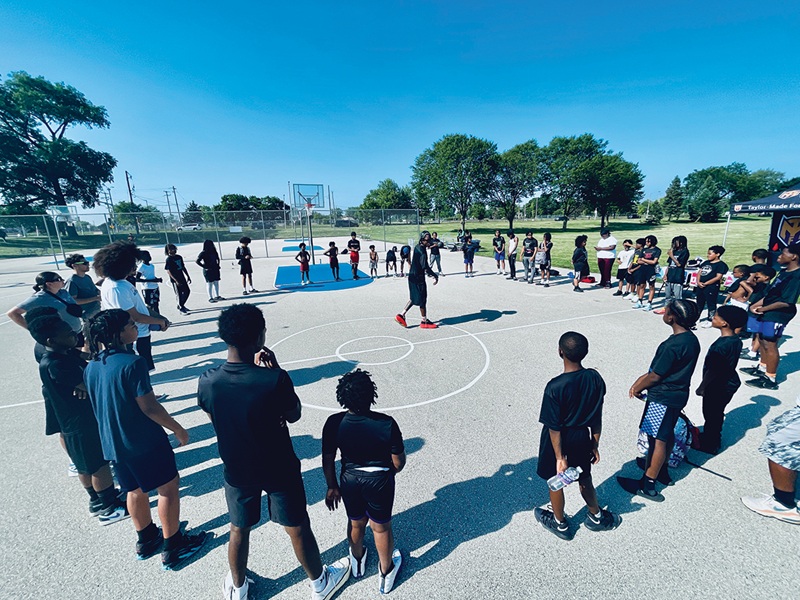
Each session of its Safe Summer and Wellness league begins with a wellness activity. The activity might be a lesson in breath work, sound healing, or time spent hiking in the recently remediated natural areas throughout McGovern Park. As Taylor put it, “If they can care for their own mental health, they won’t end up needing help with basic needs.”
The league brings kids together from elementary to high school, and players from down the block or across the region. I spent two evenings with the league, and both nights, before anyone touched a basketball, the group gathered in a large circle on the court. Taylor greeted the young men, then quickly transitioned into a conversation about emotion regulation and self-accountability.
Taylor prides himself on his ability to build relationships on and off the court. A varsity basketball player who looks up to Taylor told me simply: “Mike Taylor is different.” I nodded, understanding completely. He concluded with: “And my dad knows Mike.”
As a facilitator, Taylor is a hybrid between a therapist and coach, comfortably framing conversations around topics like keeping a cool head or avoiding ‘crashing out’ through the prism of a sports vernacular. This kind of discussion can be difficult in a quiet, controlled space. Yet on a summer evening in a public park, a group of about 50 young men participate in nuanced conversations about emotions. Taylor is a natural in the world of community work. That was a gift from his mother.
Earning The Craft
Carolyn Taylor moved her three sons to the northwest side of Milwaukee in 1990. Life was rough for her in Chicago, and she hoped for more tranquility. What she found was complicated.
If Carolyn had moved in 1970, when the city’s economy was near its industrial peak, her family would have found neighborhoods proximal to good-paying union jobs and intact industrial corridors. But by 1990, there had been a precipitous drop in manufacturing jobs, and white flight shifted wealth beyond the edge of the city.
The landscape of risk was not what Carolyn sought. Taylor remembers his experience growing up like this: “Walking down the street, it felt like Gangster Disciples one way, Vice Lords the other. The thing that kept me safe was a basketball in my hands.”
While waiting for Taylor to finish basketball practice after grade school one day, Carolyn started chatting with a close friend/fellow mother: “We both had three boys, and neither of us wanted to lose our boys to the streets. That was my focus back then. I wanted to keep them interested. I wanted to keep them focused on school.”
This conversation led them to launch a mentorship program called Striving For Higher Achievement In The Classroom And On The Court (SHACC). It was based at Sherman Park Lutheran Church and exposed youth to new experiences and different possibilities. Carolyn was resourceful. Programs ranged from professional media production to out-of-state trips, etiquette classes to studying thinkers like Stokley Carmichael and W.E.B. Du Bois.
While Taylor did not feel encouraged to excel in school, in SHACC he was an eager student. According to Carolyn, “He was the one who was most interested in knowing and going further.” His mother fondly remembers him as “a sponge.”
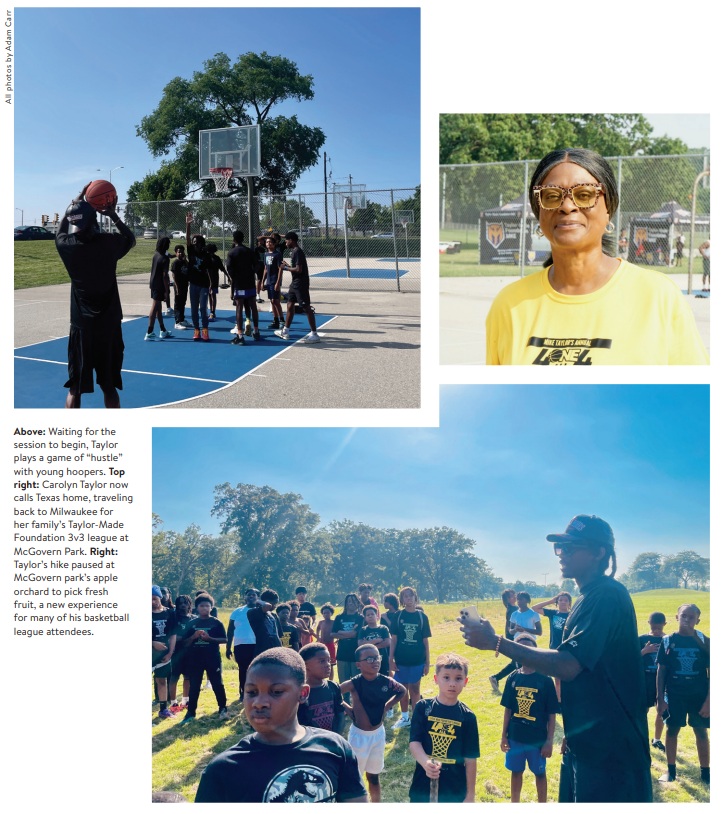
Today, Taylor and his mother actively collaborate in the operations of the Taylor-Made Foundation, including everything from strategy and fundraising to developing summer leagues. On an evening I observed their work with youth, Taylor joined the young men on a nature walk, while Carolyn facilitated dinner prep at the grills and set up folding tables next to the courts. They’re both proud that many of the volunteers who come to help grew up in the neighborhood.
Whereas Carolyn led programming when Taylor was young, now he is on point. He knows how unlikely a basketball career can be, so he uses his profile and the sports appeal to attract young players, the vast majority of whom are young Black men. Taylor-Made Foundation’s work is founded on the same principles as SHACC, but Taylor builds a playbook based on his own experiences, including loss and tragedy — the kind of loss and tragedy that seem as common today as it did when he was growing up. Taylor lost several of his best friends to gun violence and reckless driving.
As he continues to seek peace in his own life, he wants to share his hard-earned lessons with the next generations of kids to grow up on the courts at McGov. He believes the totality of his life experience — the joy and the pain — have shaped him, as he seeks to be the kind of strong, vulnerable male voice he yearned for growing up.
Uncut Milwaukee
There’s far more to Mike’s past, but what’s unfolding on the court in 2025 pulls me back to the moment. As inspiring as the Taylor-Made Foundation’s work is to witness, the organization is not finding the traction for which it strives. Though the Taylors have strong ties in the community, they have struggled to find adequate funding.
While legendary in some circles, Mike Taylor is not a household name in Milwaukee. His resume is substantial, but it’s been 21 years since he won Milwaukee Conference Player of the Year as a senior at John Marshall High School. Most Milwaukeeans simply haven’t followed him or his quixotic career.
This February, I joined Taylor as his guest at a Black History Month event in Oshkosh, where he was being honored by the Wisconsin Herd, the Milwaukee Bucks’ G League affiliate. I watched Taylor receive a warm welcome from Steve Brandes, president of the Wisconsin Herd, who knows Taylor because he was in the front office at the Idaho Stampede during Taylor’s championship season there. The event’s guest list included NBA legends, a Harlem Globe Trotter, a renowned Nike designer, and more.
Connections like this, alongside disappointments large and small, might entice a person to write the next chapter of their life somewhere that is not Milwaukee. Someplace where wealth and reputation might flow more freely.
It is, unfortunately, a pattern in my hometown with which I’ve become all too familiar. Milwaukee can ask its most imaginative to edit their aspirations until they don’t recognize them anymore. The ambitious too frequently move on. Milwaukeeans who want to pursue their dreams in their hometown need to be stubborn. And different.
While walking through McGovern Park with Taylor one late summer evening, I shared an idea that I call ‘little infinity.’ If we think about ‘infinity,’ we tend to be drawn to the big version, boundless and vast. But infinity also lies in the span between 0 and 1. It is what unfolds limitlessly when you zoom in. I use ‘little infinity’ as shorthand for the possibilities that lie in the world around you, which become greater the more you learn. Since then, Taylor and I have found ways to reference this idea in each of our conversations, especially when talking about the possibilities of the young Black men who are the focus of his life’s work going forward.
“I want them to believe that they can be great. To know they can find liberation,” he says resolutely.
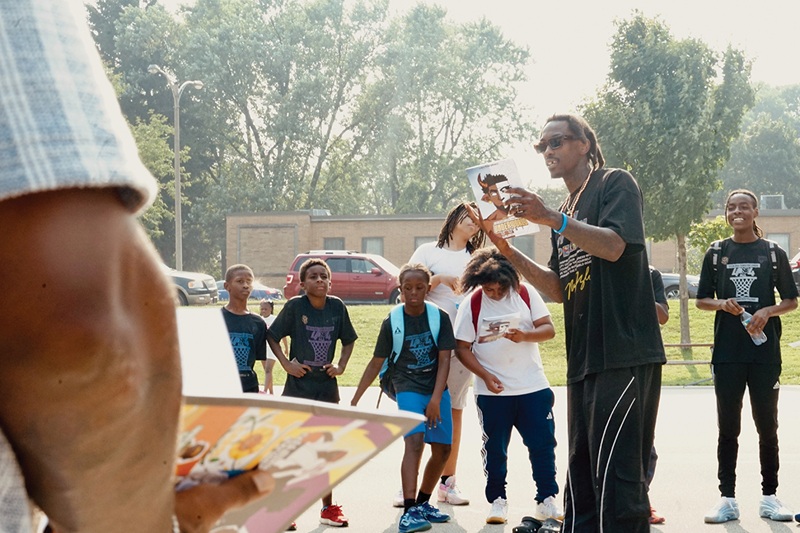
As a Milwaukee kid myself, I find joy in knowing Taylor has returned to his childhood court. He is inviting the next generation to find fellowship and meaningful lessons in their neighborhood, folding what he’s been given back into the place where he was raised. He recently bought a house in Milwaukee where he lives with his wife and child, and also created a comic book with his own artwork. In the story, he is his own superhero.

All photos by Adam Carr