
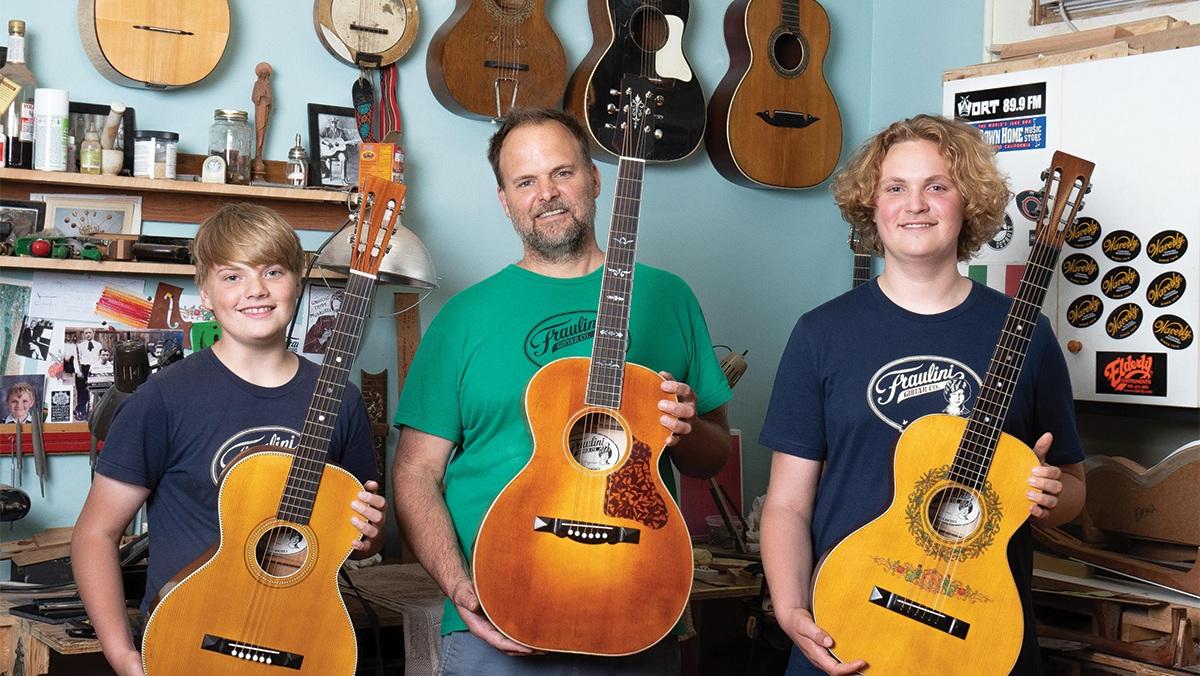
I am a luthier, a maker of stringed instruments. I build for those who play all different types of traditional vernacular music. Whether for Blues, Jazz, Ragtime, Old Time Country, Italian, Mexican, etc., I make instruments for people who would typically play antiques but want something that isn’t as difficult to tune and play, and isn’t quite as fragile and irreplaceable.
In order to make instruments that stand up to the old ones, I’ve studied innumerable rare vintage guitars and mandolins to see how they were made. I have had to learn the techniques used at the time they were constructed, which has not been easy, as the industry has changed dramatically in the period after WWII and many of the old techniques were abandoned. I have often learned forgotten techniques from different tradespeople working in other disciplines.
When most people hear that I’m a luthier, they usually want to know how I arrived at this profession. For me, it was a natural progression, as I have spent a lifetime playing music and working with my hands. I was born in Chicago, but my parents purchased an old farm in the southeastern corner of Wisconsin when I was a child. My dad spent much of his time working on the old house, various outbuildings, the vehicles he drove, and the old tractor that came with the farm. My father worked as an engineer and was an ace mechanic, a skill he acquired from building hotrods as a teenager. He was also a skilled woodworker. He often enlisted the help of his kids in many of his projects, having us fetch tools, hold boards, and tear down walls. He taught us how to fix old things and build new ones.
Eventually, I started working on some of the dairy and horse farms that were in our small community, picking rocks, baling hay, caring for and cleaning up after animals. As a teenager, I started working as a laborer on a construction site, where I picked up a wide variety of skills. After graduating from high school, I moved to Madison to attend the University of Wisconsin. I paid for my education by working as a painter and plasterer for a property management company, and I graduated from UW–Madison in 1994 with a major in social work.
The whole time I was growing up, I was also playing music. I was the type of curious kid who would try to play a tune on any instrument that was in front of me. I took piano lessons for a time and played trumpet in my grammar school band. None of that really stuck, though. I was more taken by the old harmonicas and odd instruments that my grandmother used to find at garage sales and bring over to our house. I remember being four or five years old and lying on the floor in my bedroom with a harmonica in my mouth, breathing in and out while trying to mimic the sound of a train, as I beat out a rhythm on my belly and the floor with my hands. When I was fourteen, I bought my first Blues record: Muddy Waters. Before I knew it, I was consumed by that style of music. When I was fifteen, and accompanied by my parents or my uncle, I started going to Chicago to play with Blues bands in taverns on the city’s South Side. I met a wide variety of people and had many adventures, which were much more fun than a piano recital or band concert. It was a different kind of education.
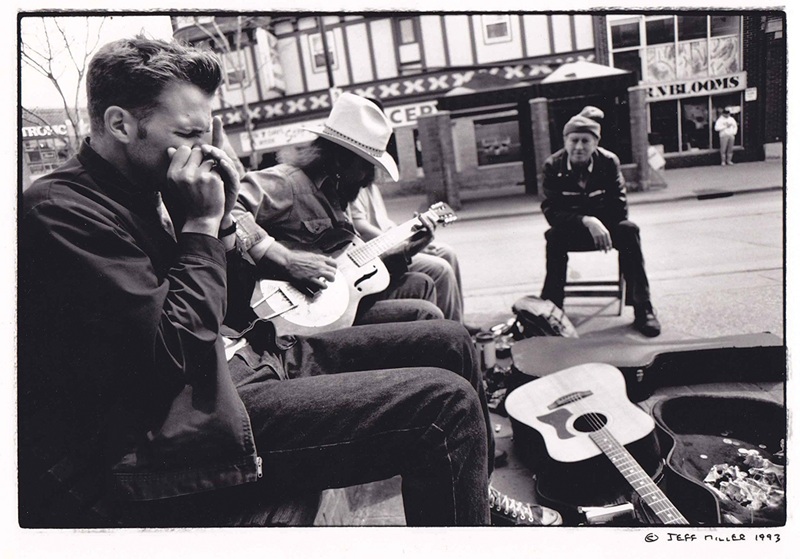
That all came to an end when I moved to Madison. I was no longer able to get into bars and play with bands, and I didn’t know anyone who played the type of music I loved. However, in the 1980s and 90s, there was a vibrant scene of busking street musicians on State Street. I started listening to one group, led by a guitar-playing crooner named Catfish Stephenson, who was a mix of Yosemite Sam, Hank Williams, and Bing Crosby. He gigged with a harmonica player named Zulu, who hadn’t cut his hair or shaved his beard since being discharged from Vietnam, as well as a percussionist named Tom, an artist who worked a day job at the Memorial Library. They played a mixture of Blues, Rags, Country, and old pop songs from the 1920s. Before long I was playing harmonica in that band when Zulu wasn’t there, and upright bass when he was.
When I wasn’t in class, studying, or working, I was usually playing music with them on State Street. Catfish left town for a time, and my friend Joel Paterson and I took his spot. Joel is one of the best guitar players of my generation, and we did our time together playing for students and Badger fans on football Saturdays. The whole busking experience taught me more about the nature of people than any sociology or psychology class I’d ever taken at the university.
After graduating, I got a job working for Operation Fresh Start, where I worked with young people who had hit a rough patch and had dropped out of high school. Some had gotten into trouble with the law; others had not. While there, I ran a crew of eight to ten participants, and we would either build new homes or rehab existing housing, which would then be put on the market as low-income housing. My job wasn’t necessarily to turn the kids into carpenters, but to teach them an employer's expectations and instill in them a work ethic, in addition to counseling them and helping them to get their High School Equivalency Diploma. I really enjoyed that work, but it was quite stressful, and within a few years, I was ready for a change.
I moved to San Francisco in 1997 to be near musicians I admired. I got a job as a carpenter at a film studio, building sets and props for commercials, music videos, and feature films. I had a guitar that needed work, and I asked a friend if she would fix it for me. Her reply was one of those life changing moments when things seem to shift and pieces are put into place.
“You should fix it,” she said. “You’re a better woodworker than I am. You can do it. I’ll show you how.”
I don’t remember if she actually showed me anything beyond the tools she used, but she gave me permission, and sometimes that’s all you need. After that, I was off and running.
The West Coast ultimately didn’t suit me, and before long I was back in Wisconsin. This time, I had a different purpose. I started scouring flea markets and junk stores for old guitars, which I would fix up and either keep or sell to friends. After a few years of fixing instruments, I wanted to try to make one for myself. I made plans for a 1920s Stella 12-string that a friend owned and was similar to the type played by Lead Belly, the great folk singer.
I spent an entire summer trying to recreate the guitar in my garage. It turned out halfway decent, and a friend asked me to make one for him. That one was better than the first, and then another friend asked if I could make one for him. That one again showed signs of improvement. The fourth guitar that I made was for my friend Alvin “Youngblood” Hart, who took it on a world tour with a Grammy under his belt. Soon I started getting requests for guitars from all the places where Alvin had played—Australia, England, France, and all over the United States. At that point I decided to try building guitars more often than just in the evenings after work and on weekends. I made the leap to crafting guitars full time in 2003.
From busker to builder
My approach to guitar building is unique. The guitar is an instrument that has always been on the move, accompanying travelers to new lands and constantly evolving. While violin makers have been trying to copy the perfection of Antonio Stradivari with an instrument that has remained relatively unchanged for the past 300 years, the guitar has gone through myriad reinventions. To this day, the guitar continues to evolve. There are a handful of guitar makers who are traditionalists, including classical guitar makers who recreate the instruments of Spanish masters and steel string makers who follow the designs of Gibson and Martin during their golden age. Those two companies have loomed large over the history of American music, and they have had a profound impact on the evolution of the guitar the world over.
My focus, on the other hand, has been on the instruments that the earliest recording artists of Blues, Country, Jazz and various types of ethnic music played when they first went into the studio. Those folks tended to be at the bottom of the economic ladder, and they couldn’t afford instruments crafted by respected companies like Martin and Gibson. Instead, they played mass-produced instruments made in large factories that supplied mail-order companies like Sears and Roebuck or the Oscar Schmidt company of New Jersey, which distributed instruments to music shops, furniture stores, and gas stations throughout the country. Guitars made by these large companies cost a fraction of what Gibsons and Martins sold for. While a Gibson or Martin might have started at $35 in the 1940s, the factory-made guitars started at $3.50.
Though some people may perceive it as folly to make replicas of inexpensive, factory-produced instruments, they offer a sound profile that was integral to the foundation of American vernacular music. That profile is what I have been striving to capture, and it is one that traditional musicians have been chasing for years. Many of these folks have spent their careers playing antique instruments, which are fragile and require regular maintenance. By following the old designs—and adding a few modern conveniences—I’m able to get the sound of an old instrument from something more comfortable for the player and more reliable than an antique. My approach was original at the time I started doing it, but it has since caught on with some other builders, large and small.
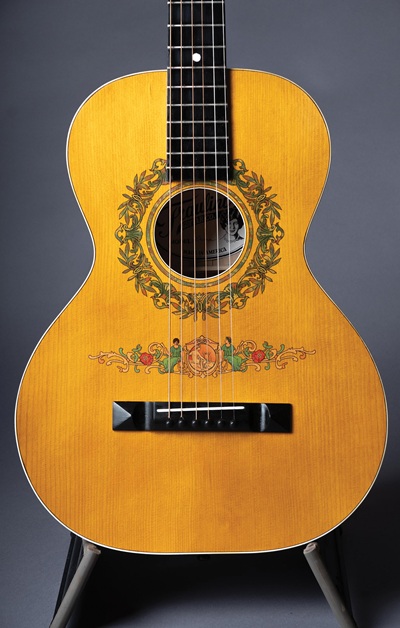 Another thing I love about many of these inexpensive old guitars is their wood. Modern luthiers are often drawn to exotic tonewoods, which are harvested in faraway lands, sometimes to the peril of the environment and population of those places. But many of the old instruments were built from domestic North American woods. For someone like me, an environmentalist who tries to grow or locally source as much as possible, the use of domestic wood is appealing. Fortunately, Wisconsin has an abundance of hardwood trees. Black walnut, white oak, birch, and maple are among the species that grow here and make for excellent tonewoods, and they all have a history of being used to make instruments. In fact, the maple that grows in Northern Wisconsin and the Upper Peninsula of Michigan is some of the most prized in the world.
Over the years, I’ve written about the use of domestic woods in order to educate both the guitar-buying public and the luthier community about domestic woods as a wonderful alternative to exotics, with their historic precedence and wonderful tone. I work with local arborists and sawyers to source wood that has been harvested around the Madison area. Some trees are felled to make way for housing, while others need to be removed safely because they’re at the end of their life cycle. I never source wood from trees taken down for clear cutting.
Old World strings became American songs
As much time as I’ve dedicated to relearning many of the forgotten techniques of the trade and studying old instruments, I’ve also tried to learn as much as possible about the craftspeople who built some of these old instruments. I am especially intrigued by the immigrant builders who came to the United States with a notion of the guitar as it existed in their country of origin. They initially arrived and built instruments for people in their ethnic communities, but gradually American popular culture began to seep into their designs, and their instruments began to change.
This happened with Italian immigrants in New York and New Jersey, who initially built flat top guitars and mandolins, but gradually, the designs of companies like Gibson started to influence these craftsmen. They began making archtop guitars and mandolins in the style of the industry giants. It was a transformation from Italian to Italian-American.
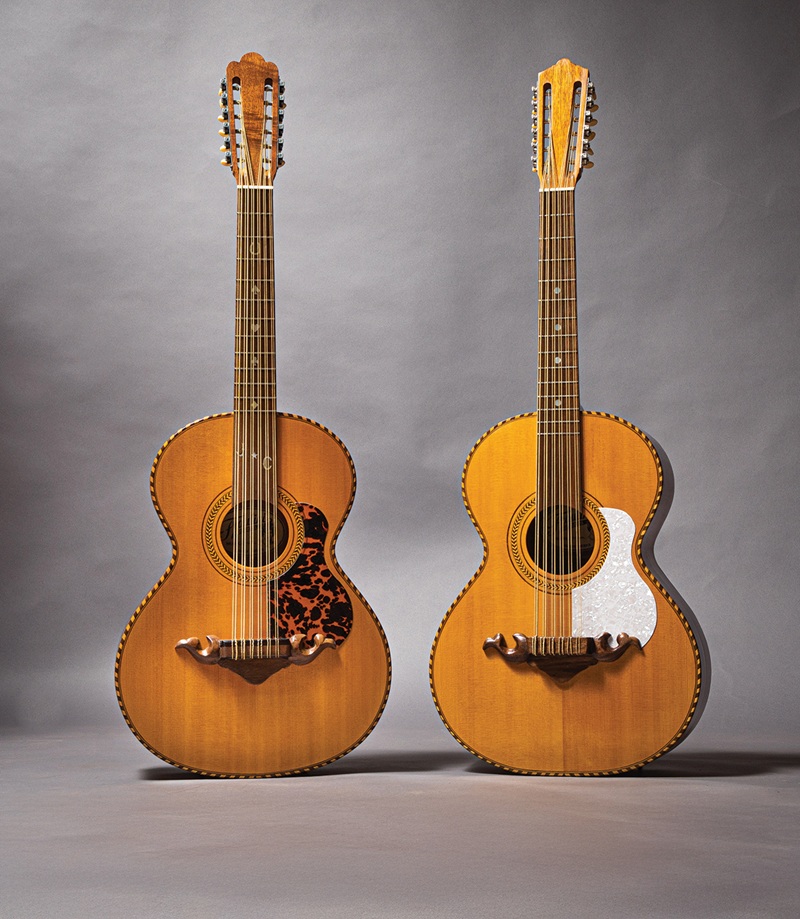
A similar phenomenon happened in San Antonio, Texas, where a handful of Mexican luthiers immigrated around 1915 to escape the turmoil of the Mexican Revolution. They initially made Mexican instruments like the bajo sexto, the guitarra septima, and the bandurria. As the second generation of these luthiers came to prominence, they began making guitars that were influenced by Martin and Gibson, but still in their own style, with a pronounced Mexican aesthetic. They were making instruments for younger musicians, who were developing a style that would become known as Tejano or Tex-Mex, which had a Mexican foundation but was influenced by Rock and Roll, Blues, and Country.
In addition, there were occasional cross-cultural exchanges, where Blues, Jazz, or Country musicians would acquire an ethnic instrument that may have been built for a different purpose. This was the case with Blues musicians Lead Belly and Willie McTell, both of whom played 12-string guitars made by Italian craftsmen at the Oscar Schmidt factory. Another example is the Country music pioneer Ernest Stoneman, who acquired an Auditorium-size guitar, birthed at a small shop in Little Italy, after a recording trip to New York. But my favorite example of overlapping cultures involves the Blues and Jazz pioneer Lonnie Johnson, who traveled to San Antonio in 1928 to record for the Okeh company. While there, he acquired a 12-string guitar made by Guadalupe Acosta, built in a Mexican style. Johnson brought the guitar back to New York and recorded with Duke Ellington, Louis Armstrong, Victoria Spivey, and Eddie Lang, among other artists. Johnson played the guitar on dozens of recordings, until he replaced it with an electric guitar in the late 1930s.
My designs tend to follow those of traditional Italian immigrant guitar makers, as my cultural background is Italian. I like to imagine what their instruments would have been like if they had not abandoned flat top in favor of archtops, and I create instruments I believe they would have made.
Over the years, I’ve made replicas of many of the instruments played by my musical heroes. I have done restoration work on instruments that I couldn’t have imagined existed, and I have developed a handful of new models of my own design. I have made instruments for people all over the world, including a handful of rockstars, but mostly for regular folks who enjoy playing traditional music. I feel incredibly fortunate that I’ve been able to do what I do, and to do it in a place that I love.
All photos courtesy of Todd Cambio