

With their varied selections of books and eclectic events, indie bookstores across Wisconsin have the potential to build bridges between groups that may not realize they have shared values, as well as to solidify the bonds within groups who believe in the freedom to read and want to amplify the voices of marginalized communities through books.
Hang around the owners of independent bookstores enough, and you’ll start to hear them characterize the value of their shops as “third places.” Coined by the urban sociologist Roy Oldenburg in the 1980s, the term “third place” refers to a gathering space that is neither one’s home nor workspace, but a separate, neutral space where people from different backgrounds can exchange ideas and build community, a sort of “public living room.”
Executive Director of the Midwest Independent Booksellers Association (MIBA) Grace Hagen says, “Booksellers are exemplars for ways to keep community strong. They create a culture of belonging.” Describing MIBA as an “amplifier and connector for independent bookstores and book-adjacent industries,” Hagen notes that MIBA’s membership has increased from 300 members to 340 in the last six months alone. Indeed, a look at the Wisconsin shops listed on the Midwest Indie Bookstore Road Map includes over sixty members across all regions of the state—each with its own flavor and focus. Over the next few issues of Wisconsin People & Ideas, we’re going to introduce you to some of them.
A-way Up North
It’s not every day—or even every lifetime—that someone walks into a shop for a book and walks out with the store instead. And yet, that’s sort of how it happened for Julie Buckles, owner of what is now Honest Dog Books in Bayfield. In 2019, she’d gone into her favorite bookstore, What Goes Round, looking for a book of poetry, which ended up not being on the store’s shelves. Instead, Buckles’ friend behind the counter told her the owner was getting ready to sell the shop and thought Julie would be a great person to buy it. Though her life at the time wasn’t conducive to embarking on a change this big—she had two busy teenagers, a fulltime job at Northland College, and a full team of sled dogs—by the time she reached her car, her hands were shaking and she called her husband, Charly. His response? Of course, she should buy the bookstore.
Months later, in September 2019, the shop reopened under the name Honest Dog—named for the type of dogs she had worked with many times as a musher: dogs who work hard, dig in, and never give up. Six months later, Buckles’ honest-dog qualities would be sorely tested. The world was in the middle of a global pandemic, and she wondered if she would ever open the doors of her store again. There was no web storefront and establishing one would take a huge amount of time since a full inventory had never been done. “I didn’t even know what I had,” she says with a laugh.
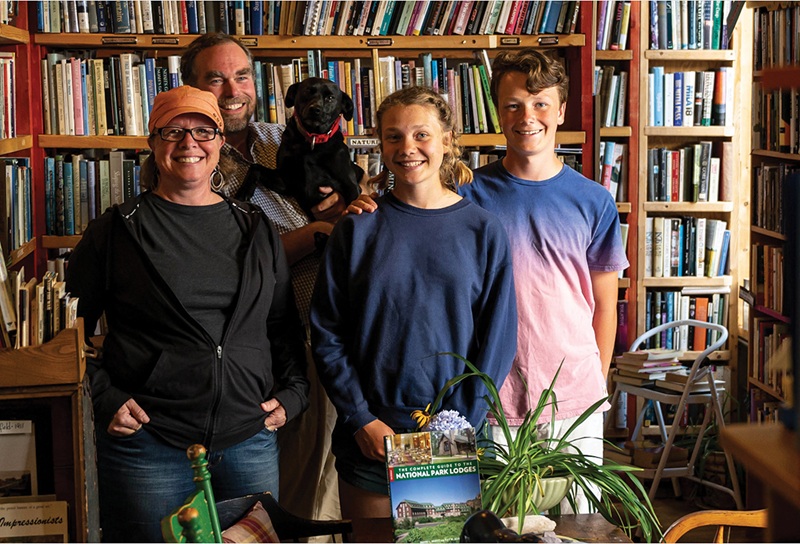
She decided to get creative and composed a social media post offering to send a personally selected book to anyone who sent her $12 and answered three questions. She and an assistant sorted books into categories, such as books that end happily and books that have a lesbian hero. Her offer yielded 1,000 orders, and by the time she’d filled them, she knew every book in the store and a lot of her new customers. The “Surprise Me!” subscription continues to this day and is joined by other variations on the theme: “YA Pick of the Month,” “Kid Subscription,” and “Beach Read,” to name a few.
Buckles compares the early days of the subscription service to librarians getting books to soldiers on the front during World War II. “We were getting letters from people who were scared. They weren’t seeing friends or parents. And so, for them, getting a book in the mail with a little hand-written note from us was a personal touch. It was a bit of building community.” She takes her stewardship seriously, recently expanding the store’s footprint to build a space for performances, book clubs, and other events that bring people together in real, physical space, to laugh together and to learn together. This is especially important in times of book banning and other attacks on books, she says. When we spoke, she was preparing to host a sold-out comedy show and was especially jazzed about having provided signed books to children in the Head Start program.
“Our role is to support literacy and build excitement for reading,” she says. When asked if she has advice for others considering opening a bookstore, her answer is simple: “Do it. Do it. Do it!”
A tweet, a toddler, and a bicycle
Most parents of toddlers don’t equate those years with having “extra time” to start a new business, but that is how Cetonia Weston, founder and owner of Niche Bookbar in Milwaukee, describes the beginning of her journey. Her two-year-old was starting to nap reliably, and she was starting to think about what might come next for her.
One evening, after her son had gone to sleep and she was enjoying a book and glass of wine, she tweeted something along the lines of “I want a place that combines books and wine.” She longed for a venue where Black-centered and Black-written books were highlighted, not only during Black History Month, but all year long. In addition, she wanted to read a wider array of stories and themes than were usually served up in February. “There was always this sort of disconnect of not being fully represented in characters,” she says. “I was tired of only seeing myself on the page in pain, in trauma, in struggle, and poverty.” By 2018, Weston realized that if she wanted to find such a place with such books, she would need to create it herself.
First, she set out to expand her reading repertoire and discovered Octavia Butler and N. K. Jemisin and other Black authors, as well as Milwaukee authors Paul Wellington and Destinny Fletcher, whom she contacted. She founded the Black Authors Collective and hosted pop-up author events at local parks, taking advantage of the opportunity to gather demographic information about the readers who believed in her mission and might support her through crowd-funding for her big dream: opening a bricks-and-mortar store.
Meanwhile, Weston took business classes and drafted a business plan. She was working on securing a building just as COVID-19 made its way to American shores. Like Buckles on the other end of the state, Weston had to pivot. Since she couldn’t open a space to bring people to books, she decided to take books to them. Inspired by ice-cream vendors, she purchased a used bike (technically an adult-sized tricycle) and commissioned a wooden bookshelf that would allow her to carry close to 100 books in its compartments.
She took it out a couple times a week to neighborhoods, block parties, and outdoor markets to build clientele. Though reluctant at first, she opened an online storefront, which allowed her to keep the ultimate dream alive: a store in the Bronzeville neighborhood of Milwaukee. In addition, members of the community she helped to build over the years stepped up to help her in the final push to get funding and permitting for building. Weston is also the author of The Misadventures of Toni Macaroni series, and her heart is with younger readers. She looks forward to hosting a “Black Fae Picnic,” complete with participants in all manner of winged attire, and a costume party book swap.
Niche is currently open in what Weston describes as a “soft capacity” while she waits for liquor and food licenses to be finalized. Soon, the shop will live up to its tagline: Black Books, Red Wine. For now, she says, “We’re doing coffee, and we’re doing books, and books are the main focus anyway, so really we’re getting off to a good start.”