
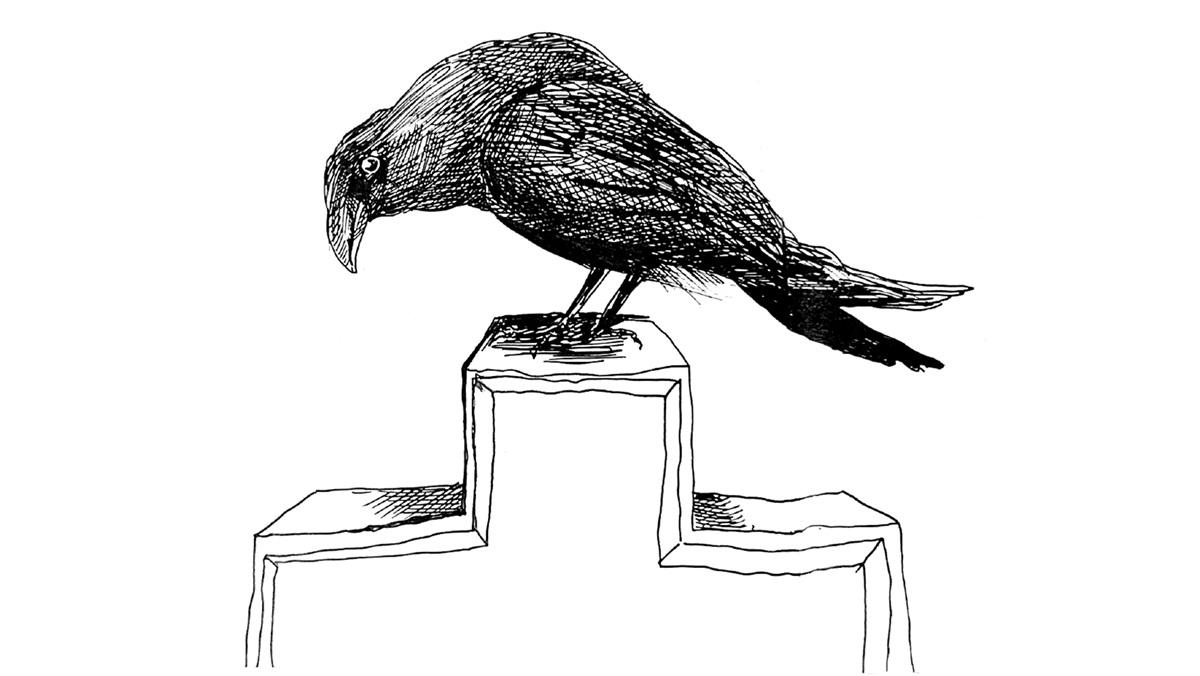
one for sorrow, two for mirth
If you’re ever driving down the highways of Tennessee around the time of Sunday service and your radio goes silent, turn around and drive the other way. You’ll usually make it out alive, but there’s a chance you’ll see things you don’t want to.
If for some reason you choose to ignore my warning and come across a little church with peeling white paint and boarded-up windows and an empty bell tower, your chances of survival will decrease, but as long as you keep your foot on the pedal and stay in the car, you’ll probably get to the other side all right. Though you might have nightmares for a few months after that.
And if your radio turns back on and starts playing birdsong, your time’s up.
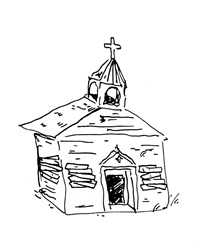 Where is this church, you ask? I couldn’t tell you. It roams from town to town, wherever the choir director senses that something isn’t quite right and takes it upon himself to purify it. Though it does tend to circle around the small town of Dove’s Glen. The director’s sister lives there, after all. Willow, I think her name is. The only one who’s touched him and lived to tell the tale.
Can you meet her? Of course you can. You’ll find her in a little yellow cottage in a grove of trees on the edge of town, with bird feeders in the shape of restaurants and hotels and shoe shops swaying in the wind, and little finches darting around in some kind of bird game of tag. The wraparound porch stairs will creak as you climb up them, and the smell of the honeysuckle plant climbing over the doorway will greet you like an old friend would. And you’ll knock on the door, and Willow will welcome you in, all smiles, wearing her long hair tied up with a crown of daisies and a pair of paint-splattered overalls.
But you’ll notice her big green eyes are dead. Like a pool that will kill you the moment you dive into them, slowly suffocating you as the current drags you down toward the bottom.
She’ll make pleasant conversation with you as she pours two glasses of lemonade, both of you getting along and laughing like old friends, and then you’ll both sit down in old rocking chairs and drink your lemonade, and for a moment you’ll forget you have any cares in the world at all—until she looks at you with those dead green eyes and asks, “You’re here to learn about my brother, aren’t you?”
You’ll try to deny it. But she’ll always know.
So she’ll sigh and sit back in her seat, and she’ll pull down the collar of her white blouse and show you the little ivory feathers lining the side of her neck. And you’ll notice how her long, curved fingers look a bit too much like talons, and her voice is a bit too melodic and perfect to belong to a human.
“I’ll tell you the story,” she offers. “On one condition. That you don’t go looking for the church. My brother is misunderstood, but that doesn’t mean he isn’t dangerous. Understand?”
Of course, you’ll tell her.
“Good.” She sets down her glass—neither of you will touch the lemonade while she speaks, because it just isn’t the time or place for relaxing like that. “Then let me begin.”
three for a wedding, four for a birth
It was 1963, thirty years ago, when their mother first arrived at the church, looking for a place she could hide her and her children from the man she was betrothed to. She was in labor, and she couldn’t bear the thought of her twin babies being raised by him, seeing as they’d soon grow up and he’d figure out that they weren’t his. And Lord knows what he’d do then, with all the rumors saying that he’d hit his first wife when he found out she couldn’t get pregnant.
 The choir were the only ones there, practicing their hymns for Sunday’s service. And who were they to turn away two babies? The woman they cared less about, because she’d been sinful enough to have children out of wedlock. One of the choir ladies was a midwife, so she delivered the babies, and then the betrothed showed up and started screaming bloody murder at the mother for leaving the house without his permission and she died of shock. The choir said a prayer, though they knew it wouldn’t do anything, of course, to keep the woman from going straight to hell.
The man left, and the police came and took the body, and the choir said a prayer and the choir director offered to take in the babies and then they all went back to practicing their hymns.
five for silver, six for gold
The director, Mr. Robert Smith, may have been the one to officially care for the twins inside the comfort of his home. But it was the whole choir that raised them. They’d all unanimously decided on names during that practice: Cassius for the boy, because it was Latin and sounded holy, and Willow for the girl, because there was a pond out back with the loveliest willow trees, and every Sunday the churchgoers would thank the dear Lord for blessing their church with them.
If you’d met Cassius and Willow back in the day, you’d have thought they weren’t entirely human, because they were the best-behaved little children Dove’s Glen had ever seen, as pure as silver and gold itself. All the choir ladies taught them their Bible stories and their manners, and when they came home from school Mr. Robert Smith taught them about discipline and what the Lord did to people who sinned, like their wicked mother. But not them; Cassius and Willow were good children, he said, because they followed all the rules.
Cassius never once questioned the rules. After all, the adults knew more than him, and if he questioned them, wouldn’t that mean he was a wicked child? And if he was sinful, then Mr. Robert Smith and all the nice choir ladies and the Lord would hate him and cast judgment on him, and he’d be doomed to the fire and brimstone of hell for all eternity.
 And at first, Willow didn’t question them either. But she’d always been a more free-spirited child, who had always been curious why it was so wrong to want to marry her best friend Eloise when she grew up, who told such fascinating stories of how the government was trying to send people to space, who had such pretty black hair hanging to her chin in soft curls, who said she wanted to marry Willow when she grew up, too. Of course, she never asked those questions to Mr. Robert Smith or the choir ladies directly, as she’d soon learned that asking them was a guaranteed way to get her palms slapped by a ruler. Instead, she wondered about them late into the night after her brother had gone to sleep, poring over her leather Bible and making notes in the margins.
Before long, both of them had grown up into fine young teenagers, with Cassius learning how to direct the choir and Willow training to be the finest singer the town had ever seen. Except now she wanted to join the choir at school, and Cassius had heard them practicing in the afternoons, singing wicked pop music. And hadn’t he found a Beatles record hidden underneath Willow’s bed?
After he confronted her about it, she promised to toss it in the pond if he didn’t tell Mr. Robert Smith or the choir ladies. She’d looked at him with tears in her eyes, swearing that another person at school had given it to her, that she hadn’t listened to it at all, so really, she wasn’t that wicked, right?
Cassius had half a mind to ignore her pleas. But she was his sister, after all. She probably just hadn’t known any better, drawn in by the allure of bright outfits and shiny electric guitars.
So he gave her a brief talking-to about the dangers of pop music and promised he wouldn’t tell a soul.
seven a secret ne’er to be told
People stopped attending the little church those days. Cassius hadn’t realized it until he overheard two of the choir ladies gossiping about it late one night during a five-minute break as they practiced. At first he’d doubted the credibility of their words: they loved a good story, no matter how much truth it actually held, despite his warnings about what happened to those who spread gossip.
But as he got up to direct the choir the next Sunday morning, he realized they were right. There were spaces in the pews that he couldn’t remember being there when he was a child. There was a leak in the roof that they could have fixed if they’d had enough money from donations. The paint on the wood outside no longer looked fresh and shiny and new.
It’s my fault, he thought as he left the sanctuary after the service was done. He’d messed up. He hadn’t told anyone about Willow’s wrongdoing, even though Mr. Robert Smith and all the choir ladies always instructed him never to keep secrets.
The secret had weighed on his chest for weeks, like a hot nail pierced through his heart. Like filthy blood staining his hands. Every time he looked at the people who had taught him that good children were honest, good children never kept secrets, he found himself unable to swallow.
When the pastor preached about honesty, Cassius’s insides writhed like eels. When Mr. Robert Smith called him a good child after he directed the choir well, Cassius wanted to vomit. When the choir ladies congratulated him for his good grades, the weight on his chest sucked the air from his lungs.
So Cassius would be extra good. He would follow all the rules twice as well. He would lead the choir with twice as much fervor. He would take care of Willow twice as much.
All around him, the chapel crumbled and the congregation left.
eight for a wish, nine for a kiss
It was in their last year of high school, a week before Christmas, when Willow began to speak of going away to college.
She wanted to go to school to study music. Cassius knew her beautiful, melodious voice was really the only reason people kept coming to church. And all the choir ladies and Mr. Robert Smith thought it was an excellent idea—none of them had ever been to college, and Willow had found a school only a few hours’ drive away with an excellent music program. She promised she’d come back to sing in the choir on holidays.
It wasn’t that Cassius didn’t trust her. But he’d heard the stories of the outside world. A horrible place of sin and evil, devoted to attacking everything he held dear. A place where someone so kind and gentle as Willow could easily be led astray. She’d already been ensnared by the thrill of pop music; what was next? And everything would be his fault, his fault for not protecting her, his fault that she’d end up being punished for all eternity.
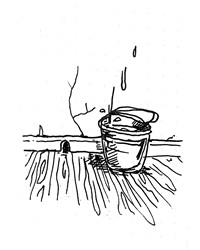
She was going to leave him, too, just like everyone else at the chapel. Because he was terrible and filthy and selfish. Because he’d kept her secret. Because he was a wicked child, born out of wedlock from a wicked mother, and deserved to drown in a lake of fire for the rest of time.
He couldn’t let her go. He was staying here at the church, continuing to direct the choir so he could make up for the secret he was keeping. He wasn’t going to lose her like this.
He spent all the next week pacing in his room and silently debating with himself about whether or not he wanted to approach her about it. He was even distracted during choir practice, which had never happened. Finally, on Christmas morning, he figured out the words he wanted to tell her and wrote them all down on note cards so he wouldn’t get it wrong. She wasn’t in her room, so he hurried outside to search for her in all the usual places she liked to pass the time, and found her sitting underneath the bare magnolia tree in the backyard.
And she was kissing Eloise.
ten a bird you must not miss
Cassius’s note cards dropped out of his hands.
Eloise was the one to notice him first. Her eyes flew open, and she quickly pulled away from Willow, who at first looked confused then froze when she saw Cassius.
“I-It’s not what you think!” Eloise begged, raising her hands in a gesture of surrender.
Cassius didn’t know what to think. Here was Willow, his beautiful younger sister, who had the most angelic voice in the whole town and always took care to feed the birds and help the elderly cross the road, so blatantly engaging in wickedness.
It couldn’t be her fault. She’d been raised better than this.
No, it was his. He should have realized this. He should have realized her mistakes and guarded her from them, because it was his job to protect her, his job to take care of her. It was all his fault. Everything was always his fault.
“Willow.” His voice was cold. “Step away from her.”
“No.” Her voice was angrier than he’d ever heard it. “You don’t get to control me!”
“I’m not controlling you! I’m-”
“You were coming out here to tell me I can’t go to college, weren’t you? I saw how your face looked when I first mentioned it! Well, I’m done, okay?” She folded her arms in a most unladylike manner, striding towards him. “My life doesn’t belong to you! And if I want to go to college and listen to pop music and—and kiss girls, then damn right I’m going to!”
Again, Cassius found himself unable to speak.
Willow was leaving him. Willow wanted to leave him.
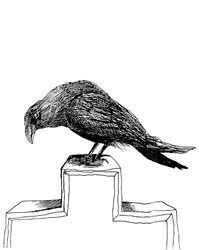 It was his fault. It was his fault for being such a wicked child. It was the Lord punishing him for holding the secret, for every little misstep he’d ever made. By taking away the congregation of his church, and now his best friend, his beloved sister.
Maybe he hadn’t been able to protect her in the past. But he could protect her now.
He reached out and grabbed her wrist. Ivory feathers burst from the skin of her arm all the way up to her neck.
“You aren’t going anywhere,” he hissed. “You’re going to stay here, and atone for your mistakes!”
Willow didn’t answer him. Her green eyes widened in terror as she stared at the feathers crawling up her arm, the way her fingers and nails were lengthening and curling like talons.
And that was when Mr. Robert Smith heard the commotion and came outside.
eleven for hope, twelve for health
At first, the arrival of his caretaker filled Cassius with hope. Here he was, coming to set everything straight. Surely Willow would listen to Mr. Robert Smith. He was an adult, after all, and an authority.
But the choir director only stared at Cassius and the feathers on Willow’s arm.
“Demon child,” he whispered at Cassius, then began to pray under his breath as he backed up.
Willow wrenched free from Cassius’s grip, the feathers retracting, and ran, Eloise and Mr. Robert Smith with her. Cassius wanted to chase after him, but everything in his body had gone numb.
What had he done?
What kind of power—what kind of curse—lay within his hands?
Tears gathered in his eyes and slipped down his cheeks. It was another punishment, wasn’t it? He’d kept a secret. He’d driven everyone away from the church. He’d pushed his sister and caretaker away, and now he bore this curse.
He couldn’t keep the way Willow had looked at him out of his head. The way she’d stared at him in fear, like he was some sort of monster.
He was a monster. Wicked and sinful and evil in every sense of the word.
He had to be punished.
Silently, slowly, he left his backyard and walked down the street to the church at the edge of the town. He pushed open the wooden door barely staying on its hinges, found the cleaning closet, and began to dust the pews in the sanctuary.
Maybe one day the church would be as spotless as he remembered it. Maybe one day people would start coming back.
Maybe one day he could be worthy of forgiveness.
thirteen beware of the devil himself
Willow will finish her story, and then she’ll just sit there in her chair, a distant look in her deep, dead eyes. You’ll quietly excuse yourself, and then you’ll either heed her words or wonder what’s so dangerous about a sad, lonely man in a sad, lonely church and then decide to go investigate.
If you choose the latter, you’ll almost certainly find the church. It has a habit of showing up to people who wish to see it, as Cassius can then gather them into his choir.
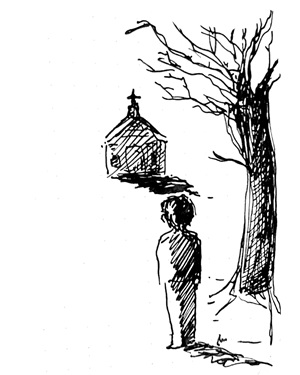 You’ll find him in the sanctuary, fixing a roof that will never stop leaking or scrubbing floors that will never be clean. He’ll stand up to greet you, and though he should be in his thirties by now, his face will be ageless. There is something off about it, but you cannot quite tell what it is.
He’ll ask you to confess your sins. Do not answer him. If you do, he’ll learn enough about you to keep you from leaving. While you’re telling him the worst things you’ve ever done, you’ll feel a pain in your chest, and the walls will start to bleed.
He’ll lay his hands on you to bless you. As he’s speaking, you’ll feel yourself shrinking until feathers burst forth from your skin, too. You’ll thrash and flail and try to escape his grasp, but he won’t let you. He’s perfected the technique by now.
Once the transformation is completed, you’ll have no memory of who you ever were. You’ll just be another little bird in the choir he directs for eternity, as he tries to atone for his sins.