
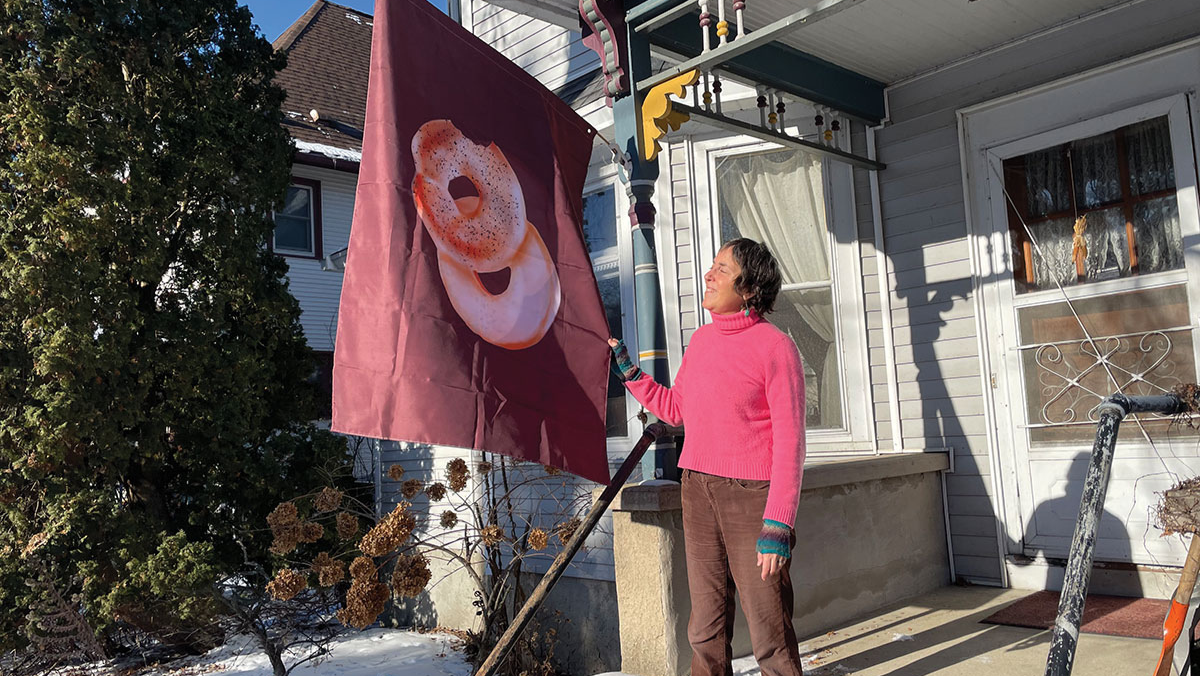
Born and raised a New Yorker, I have strong opinions about what makes for a proper bagel. My mother was the culture-bearer of my family’s Yiddish roots. After she died a couple of years ago, I appointed myself a bagel expert and headed out on the Great Midwest Bagel Quest to taste and judge bagels by the traditional NYC standards. Along the way, I have learned some Midwest Jewish history and talked with people about the foods that bring them comfort.
The bagel first arrived in this country with the arrival of hundreds of Jewish bakers, part of the huge wave of Eastern European immigration from the late 1800s to the early 1900s. In the first half of the 20th century, bagels were an everyday food for Jewish people in America. If you lived somewhere that didn’t have enough Jewish residents to support a Jewish bakery, bagels were baked at home. But if you lived in one of the Jewish enclaves throughout the country, like New York City, Detroit, Chicago, or Milwaukee, there were plenty of Jewish bakeries selling bagels. Milwaukee had the ninth largest Jewish population in the country in 1920, with 20,000 or so Jewish residents who felt strongly about having daily access to fresh bread. Milwaukee also has a strong union history, and Milwaukee’s Jewish Bakers Union first went on strike in 1919. A 1941 article, “Jewish Bakers’ Union Goes on Strike for Increase in Wages,” declared that Milwaukee Jews faced a shortage of rye bread, strudel, and begels.
A month into the quest, I was excited to come across a very early mention of bagels in the Wisconsin Jewish Oral History archives at the Wisconsin Historical Society. A woman named Diana Siegel grew up in Marinette in the 1930s, and in the interview she describes the Jewish foods of her childhood. Marinette is a small city about 170 miles from Milwaukee. When Diana was a child, Marinette had about 200 Jewish families. She recalled that her mom ordered their kosher meat from Milwaukee and packed it in dry ice for transport. Bagels, however, were made at home. Apparently the great-grandmother had sent Diana’s young mother into the Lithuanian forest to learn to bake. The basics of her training sound familiar: after she shaped the dough and let it rise, she would cover it with a warm cloth, put the bagels in boiling salty water, then cook them. In the forest in Lithuania, the final step was done “in a hot cooking pan on a grill that was just above the dirt.” We don’t know how Diana’s mother adapted the recipe for 1930s Marinette, or how the bagels tasted. But, as the self-appointed Midwest Bagel Expert, I’ll bet they tasted like home.