
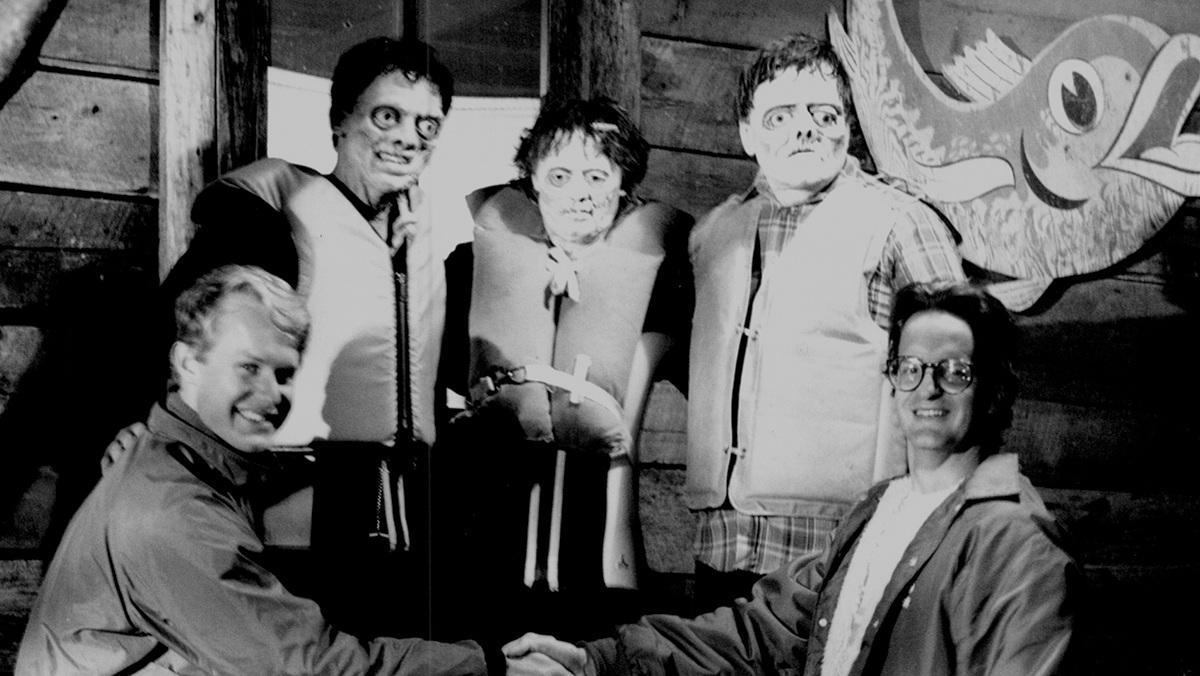
In the summer of 1985, a rash of grisly murders broke out across a small Northwoods town in Wisconsin. Not in real life, thank goodness, but in the film Blood Hook—a somewhat campy horror movie that hoped to ride the wave of popularity that epitomized 1980s horror.
“We didn’t put a label on it,” explains David Herbert, the film’s producer. “We hoped it could slip into that Friday the 13th and Halloween style.”
Watching Blood Hook today (streaming on Peacock and available on Blu-ray), it's easy to see the bloody fingerprints of some of the era’s most iconic slashers. From the “whodunit” killer to the young adult victims, in some ways, Blood Hook felt like a natural addition to the genre. However, in other ways, it defied genre, mainly by blending humor alongside horror.
“We weren’t fully horror or fully comedy,” Herbert remembers. Audiences weren’t quite sure what to make of it.
Part of the humor came from the killer’s weapon of choice—an over-the-top giant muskie hook, which the killer skillfully cast from one victim to the next. Admittedly, it was an unconventional choice, but one that seemed a perfect fit for the fictional town where the film was set and, more importantly, for the real-life town where it was filmed.
Although born and raised in Rochester, Minnesota, Herbert spent his summers at his mother’s lake house in Hayward, Wisconsin, the “Home of World-Record Muskies.”
Often, Herbert would bring his high school pal Jim Mallon along for long weekends at the lake. While Herbert and Mallon enjoyed the usual lake activities, they also loved making movies. Their first amateur film was titled The Revenge of the Hill People—filmed on location in Hayward in the early 1970s, starring Herbert and several of their high school friends.
Mallon (who would go on to be the producer and a puppeteer of the robot Gypsy on the famed television series Mystery Science Theater 3000) co-wrote the script.
“So we put this goofy film together,” Mallon said. “And that kind of got us thinking about how much fun it was making movies.”
A little over a decade later, Mallon and Herbert returned to Hayward for their follow-up film—only this time, they had a little more experience, a professional crew, and a $200,000 budget. To invest themselves fully in their effort, Herbert quit his marketing job at IBM, and Mallon took a leave from his work at a public broadcast station in Madison.
While all those involved hoped the film would prove profitable, for Mallon and Herbert, it was also a chance for two lifelong friends, then 29 years old, to do what they loved most. Over the course of five weeks in late summer 1985, they concluded principal shooting for Blood Hook, with Herbert producing and Mallon directing.
“Everybody was operating in this summer camp dream situation,” Mallon recalled. “We got a lot of miles we wouldn't have gotten any other way. It was all powered by dreams, people, and passion.”
Most impressively, they did it without any tax incentives—a necessary component for filmmakers’ budgets today. Instead, Herbert hauled his slide projector from one investor meeting to the next, highlighting the recent success of similar horror films and noting, too, that fishing was one of the biggest and most lucrative sports in the country.
To make ends meet, they also relied on sponsorships and local support.
One afternoon, Herbert called up Leinenkugel’s—a brewery then headquartered in Chippewa Falls—and said, “We're shooting this film. If we show your Leinenkugel’s sign, will you give us some beer?” Within days, a five-by-eight-foot trailer full of beer arrived on set, much to the appreciation of the cast and crew.
Closer to the set, Hayward’s citizens also chipped in. Representatives from the local sheriff’s department were thrilled that Hayward was the setting for a horror film and loaned the production a squad car and uniforms. Additionally, the father of one of the film’s lead actors loaned them a boat.
But perhaps the greatest (and strangest) act of generosity came by way of the film’s acquisition of a freshly caught muskie, which proved vital to the plot and couldn’t be created by the prop department. Famously elusive, muskies are often called “the fish of a thousand casts,” and the film’s shooting schedule hardly allowed time to catch one. So, they approached a local 11-year-old who had recently caught a 45-pounder.
“Can we borrow your fish?” a production assistant asked. “We’ll pay to have it mounted once the film’s done.”
The young fisherman welcomed the terms.
Midwest hospitality reigned supreme.
When the film was released in 1987, it received mixed reviews, in part due to the genre confusion.
“When it went out theatrically, some people may have said, ‘Wait, this isn't Halloween. What the hell?” Herbert recalled.
Yet, over three decades later, when Blood Hook was re-released on Blu-ray in 2022, it experienced a resurgence of viewers, all of whom, at last, seemed in on the joke and better understood the comedy-horror genre.
In 2024 and 2025, Hayward’s The Park Center hosted screenings as part of the city’s Musky Fest and hosted Mallon and Herbert as special guests. While there, the film’s director and producer witnessed a new generation’s response to their film.
“It was really, really rewarding,” Herbert said, “to see people laughing at it the way we did.”
Chuck Abrams, the marketing chair of the theater, noted that the annual showings of Blood Hook have become one of the highlights of their season, filling every seat in the 257-seat theater. Not that viewers stay in their seats. In recent years, the film has lent itself to a “guest interactive” experience, like The Rocky Horror Picture Show. People cosplay as their favorite characters and enjoy a rollicking good time, laughing and shouting at the screen.
Despite the resurgence, was Blood Hook initially a success? It depends on how you measure it.
“From a pure investment business point of view, it was not successful,” Herbert said. “We made about as much money as it cost. Our investors didn't get back their full investment.”
Nevertheless, Herbert describes making Blood Hook as “the most rewarding and enriching business experience” of his life.
Jim Mallon remains equally proud of the film and grateful for the opportunities that came with it. Although the movie never sailed to the top of the box office as did other 80s horror films, it provided him with the exposure that led to his next opportunity. Shortly after Blood Hook’s premiere, the Milwaukee Journal published a six-page Sunday insert about the movie, complete with splashy photos. When Mallon applied for a station manager job at KTMA in Minneapolis, he brought the spread with him.
“And I think that [newspaper insert] was single-handedly responsible for me getting the job. And that's where Mystery Science Theater 3000 was born.”
For those who’ve never had the pleasure, the cult-classic comedy show Mystery Science Theater 3000 revolves around a janitor and four wisecracking robots poking fun at B-movies. Were it not for Blood Hook (which some would consider a B-movie itself), the show might never have been.
While Blood Hook never endured the ribbing of the MST3K wisecracking robots, another Wisconsin-based horror movie would. In 1975, Bill Rebane directed The Giant Spider Invasion—the story of giant eight-legged arachnids who invade the town of Merrill, Wisconsin. Filmed in and around Merrill, it arguably helped pave the way for future horror films, including Blood Hook. And in 1997, it would find itself in the comedic crosshairs of MST3K.
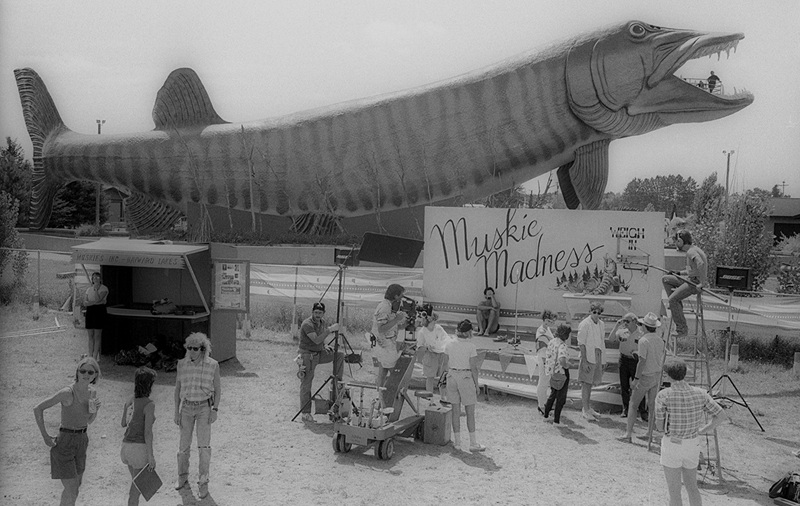
Thanks to Jim Mallon, David Herbert, and other local, low-budget horror films of the era, Wisconsin had its moment in the spotlight. But by the early 1990s, that spotlight began to fade. Wisconsin is not Los Angeles, or Atlanta, or any other filmmaking hub. With few exceptions (most recently the 2022 indie hit Hundreds of Beavers, filmed throughout northern Wisconsin), the state is not a sought-after location for the film industry.
But that might change following the recent passage of Wisconsin’s 2025-2027 state budget, which earmarked $5,000,000 in tax credits per fiscal year, as well as a 30% tax credit on expenditures for productions filmed in Wisconsin. Additionally, a Wisconsin Office of Film and Creative Industries will be created under the Department of Tourism. The idea is that the tax credits, in addition to the office, will lure filmmakers to the state.
Nathan Deming, a 36-year-old filmmaker and film advocate now living in Eau Claire, is especially excited about what comes next. He grew up making movies in Wisconsin, though after completing film school, he became acutely aware that it was not feasible to build a filmmaking career in one of the three states without so much as a film office.
“Wisconsin trains like 500 film and TV graduates a year,” Deming says, “but we’re training them to leave.”
Deming now splits his time between Eau Claire and Los Angeles but is doubling down on the future of Wisconsin filmmaking. There is a certain magic and mystique to filming in some of Wisconsin’s most scenic locations, Deming says, particularly northern Wisconsin, where several recently written screenplays hope to be filmed.
“It’s kind of like our own Wild West,” Deming says.
While Republican legislators, Representative David Armstrong (R-Rice Lake) and Senator Julian Bradley (R-New Berlin), led the charge to pass the tax credit and funding appropriations, the bill ultimately passed with bipartisan support.
In a time when arts funding continues to decline, Wisconsin legislators from both parties appear to recognize the importance of investing in the future of the film industry.
“We live in such a culturally fragmented time,” Deming says. But because Wisconsin is a purple state, Deming believes Wisconsinites may have a clearer sense of what makes for good entertainment simply because we’re not “completely in our own echo chambers.”
Storytelling is universal, he says. And tax credits help filmmakers tell them.
“At the time we made [Blood Hook], Minnesota had an investment tax credit for films made by Minnesota companies,” recalls Blood Hook producer David Herbert. “We definitely signed up for it and it passed along a credit to our investors. If Wisconsin had a tax incentive or other benefits to help our investors, it would have been a big plus.”
Nevertheless, given their close ties to Hayward, Mallon and Herbert took a chance on Wisconsin anyway. They hauled their cameras and crew to the Northwoods and left a legacy far larger than any giant bloody muskie hook.
“The future of Wisconsin filmmaking,” Deming says, “is tied to those pioneering moviemakers who came before.”
Folks like Jim Mallon, David Herbert, and others who took a chance on Wisconsin, long before Wisconsin took a chance on them.
“Maybe,” Deming says, “thanks to the tax incentives, we can continue to build our cinematic identity here.”
It’s the happily ever after Wisconsin is looking for.