
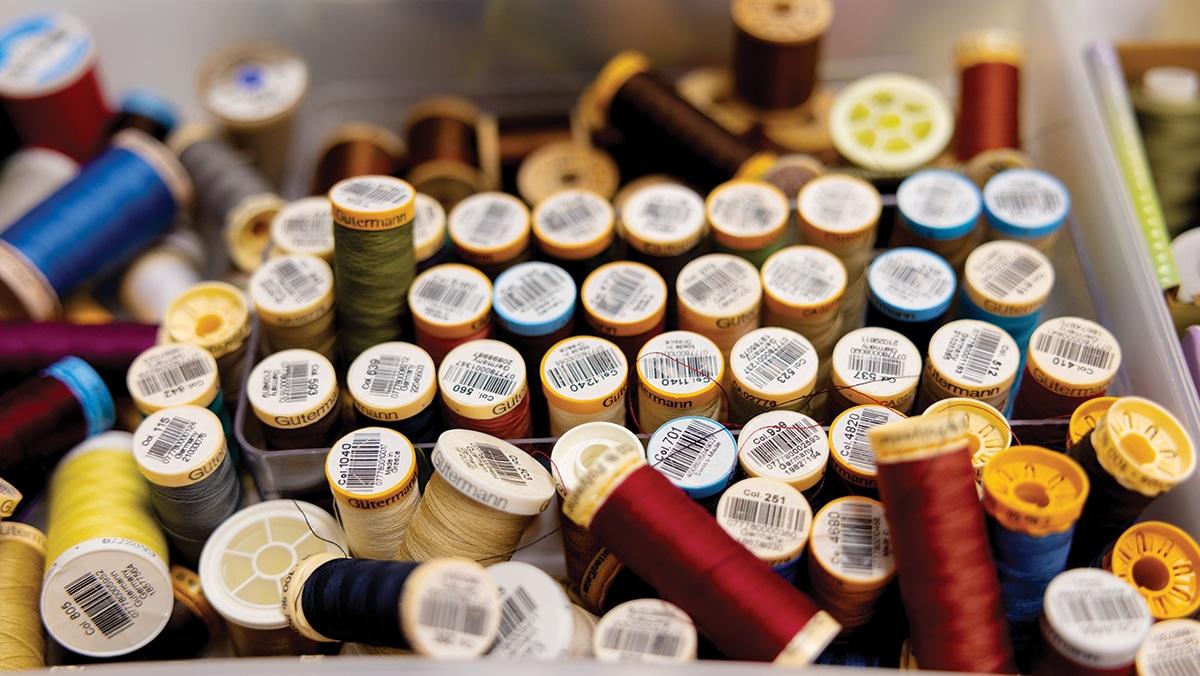
In the air-conditioned and humidity-controlled environment of the Helen Louise Allen Textile Collection, a team of faculty, staff, students, and community volunteers has spent the hot and muggy days of summer thinking about objects typically associated with warmth and winter comforts: quilts. How have quilts been made and used in the past, and in what ways are they still meaningful today?
Those questions are central to two new exhibits opening in Fall of 2025: Find Your Quilt and Parallel Lines: Quilts and the American Landscape. As curators based in the School of Human Ecology at the University of Wisconsin-Madison, we began our investigation of approximately 100 quilts (as well as numerous unfinished quilt blocks and fragments, and other quilted textiles such as clothing) within the Helen Louise Allen Textile Collection with a core ethos: quilts are collaborative artifacts. As much as we celebrate the individual maker who crafts each quilt, we also recognize that these makers work in an extensive network, both known to them and unrecorded: weavers and printers of fabrics that are incorporated into the quilt; entrepreneurial designers who publish patterns in newspapers and magazines or sell kits; neighbors and friends who help stitch the layers of the quilt together; and even future generations of family and collectors who preserve them for posterity.
Quilts are defined by their material construction as layered objects, but they also accrue layers of meaning as they pass through the many hands of makers and users, across space and time. One nineteenth-century American quilt, almost square with seven rows and seven columns of circular motifs, is skillfully constructed from diamonds and triangles of indigo-dyed fabric against a white ground. This particular motif, with an eight-pointed star at its center, may have been an original creation. It has not yet been located among the many quilt block patterns that have been published since the nineteenth century. However, closer examination reveals that numerous hands contributed to its making. The quilting stitches are intricate, but the designs are inconsistently placed, suggesting that after the maker pieced the quilt top, she relied on others (perhaps neighbors or family) to help stitch the layers together. The quilt was also mended in the twentieth century, showing how additional craftspeople preserved its beauty and utility across generations.
If the blue and white quilt shows community across time, another quilt in the collection shows how makers across the globe can craft together. At the turn of the twenty-first century, quilters in Ghana and the United States collapsed the distance between them to collaborate in the Celestial Stitches Heritage Quilt Program. The work invested in the remarkable quilt is almost miraculous. It is made from approximately 1,300 small pieces of African batik (wax-resist dyed) cottons, likely remnants of clothing, stitched into a patchwork quilt top by Ghanaian seamstresses. The quilt top was then shipped to the United States, where it was quilted together by experienced volunteers, elder African-American women, who live in Savannah, Georgia, and quilt together in a church group. This piece was made with the dual aims of creating economic opportunities through quiltmaking for women in Ghana and sharing the Christian gospel through collective crafting and conversation in the United States.
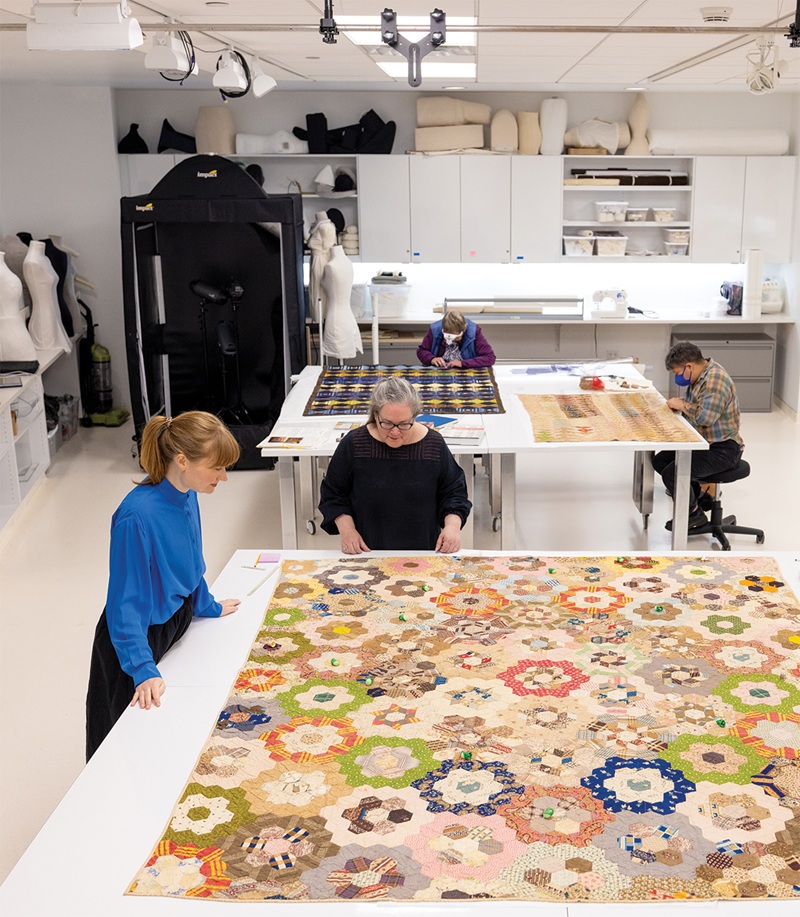
The journey of a quilt from textile storage to exhibition also relies on many hands. It took two collections assistants to carry a vibrant hexagonal patchwork quilt out of the collection storage and carefully lift it onto a table in the workroom before it could be inspected. The bright colors and astonishing labor in this object are striking – there are 1,743 small “hexie” patches, created using the meticulous paper piecing technique in which fabric is sewn onto or wrapped over paper foundations to create precise designs. It is an example of one of the earliest published American quilting patterns — called “honeycomb” in 1835 by Godey’s Lady’s Book but often known as “Grandmother’s Flower Garden.”
Close examination revealed a small name and date inked onto the back of the quilt. Although faded and hard to read, it looks like “Julia Morris Jackson, 25 Dec [19]11.” Investigative research involved time in libraries and at the computer, as well as poring over genealogical records. The research trail led to the Wisconsin Historical Society where boxes of Julia’s letters survive. They reveal that she sewed from childhood and loved wearing the color green, a hue also used strategically across her quilt design. Research findings from the curators’ investigations were condensed into short label texts (capped strictly at 150 words!) to prompt visitors to make personal interpretations as they piece together the history of Julia’s quilt: Perhaps some of the fabrics she used were repurposed from her own clothes? Or from the clothes of her six children?
Julia’s quilt was one that benefitted from careful stabilization, due to the dozens of small holes that had opened up in patches of the cotton after years of love and use by her family. Intended to be nearly invisible, netting is stitched over tears or holes to protect the quilt from further damage.
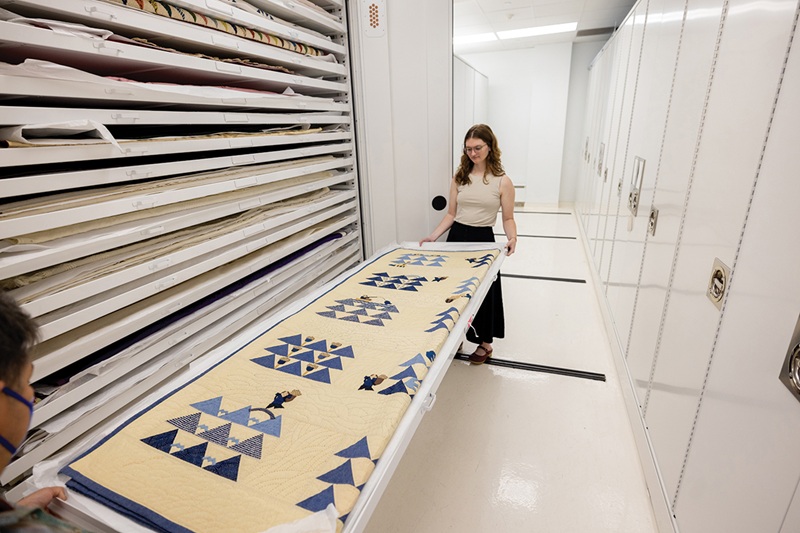
Seven dedicated and skilled volunteers and students spent cumulatively over a thousand hours preparing textiles for exhibition. At the same time, the exhibition team designed the gallery layout, chose colors for the walls, and assessed the mounting needs of each object. Most quilts require bespoke mounts for display– some need support from flat beds and slant boards, while others can hang from the walls, attached with velcro backing. For these two exhibitions, 278 feet of velcro were stitched for mounting. Thanks to these efforts, quilts can be enjoyed by researchers, students, and visitors for generations to come.
As every visitor brings their own stories and interpretations with them into the galleries, audience engagement is an important form of collaboration. As part of the “Quilting Connections” season, the Nancy M. Bruce Center for Design and Material Culture is hosting a year of events – from talks and hands-on workshops to quilt documentation days, book clubs, and jazz performances of compositions inspired by quilts on view. Each of these programs is part of the collaboration that adds layers of meaning to the historic and contemporary quilts on display.
The Helen Louise Allen Textile Collection
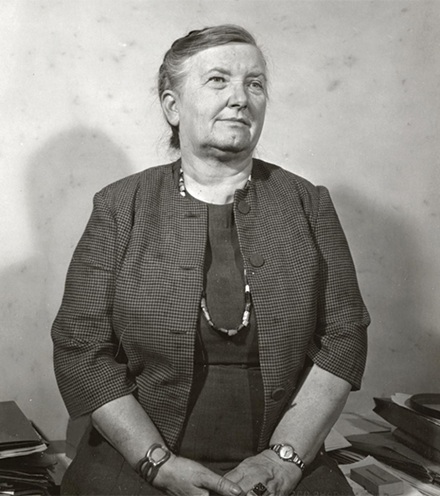
Throughout her life, Helen Louise Allen (1902–1968) acquired a significant collection of textiles, which she used for research and teaching in her role as professor, teaching weaving and other textile techniques and histories, for the Related Art Program at the School of Home Economics (now School of Human Ecology) at the University of Wisconsin–Madison. She bequeathed this collection of about 4,000 objects to the school, and since then the collection has grown to accommodate nearly 14,000 textiles that represent a breadth of cultures, traditions, techniques, and materials. This collection brings researchers and students from across the world to Wisconsin.
Quilts make up only a small portion of the collection, although the approximately 100 examples (not counting quilt blocks, tops, and other fragments) do take up a disproportionate amount of storage space! Most of the objects going on view for the 2025-2026 season have not been exhibited before, or were last seen twenty years ago at the Quilts: Artistry in Pattern exhibition hosted by the Elvehjem Museum of Art (now the Chazen). In the last five years, the collection has been built strategically to broaden representation of the quilting world. Some of these newly acquired quilts from Gee’s Bend and the collection of Roland Freeman (folklorist and photographer) will be on display, as will loans from contemporary Madison and Milwaukee-based craftspeople who are at the cutting edge of quiltmaking.
UPCOMING EXHIBITIONS
Find Your Quilt
October 8, 2025 – March 1, 2026
Parallel Lines: Quilts and the American Landscape
September 3, 2025 – May 10, 2026
Nancy M. Bruce Center for Design and Material Culture,
School of Human Ecology, University of Wisconsin–Madison
Learn more at cdmc.wisc.edu