
Women of Yerkes | Yerkes Timeline | Charles Tyson Yerkes Jr.
On a clear evening each October, over 2,000 candles line trails winding through an arboretum. The trees on this hallowed ground were carefully planted more than a century ago, and the paths lead to a great refractor dome. Hundreds of people come together for a chance to gaze at the stars and what the event organizers call “grounded luminescence.” It is a landscape rich with fresh energy and imbued with ancient questions.
How do you explore the natural world with your whole self? How do you build a bridge between knowledge and expression, or between the sciences and the arts?
What was once a temple for astronomy, designed to reveal the secrets of the heavens, has been transformed to stir the human spirit and reveal different truths in a new way. The leadership at Yerkes Observatory has opened the historic grounds to artists and scientists, inviting people of all ages to create, to explore, and to build a better tomorrow. Doing so, they are securing a future for this Wisconsin institution.
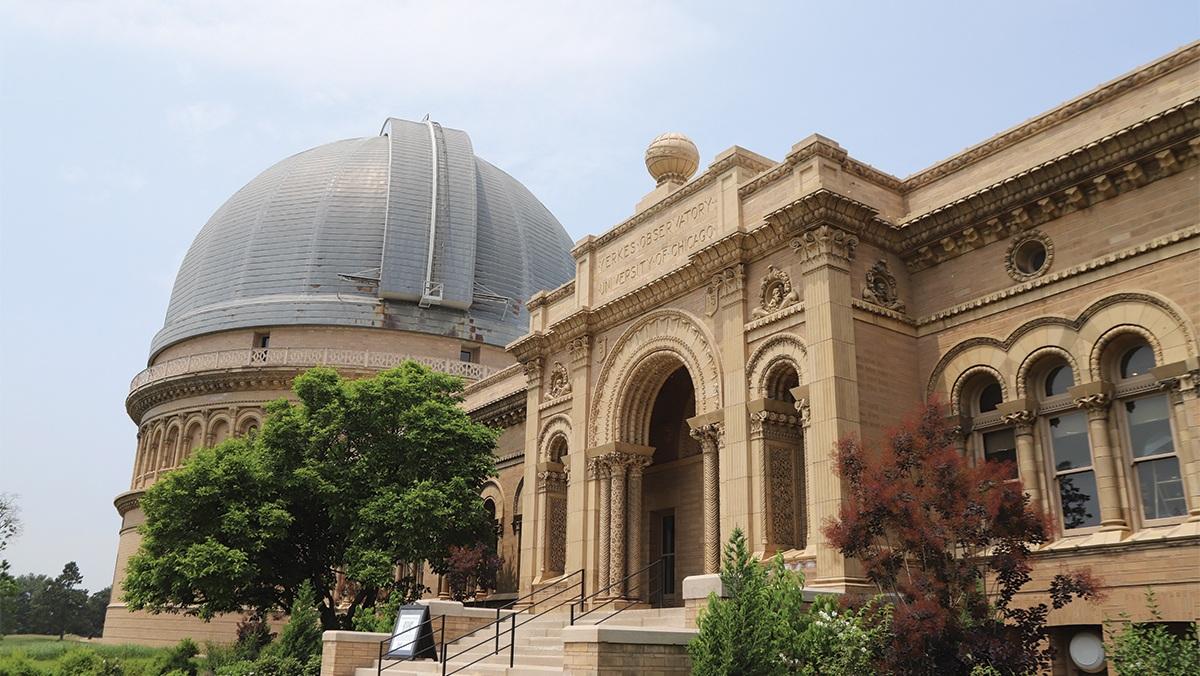
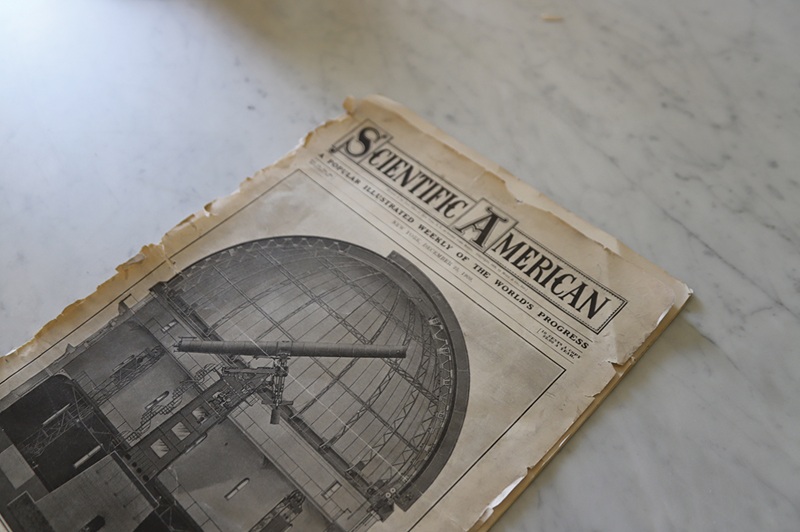
When it opened in 1897, the Yerkes Observatory was built to become everything of which scientists had been dreaming for the exploration of astronomy. Located on a sprawling and beautiful 70-acre estate along the southern edge of Wisconsin near Lake Geneva, the observatory was groundbreaking for its stargazing technology. Owned and operated by the University of Chicago, it housed the world’s largest refracting telescope ever built and was a permanent accommodation for laboratories, classrooms, and workshops.

The enormous telescope's ability to capture intricate, expansive, and previously unimagined images of the universe attracted a roster of equally groundbreaking scientific talent to study there. That list was not limited to impressive names such as Edwin Hubble, Carl Sagan, Subrahmanyan Chandrasekhar, and Nancy Grace Roman. Even Albert Einstein insisted on visiting the observatory on his inaugural trip to the United States. But as the years marched on, time began to take its toll.
Over the decades, technology advanced. Despite the many catalysts to scientific inspections and advancements that took place at Yerkes, as well as the career-launching role it played for countless astronomers, it simply wasn't enough to prevent this "birthplace of modern astrophysics," as it was named, from closing its doors. The upkeep proved too costly for the University, and the observatory ceased its exploratory vision in 2018.
But that was not the end. In recent years, a groundswell of support has reached for the stars to save Yerkes Observatory. What came next was a transformation that honored the scientific past of the observatory, while inviting a reimagining of its purpose. To preserve Yerkes as a civic asset in perpetuity, the Yerkes Future Foundation rallied around a mission to “advance humankind’s understanding of the universe and our place within it, igniting curiosity, facilitating exploration, and nurturing a deep sense of connection with our planet and each other.”
Dr. Amanda Bauer was one of those drawn to the foundation's new vision. “I was really fascinated by the history of the observatory, the legacy that it carried with it, all the famous people who came through it,” she says of why she took the job as the Deputy Director and Head of Science and Education at Yerkes three years ago.
Bauer appreciates that Yerkes invites innovation. She is ready to try new things. Her approach has been to pay attention to what is working and to build programs that are responsive to the community. She says she hopes to create new and meaningful cross-pollination between astronomy, the arts, and outreach.
“And if something isn't working, then let's pivot away from that,” she explains, adding that Yerkes’ future must be responsive to the interests of the people who visit the observatory. “All of the programs, all of the public outreach, the collaborative efforts, the research programs that we're doing are to really harness that sense of connection within people.”
During educational programs and visits from different schools, the telescopes are pulled onto the lawn for demonstrations and hands-on activities. “Members of the public get to use the largest refracting telescope in the world, which honestly never gets old,” says Bauer.
A PLACE FOR THE ARTS
Since opening to the public in 2022, Yerkes’s modern programming repertoire has been motivated by a desire to harness the creative spirit of the place. However, some hard truths have had to be grappled with in these first years. Walt Chadick is the Director of Programs and External Affairs at Yerkes. He says the team had to understand that if one of the most affluent universities in the world couldn’t cover the costs, then they were going to have to do things differently.
Chadick and Executive Director Dennis Kois understood that if they were going to create meaningful visitor experiences, programs had to be more than “twelve people looking through a telescope in the middle of the night.” What they had going in their favor included a 50-acre campus designed by the famous landscape architect, John Charles Olmsted, and remarkable Beaux Arts buildings designed by Henry Ives Cobb.
Chadick and Kois both came to Yerkes from past work in the arts and believed that building connections with artists could bring new vitality to the buildings and grounds.
“We knew so many musicians and writers and painters and sculptors inspired by science. It could be astronomy specifically, but it could also be physics and biology and any of the sciences,” Chadick explains. Like Bauer, Chadick believes the blending of art and science isn’t in competition or contradiction, but instead it’s a natural combination. A speaker series has brought Nobel Prize winners as well as the U.S. Poet Laureate.
One distinct set of Yerkes’s flagship programs focuses on music and features the four-time Grammy-winning contemporary music, Eighth Blackbird. They have led a two-week immersion program for a cohort of 20-25 musicians since 2023. Called the Blackbird Creative Lab, it has brought together pianists, composers, violinists, singers, harpists, flutists, and others. At the end of the program, they perform for the public under the great refractor telescope on the lawn. Chadick believes the program offers the artists an opportunity to grow in important ways, such as entrepreneurship and grant writing, while giving back to the community.
The second early experiment at Yerkes – which is still going strong – is the annual creation of the world’s tallest glass tree. “We take 6,000 recycled bottles, and then we have a furnace that heats them up to 2,200 degrees. We let folks from the community put a pole in and pull out liquid glass,” describes Chadick. “As it's hardening on this spinning 37-foot-tall frame, it creates this stunningly gorgeous, bizarre, spinning glass tree right in front of the observatory.”
The Yerkes art team continues to expand the artful offerings. In the summer of 2025, they broke ground on a 27-foot-tall play space designed to look like a supernova. They dream of one day opening a state-of-the-art performance art center that honors the history of this southern Wisconsin gem.
ALWAYS A PLACE FOR SCIENCE
Mallory Conlon is the Outreach Astronomer on staff at Yerkes. She has spent her career at the intersection of science and education. Art aside, another integral component of the Yerkes Observatory rebirth is education and creating opportunities for all ages to learn about astronomy.
“Astronomy is one of those sciences that we like to call a gateway science where people are exposed to it, they're shown the images, they hear the talks about just how grand and big the universe is,” says Conlon, “and that sparks their excitement for science in general.” Student groups from around the region come to the observatory for hands-on STEM or STEAM activities. Professional development programs for educators help teachers feel more confident in bringing physics and astronomy into their classrooms. For both Bauer and Conlon, Yerkes is a place for asking questions and honoring curiosity.
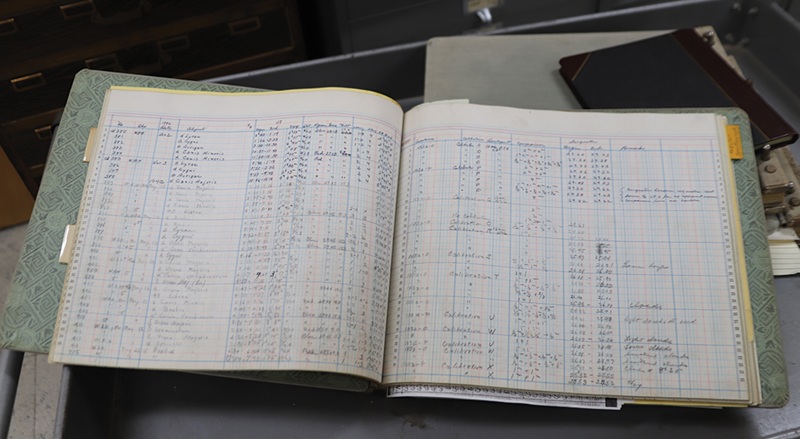
The team is creating a digital archive of the more than 180,000 glass plate images of the sky that have been taken since the observatory opened more than a hundred years ago.
“In astronomy, what we're interested in is how things change over time, so with our glass plate collection, we can provide those baseline observations from 50-100 years ago and then use that to compare it to new observations today,” explains Conlon.
Conlon believes that in today’s instantly-accessible and internet-led world, there’s a lot to be gained by scientists, students, and community members who can see and use some of the older technology still available at Yerkes. While the Great Refractor Telescope is no longer useful to scientists, two other telescopes in smaller domes are being restored and modernized. Conlon hopes they can be used by students in the future. “Getting that hands-on experience provides a deep appreciation for how science is actually done,” she says. “It's not just all computers — there is a real, tangible process to it and we're the reminder of that.”
According to Conlon, Yerkes has an important role providing opportunities for people of all ages and backgrounds to come to the observatory. She hopes they go away with positive memories of deeply meaningful science.
“There is a deep, human connection to understanding the way that things were done in the past,” she says. “And yes, it was built for astronomy, but now it's also being used for so much more than that.”
Chadick echoes that sentiment. “We want to be based in intellectualism, and based in education, and based in that shared wonder that the arts and science have in common,” he says. “A big part of this is experimentation. It's true of scientists, it's true of artists, and it's true of Yerkes’s new mission. We are a great experiment in how a 130-year-old observatory can be reborn anew.”
All photos by Steven Potter
The Pioneering Women Of Yerkes
As in other realms of scientific research, men are recognized for much of the work done in astronomy during the early 1900s. But at Yerkes Observatory in the first half of the 20th century, women were also exploring and cataloging the starscape. And it wasn’t just a few women, it was many.
Using photographs as the starting point to identify them, historians and librarians over recent years have found that more than 100 women worked at Yerkes from its first days through 1950. Some of the women were secretaries, but many worked as so-called ‘computers’ who solved mathematical equations, and many were astronomers. Other documents such as personnel records, logbooks, and correspondence were used by University of Chicago historians to build the roster of women who worked at the observatory.
Back then, not many women were permitted to work as professional scientists. Still, these pioneering women at Yerkes analyzed data and astronomical observations as well as collaborated with researchers around the world and published papers. Two factors helped these women find work at Yerkes. One was that the observatory was near a railway that went to Chicago, so women could travel efficiently, safely, and alone. Secondly, the observatory director from 1905 to 1932 was self-proclaimed suffragist Edwin B. Frost, who didn’t hesitate to hire women.
One of the standout female astronomers at Yerkes was Harriet McWilliams Parsons, who did her research at the observatory and earned a Ph.D. from the University of Chicago in 1921. Her groundbreaking research involved measuring the colors of the stars in the Pleiades, a star cluster within the constellation of Taurus.
In a now relatively famous photograph of Albert Einstein’s visit to Yerkes in 1921, there were also eight women scientists. It was this photograph that inspired University of Chicago historians to dig into who the female Yerkes scientists were – and one of them was Dorothy Block. She held the title of assistant of stellar spectroscopy, a role that required her to operate the impressive refracting telescope. Later in life, Block and her astronomer husband, John C. Paraskevopoulos, were charged with relocating Harvard University’s Boyden Station Observatory from Peru to South Africa, to take advantage of better weather conditions.
Another of the many women scientists at Yerkes was Mary Ross Calvert, who built on and finished the work of her astronomer uncle Edward Emerson Barnard after his passing. Her work included publishing a pair of the first atlases of the Milky Way galaxy.
Nancy Grace Roman, who became NASA’s first chief of astronomy during the 1960-70s, worked at Yerkes Observatory after graduate school. At Yerkes in the 1950s, her research focused on stellar spectroscopy, identifying different types and speeds of stars. Roman is also known as the ‘Mother of Hubble’ for her foundational role in planning the Hubble Space Telescope. In her honor, NASA has named its next flagship astrophysics mission the Nancy Grace Roman Space Telescope. Scheduled to launch in 2026 or 2027, it will investigate the mysteries of dark energy and dark matter as well as search for exoplanets using infrared light.

Timeline of Yerkes Observatory
by Steven Potter
1895
Construction of Yerkes Observatory begins in Williams Bay in Walworth County.
1897
Construction finishes and the observatory opens, housing not only the world’s largest refracting telescope (at the time) but also laboratories, workshops and libraries. The first on-site conference of astronomers and astrophysicists is held.
1909
While tracking Halley’s Comet, Yerkes astronomer Edward Bernard accidentally takes the first-ever photo of the dwarf planet Pluto. This photo is believed to have been taken more than 20 years before the planet’s official discovery.
1921
Albert Einstein visits the observatory – it was one of two places he insisted on visiting during his first trip to the United States (the other was Niagara Falls).
1951
While director of the observatory, astronomer Gerard Kuiper proposed that a belt of icy bodies might lie beyond Neptune. These bodies – which are believed to be remnants of the early solar system, would later become known as the Kuiper Belt. Later in his career, Kuiper helped identify landing sites on the Moon for the Apollo program.
1960s
Two more refracting telescopes are added to the Yerkes array in the eastern domes.
1991
Researchers at Yerkes used leftover components from the Reagan-era Star Wars program to develop adaptive optics, which employs computer-controlled mirrors to correct for the distortion of stars caused by the earth’s atmosphere.
2020
The University of Chicago transfers ownership of the observatory and its surrounding 50-acres to the Yerkes Future Foundation nonprofit organization, setting in motion everything the site has become today.
Who was Charles Tyson Yerkes Jr?
By Steven Potter
Yerkes Observatory bears the name of the man who put up the money to build it. Charles Tyson Yerkes Jr. was a Quaker-born man who lived from 1837-1905. In my research, I found historical records indicating that Yerkes Jr. was in fact quite deliked for his pattern of unscrupulous business tactics, with some calling him ‘the most hated man in Chicago’ during the Gilded Age of America.
Though he’s credited with creating transportation systems like the London Underground and the Chicago El Train later in life, he began his career in finance working for the city treasurer in Philadelphia. After stealing money from the city’s coffers to gamble and eventually lose in the stock market, he was convicted of larceny and sentenced to almost three years in prison. In an attempt to avoid time behind bars, he devised a plan to blackmail two influential Pennsylvania politicians and that ultimately led to a sentence of just seven months.
During the 1880s, he moved to Chicago where he created a stock and grain brokerage and began to buy up and take over parts of the city’s railway system. To do this, he resorted to practiced tactics of bribery and blackmail. Once he had his hands on the railway system, he opposed changes that would cost him money or benefit commuters. His ire in the public eye and press grew greater in following years.
In an effort to improve his badly soiled reputation, in 1892 Yerkes funded the world's largest telescope after being lobbied by the astronomer George Ellery Hale and University of Chicago president William Rainey Harper. Initially, he only intended to fund the telescope but was eventually convinced to pay for the entire observatory project. He also made a donation of $500,000 to the university. (That same amount, adjusted for inflation, would be almost $20 million today.)
According to the writer John Franch, who authored the Yerkes biography entitled “Robber Baron,” the shady financier made a speech at the dedication of the observatory in 1897 that noted the “uncommercial” nature of astronomy.
"There is nothing of moneyed value to be gained by the devotee to astronomy," said Yerkes. "There is nothing that he can sell. Consequently, the devotee of astronomy has as his only reward the satisfaction which comes to him in the glory of the work which he does and the results which he accomplishes."
But Yerkes’ name isn’t his only recognition at the observatory: Inside the main building’s rotunda, his face is sculpted into the pillars and on the walls more than 200 times. As a nod to his loathed persona and public image, these dozens of depictions have him styled to resemble the devil.