
Excerpt from "Wisconsin Idols: 100 Heroes Who Changed the State, the World, and Me" reprinted with permission from Wisconsin Historical Society Press
Introduced by Jessica Becker
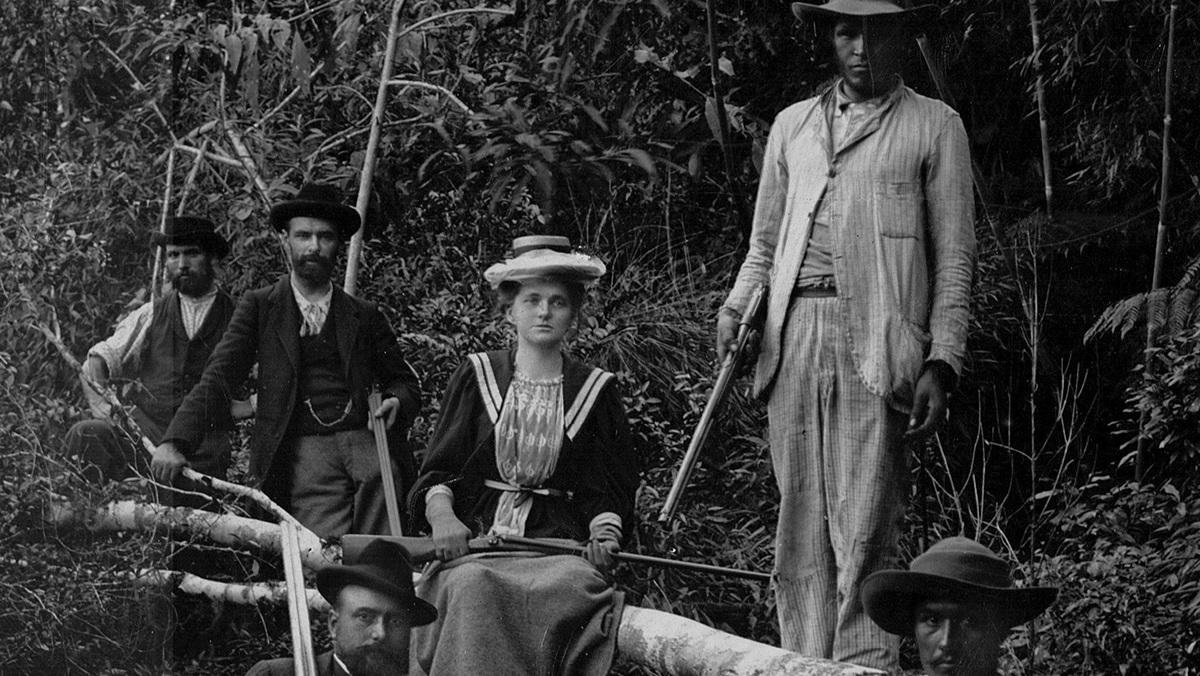
Only a few women were asked to join the Wisconsin Academy in the early years, and one of them was Harriet Bell Merrill. Known to her friends at Hattie Bell, she is now recognized as an important pioneer in the field of limnology, or the study of lakes and fresh water, a field of research for which UW–Madison is known worldwide. The explorer, teacher, and zoologist was the first women officer of the Wisconsin Academy of Sciences, Arts and Letters and vice president of science from 1896 to 1898. This magazine’s former editor, Sandra Barnidge, wrote that “Merrill was almost certainly the first professionally trained limnologist to conduct fieldwork in Brazil — and probably everywhere she traveled.”
We are pleased to share two excerpts from a collection of essays called Wisconsin Idols: 100 Heroes Who Changed the State, the World, and Me from the author Dean Robbins. Robbins celebrates our state’s people and ideas by shining a light on women like Merrill and pioneering microbiologist Esther Lederberg among other “legendary” and household names. Robbins is something of a legend himself, as the current editor of On Wisconsin magazine, the previous editor of Isthmus newspaper, and the acclaimed author of a growing collection of nonfiction children’s books. With Wisconsin Idols, he honors the humanity of some of his personal heroes by offering all of us a chance to better understand Wisconsin through their personal struggles and groundbreaking achievements.
Harriet Bell Merrill: Hunting for the Unseen
I never had a limnologist hero until I learned of Harriet Bell Merrill, who advanced the field while gleefully ignoring restrictions for women in the early twentieth century. Wearing a pair of men’s high-top boots, she traveled solo through South America to conduct research for the University of Wisconsin and collect samples for the Milwaukee Public Museum. Her brother insisted that it was “entirely out of the question for a petite little woman to hazard such a rigorous venture.” Yet Merrill made a career of doing things that were entirely out of the question for women.
Born in Stevens Point in 1863, she grew up fascinated by the Wisconsin River. Rather than fitting into a conventional role, the budding scientist collected rocks, insects, and plants to scrutinize under a microscope. She graduated summa cum laude from the UW in 1890 at a time when many disapproved of women students. Eyebrows rose when she hiked up her skirts to collect specimens in muddy fields and lakes, a bulky camera around her neck.
In Milwaukee, Merrill taught science to high school and college students. She earned a master’s degree at the University of Chicago and joined the UW faculty as a pioneering female professor of zoology, specializing in water fleas. In 1902, she realized her lifelong dream: conducting fieldwork in South America. Shrugging off the critics, Merrill laced up her men’s boots and boarded the SS Byron in New York City. She considered it “a release as liberating as loosening the constraints of corset stays and changing to a shift.”
From the get-go, the journey tested her mettle. On board, cockroaches swarmed her pillow and found their way into her teacup. And on the two-thousand-mile trek through remote parts of Brazil, Paraguay, and Argentina, she braved wild animals and perilous rivers. Merrill carried on despite the threat of cholera, yellow fever, and bubonic plague. On one hike, her boots sank into the mud with every step while six-inch thorns shredded her clothes. By the time she reached a clearing, she wrote in her notebook, “I felt I had awakened from a nightmare.”
But the notebook also captures Merrill’s sense of wonder as she collected plant and animal specimens, many of them new to scientists. “Enormous tropical butterflies cluster together like fluttering masses of bright blossoms,” she wrote, “all open to the heavens where colorful species of birds and insects fly unwarily about in a symbiotic paradise.”
As a woman traveling mostly alone, Merrill entered local legend. South American newspapers printed flowery accounts of her exploits, though writers seemed perplexed by her footwear. They dubbed her “the courageous American woman.”
At the end of her expedition, Merrill had reason to be proud. “I believe, when I left home, that many of my friends thought I would never return alive,” she stated, “but they were mistaken.” She examined the more than seven hundred samples she’d collected, published articles about her trip in the Milwaukee Sentinel, and presented her findings at the University of Chicago and Cornell University.
Despite ill health, Merrill made another arduous trek through South America and the Caribbean five years later, visiting Brazil, Venezuela, Trinidad, British Guiana, and Curaçao. “I keep hunting for the ‘unseen’ through the rain forests and waterways,” she wrote.
In 1915, the fearless scientist died from a heart condition at age fifty-two while pursuing her PhD at the University of Illinois. The world virtually forgot about her until the 1990s, when her grand-niece Merrilyn Hartridge published a biography. I hope future generations remember Harriet Bell Merrill for excelling in a male-dominated field when few thought she could.
Happily, the surname “Merrill” is guaranteed to live on forever in the annals of science. One of her fellow UW researchers named a species of crustacean in her honor: Diaptomus Merrilli.
More about Merrill's life and work can be found on Writing Roughshed by Sandra Barnidge.
Esther Lederberg: Credit Where Credit’s Due
When husband-and-wife scientists Joshua and Esther Lederberg posed for a photo at the 1958 Nobel Prize ceremony, just one of them looked happy. Facing the flashbulbs in a tuxedo, Joshua smiled. And why not? The Nobel committee had immortalized him and his two male colleagues for their work in microbial genetics.
At his side, in a gown and elbow-length gloves, Esther did not smile. Indeed, her stony stare could have melted the camera. She had received no share of the Nobel, despite her key contributions. And Joshua scarcely acknowledged her in his remarks.
So let’s acknowledge her here.
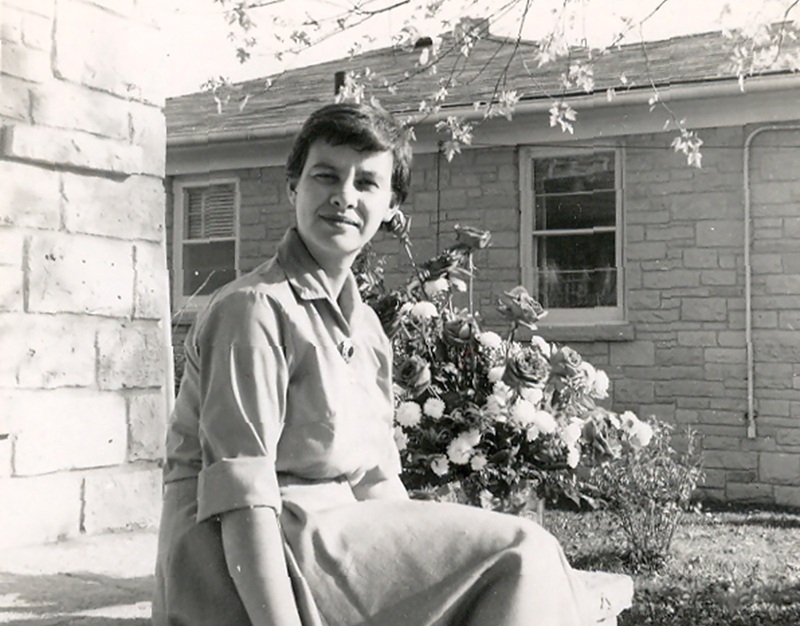
Born in 1922, Esther Zimmer entered a world that undervalued female scientists. At Hunter College in the late 1930s, she studied biochemistry despite teachers who told her the subject was too hard for women. She continued defying the naysayers and earned a master’s degree in genetics at Stanford University, where she met the scientist who would become her first husband, Joshua Lederberg. After the couple moved to the University of Wisconsin in the late 1940s, Esther received her PhD, joined her husband’s lab, and contributed to a revolution in the field of microbiology.
Esther’s male colleagues hailed her creativity with a pipette and a petri dish. Working from her UW lab bench, she made major breakthroughs that revealed how microorganisms share genetic material. She discovered the lambda bacteriophage, a parasite that became a model for studying viruses and genetics, setting the stage for understanding DNA. She discovered the bacterial fertility factor called the F-plasmid. And she helped develop a transformative technique called replica plating, which allowed geneticists to duplicate bacterial colonies using sterilized scraps of velvet. Nothing if not resourceful, Esther initially tested the method with the powder puff from her makeup kit.
The husband-and-wife team published papers together and shared the 1956 Pasteur Award for contributions to science. Nevertheless, Joshua regularly received sole credit for work they did together. Fast forward to her stony stare at the Nobel ceremony.
Esther’s colleague Stanley Falkow later stated that Esther’s “independent seminal contributions in Joshua’s laboratory… surely led, in part, to his Nobel Prize.” Lise Meitner, who helped discover nuclear fission in 1938; Chien-Shiung Wu, who made an essential particle and nuclear physics discovery in 1956; and other women scientists passed over for Nobels must have known how she felt.
After a decade in Madison, the couple returned to Stanford, where Joshua was treated like royalty while Esther was offered an untenured position with scant funding to continue her research. And thus did a brilliant female scientist pass into obscurity. “If Esther would have been a man,” said her biographer Rebecca Ferrell, “all kinds of things would have been different.”
Joshua developed big-ego syndrome following the Nobel Prize, and the couple divorced in 1966. Esther spent the next part of her life advocating for women, pursuing her passion for literature and music, and founding Stanford’s Plasmid Reference Center. She died in 2006, certain that she’d be forgotten.
Luckily, it didn’t happen, thanks to advocacy by Esther’s second husband and various writers and scientists. Now you, too, can spread the word and keep her memory alive.