
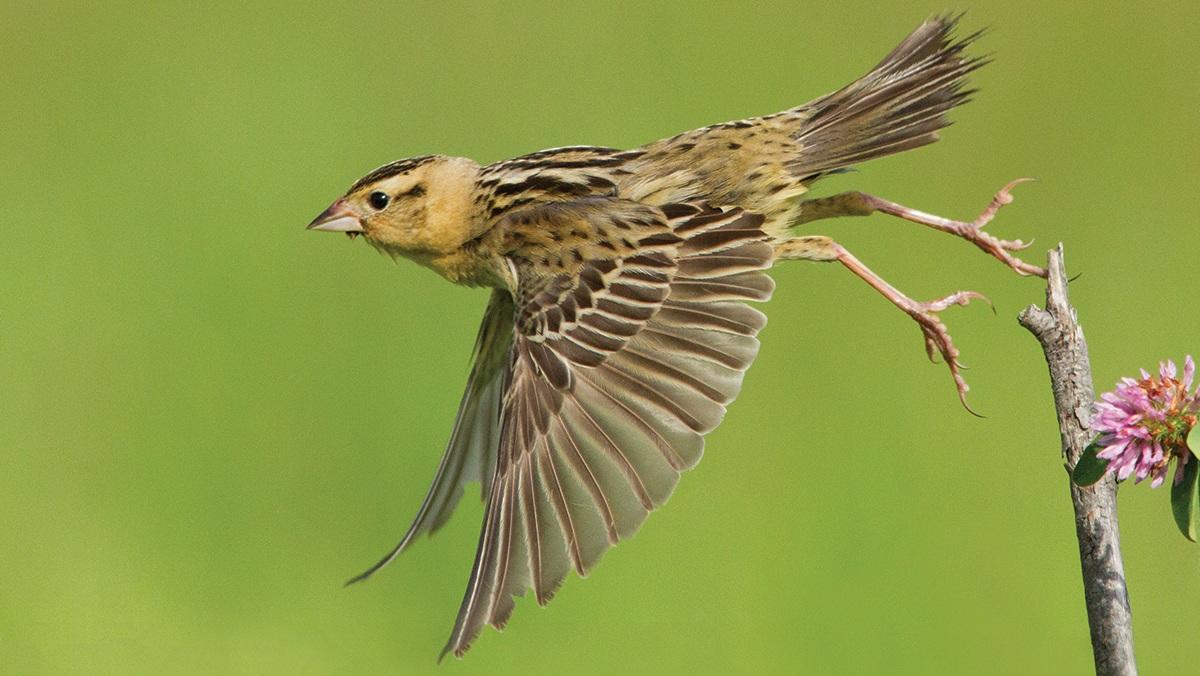
Day 1: Preparing for migration and dreaming of the Southern Driftless
It’s mid April, about that time of year for me to document my upcoming migration. The days are getting shorter here in the Pampas of Argentina, and I can feel the urge to migrate North. I’ve been feasting on insects and seeds, putting on half of my body weight in reserves. Soon I’ll join my flock, heading north to our home in Wisconsin’s Southern Driftless region. It’s in this unique place where we grassland birds have found expansive habitat suitable for our nesting needs.
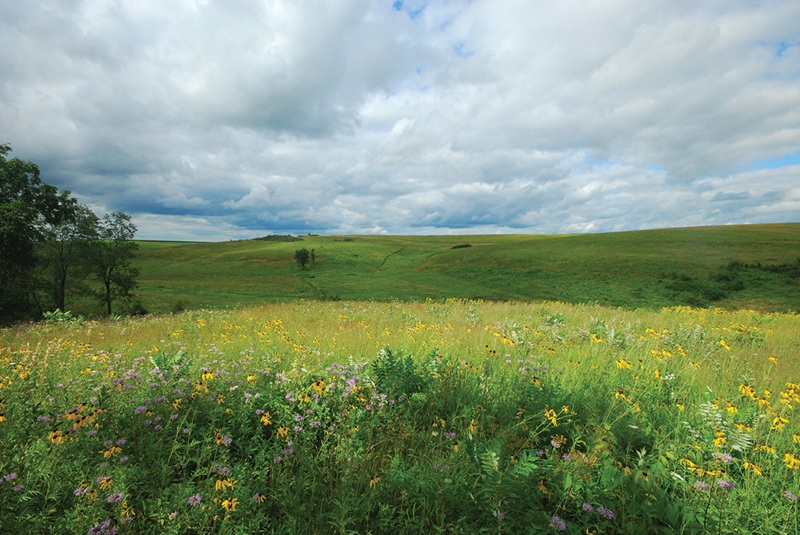
After eight months away, I can’t wait to see the deep greens of the grasses, the light blue of the sky, and the bright yellow, red, and purple forbs that accent the landscape. I can already hear the subtle sound of grass blowing in the wind and the songs of the many birds that reside in this region. But I am not there yet—it is still thousands of wing-beats away.
Day 15: Migrating north through uncertainty
It’s almost May and we’ve been flying for two weeks, covering thousands of kilometers. Though, as Bobolinks, we have one of the longest migrations of any North American songbird, the thought of reaching the Southern Driftless region keeps me going. We have been flying there for as long as any of us can remember. Like many other grassland birds, we nest on the ground, so we are particular about the height and density of the grasses where we choose to build our nests. We prefer medium-height grasses with no trees around, as trees can house and hide predators of our eggs and chicks. We can usually find these nesting spots in prairies, hay and small grain fields, and well-managed pastures.
Unfortunately, these grasslands we depend on are diminishing rapidly, causing a decline in various bird species. The other day, my tuxedoed Bobolink partner, Tux, cautioned that of all groups of birds, the grassland groups are experiencing the quickest rate of decline—about two percent annually. Because of this, Bobolinks are considered a “tipping point species,” meaning we are showing an accelerated rate of decline. I knew our numbers were dwindling, but I hadn’t realized we were among the most at risk.
They say the biggest reason for our decline is habitat loss. Historically, the Southern Driftless region was rich in prairies and open oak savannas. But over the years, our family has seen these open oak savannas and prairies turning into row cropped agricultural fields crisscrossed by roads and dotted with human houses. Another issue affecting our grasslands is encroachment from invasive woody brush and trees. In the past, these were kept in check by fires, which used to occur every three to five years in the region. Over the last 100 years, however, fire has been suppressed to protect human structures, and this has allowed invasives to spread throughout the grasslands. As a result, it has been increasingly difficult for us to find a favorable place to nest.
We have plenty of time to reflect during our journey north, and each year I find myself thinking of all the uncertainties we experience year after year. I hope this year we find an adequate spot to raise our chicks.
Day 30: Finding a home among the wildflowers
It’s May 15, and we’ve made it! The Southern Driftless is always a welcome and beautiful sight to see after such a long journey. It feels great to fly once again amongst my favorite purple hues of the spiderwort, wild lupine, and pasque flower. Upon arrival, Tux and I choose a cozy niche of the grassland to call home for the season. The humans call it the Schurch-Thomson Prairie, and it’s owned and cared-for by a group called The Prairie Enthusiasts. Although there is row-cropped agriculture nearby, this prairie has everything we look for in a home: medium-height grasses, a treeless open landscape, and little woody vegetation. Another interesting observation is that humans enjoy visiting Schurch-Thomson Prairie, just like we Bobolinks do! Today they were walking on the trails and taking photos of wildflowers, butterflies, and, of course, us birds.
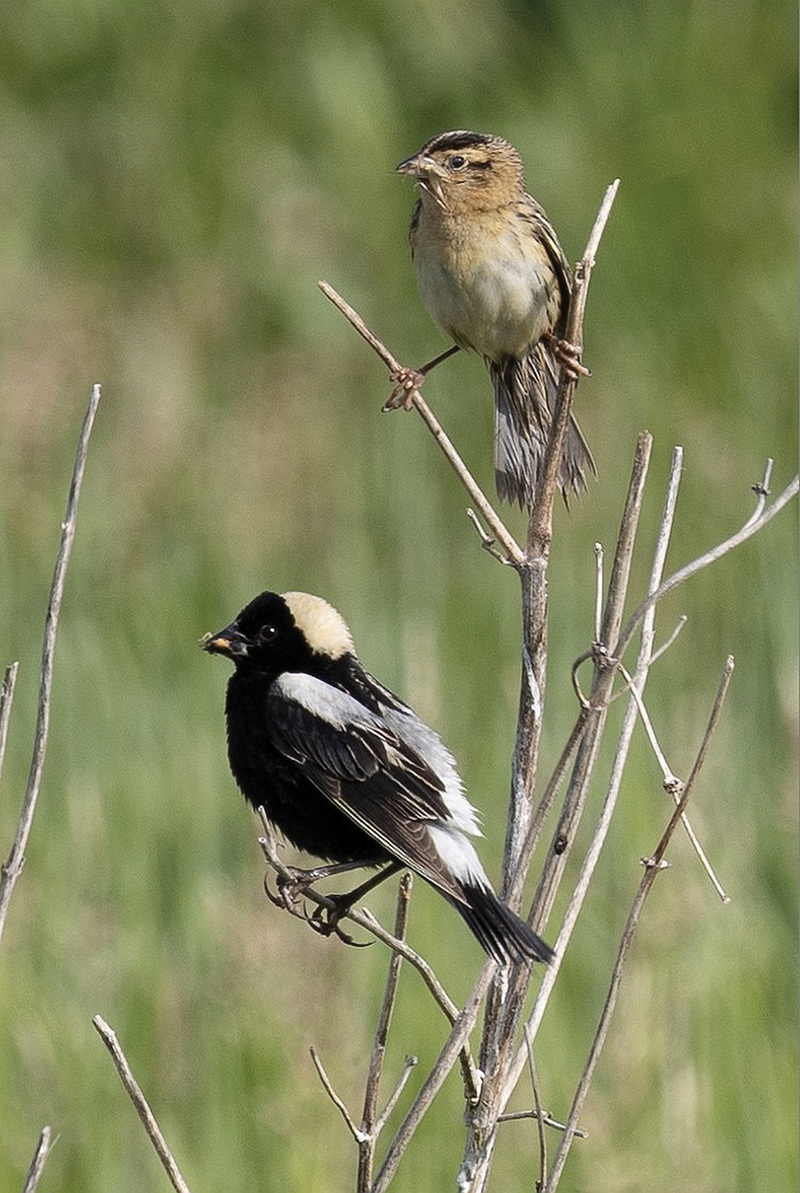
I found some perfectly dense grass to build my nest in an open field. It should take me about two days to build my comfortable, two-inch nest of grasses and sedges. In the meantime, Tux has been keeping an eye on our surroundings while gathering food. As I watch him fly, I can’t help but think that his plumage looks like a black-and-white patterned tuxedo, with a striking yellowish hood.
Later today, I am going to catch up with my friend Sandi, an Upland Sandpiper I met last year while exploring the nearby Military Ridge Prairie Heritage Area. During the breeding season, Sandi lives at Barneveld Prairie, which is only a few wingbeats away to the northwest. Her home is owned and managed by The Nature Conservancy. She, too, is busy finding a good place in the grasslands to nest and will migrate back to Argentina with us Bobolinks at the end of the summer.
Day 45: Nesting and listening to the land
It’s the end of May now, and while discreetly incubating my five purple-speckled eggs, I’ve had the advantage of overhearing human conversation about the work being done to protect habitats like mine. I now understand that conserving the grasslands of this region is no small feat. One of the challenges to achieving landscape-scale grassland conservation is the land being fragmented. Ninety-five percent of the land in the Southern Driftless region is privately owned, and most of it is divided into small parcels ranging from twenty to 300 acres. Managing land takes a coordinated effort from everyone—conservation organizations, governmental organizations, private sector contractors, and private landowners—to help protect these vital grassland ecosystems.
Apparently, there has been an array of conservation partnerships in the region over the past few decades. The Wisconsin Department of Natural Resources and the Natural Resources Foundation of Wisconsin have identified the Southern Driftless as an ecologically important region to conserve. Groups like the Blue Mounds Area Project, Pheasants Forever, the U.S. Fish and Wildlife Service, and various county conservation departments are helping to connect landowners with resources to manage their land.
Organizations like The Prairie Enthusiasts and The Nature Conservancy are also playing their part by owning and managing some of the parcels that have vital grasslands on them, and land trusts like the Driftless Area Land Conservancy are working with landowners who want to protect their properties forever through land easements. There are even special avian focused groups, such as the Southern Wisconsin Bird Alliance, the Wisconsin Bird Conservation Partnership, and the American Bird Conservancy, that are looking out for birds like Sandi, Tux, and me.
Hearing about all of this work, I feel grateful for all of these groups and individuals who have contributed to the achievements thus far. However, I recognize that there is still more work to be done to make sure the eggs I am incubating today will have grasslands to return to in the future.
Day 60: A new generation
Good news! It’s June 14, and my five eggs have hatched! Tux and I have been busy caring for our young. Even though Tux provides food for other nests in addition to mine, our chicks are putting on weight and are looking healthier every day. In a week and a half or so, they will have fledged and will be ready for flying lessons, my favorite part of raising our chicks. I already talked with a couple of other Bobolinks teaching their young to fly, some of which chose to nest on private lands this year.
Through conversation with my fellow Bobolinks, I am identifying more and more private landowners who are recognizing the importance of grasslands and are deciding to take steps to restore their land on their own. Some humans have beautiful grasslands which they use to produce hay for rotational grazing, and they are making sure not to disturb our nests from May 15 to July 1. We are very appreciative of these new bird-friendly haying and grazing practices. I hope this trend continues to grow, as it might help Bobolinks move away from being a “tipping point species.”
The other day, as our first egg was hatching, we overheard humans from a group called Pheasants Forever talking about how they are training landowners to administer prescribed fires on their own property through a series of workshops and teachable burns. They mentioned that using prescribed fire may turn the brushy sections of their land into the open prairies they once were. Maybe someday, one of those private landowners’ restored grasslands will be the place one of my chicks chooses to nest when they reach my age. That’s a nice thought.
Day 110: Preparing for Argentina with hope for the future
It’s early August and all of our chicks can fly, meaning it’s time to set our sights on Argentina. The Southern Driftless region has been a great home for us, but the cycle of migration continues. As we get ready to leave this special place, I reflect on what I have learned this year through listening to Tux, my other grassland friends, and respective humans as they passed the nest. It’s clear that continued pressures from land-use change, lack of resources for land management, and the fragmentation of land parcels have made it difficult to achieve landscape-scale grassland conservation needed to protect grassland bird populations. But there are multiple efforts from different groups of people and private landowners who are working on our behalf to help restore this land to the open oak savannas and grasslands that once spanned the landscape here.
For these efforts, my friends and I are truly grateful. I’m hopeful that efforts like these will continue so my young, and their young, will be able to find safe places to nest in the future. But for now, it is time again to warm up these muscles and prepare for our long journey south.
See you next year, Wisconsin!

Interested in visiting the places where Bobbi, Tux, and Sandi call home? The Schuch-Thomson Prairie and Barneveld Prairie are in southwestern Wisconsin, a forty-minute drive from Madison.
Southern Driftless Grasslands (SDG) is a dynamic partnership of public and private organizations working together to actively support the conservation of grasslands in Southwest Wisconsin to benefit the region’s wildlife, water, farms, and communities. Partners envision Southwestern Wisconsin to be a place rich with healthy grasslands, successful working farms, clear flowing streams, diverse wildlife, and people who value and enjoy this landscape. To learn more about how SDG partners are helping to restore grasslands for birds like Bobbi, please visit DriftlessGrasslands.org.
Editor’s Note: The bird footprint used as Bobbi the Bobolink’s signature was generated using OpenAI’s ChatGPT.