
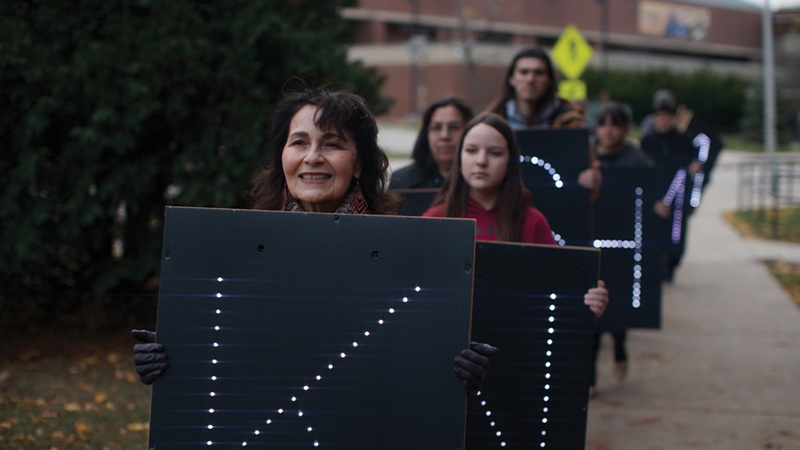
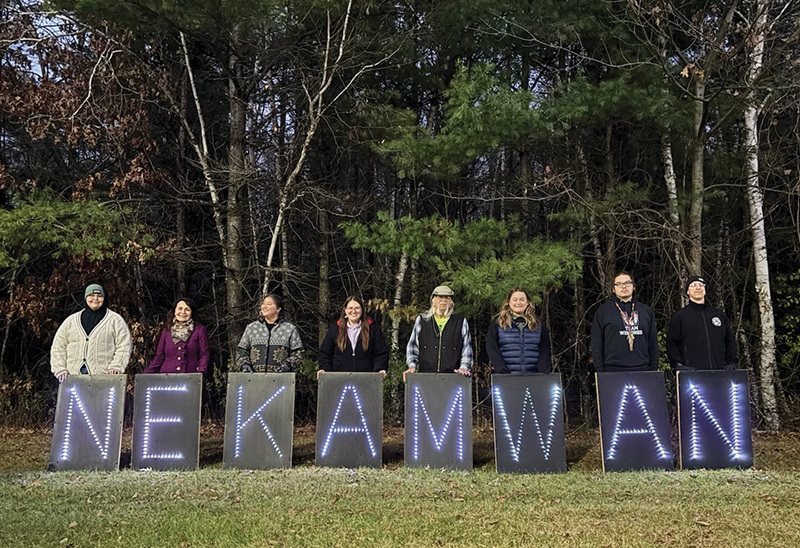
We rolled into the College of Menominee Nation in Keshena on a Friday night, as the setting sun broke through the clouds and cast the campus in peaceful purple and grey light. I saw artists Lane Hall and Dusan Harminc of the Overpass Light Brigade setting up illuminated letters beneath a small stand of hemlock trees to create a vividly illuminated poem-video with words in the Menominee and Mahican languages. Community members from the Menominee, Oneida, and Stockbridge-Munsee Mohican reservations slowly gathered around the neon-blue letters, curious about how they would come together to form words.
Waewaenen. Menominee, thank you. Neka:mwan. Mahican, song.
We walked down a wooded path to a firepit, where we all were assigned letters to hold for the film. I held a W next to Menominee elder Dale Kakkak, who told me about his time as a reporter for The Circle news in the Twin Cities, which I now call home. Together we spelled the word Neka:mwan, the Mohican word for song. An elder once told me that the land misses our Indigenous languages, and so to speak it out loud whenever we can. “Nagamon,” I whispered, the word for song in Anishinaabemowin.
I was there to help facilitate the first #LanguageBack poetry workshop with Dr. Kimberly Blaeser and language keepers Brock Schreiber (Mahican) and Richard Oshkeshequoam (Menominee). As an Anishinaabemowin language learner at the very infancy, if not embryonic stage, of my language-learning journey, I was intimidated to be trusted with this responsibility. Who was I, an Ojibwe poet who writes mostly in English, to come onto Menominee land with my humble handful of words playing the role of teacher? But as we gathered under the setting sun, college students and elders, mothers and daughters with flannel jackets layered over gorgeous ribbon skirts, I realized that we had all come just exactly as we were, joking and sharing words with each other, opening like milkweed pods to reveal our most tender selves.
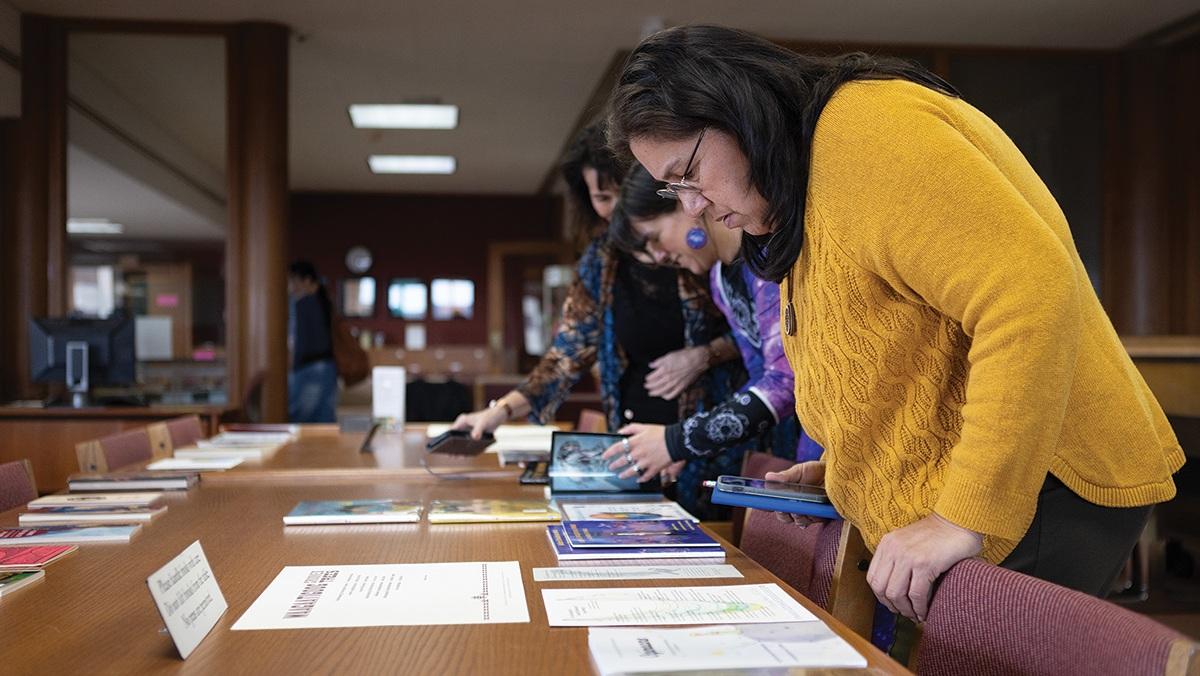
The next morning, the workshop began with a keynote speech by Blaeser, who founded Indigenous Nations Poets (In-Na-Po) and received pilot funding from Wisconsin Humanities to facilitate the first two #LanguageBack workshops, including the first one at the College of Menominee Nation. A second workshop would be held a few weeks later, at the University of Wisconsin, and include language keepers Rosa King (Oneida), and Kai Pyle (Anishinaabemowin).
“I need not tell you the history that lives in your bones,” Blaeser said. “We are assimilation’s children—inheritors of both beauty and heartbreak, of lands and languages linked in longstanding relationships, of land and languages stolen in an effort to destroy our relatedness.
“And though we are assimilation’s children, we are also the children and grandchildren and great grandchildren—the blood relations—of determined and triumphant survivors. Survivors who gave us stories and songs and sacred ways of being. Survivors who nourished us with laughter as well as food. Lucky us to have the privilege to carry these inheritances into our living and into our writing.”
As Blaeser spoke, the room buzzed with excitement, the urgency of protecting our languages swelling in our hearts. “Warrior” and “Poet” aren’t often adjectives associated with each other (although Audre Lorde and Joy Harjo’s respective memoirs, Warrior Poet and Poet Warrior, would beg to differ). But in the room that day, we each became a warrior poet for our languages and nations.
Nervous to follow up Blaeser’s irresistible energy, I led the group through some of the basic elements of poetry, metaphor, rhythm, and form/shape, encouraging them to write an ekphrastic poem—a poem inspired by the visual arts—about art from their community, whether that be a bandolier bag or a painting or a quilt, thinking of our Indigenous languages as life we can breathe into this art to help it come to life.
After our quick introduction to poetry, Schreiber and Oshkeshequoam took the reins, writing words in Menominee and Mahican on the white board and showing us all the ways the languages intersected and diverged. Ketāpānen, the word for “I love you” in Menominee, was Kta’Wãanin in Mahican. The words for “house” were Wekiam and Weekwam, similar to the Anishinaabemowin wigwam. I could feel the ideas for poems swirling in the air, the sound of swift pencils filling the room. Sitting back and taking it all in, I was amazed at how well this curriculum was working on its very first try. I couldn’t believe that I was now part of something so important and necessary in our language-wounded world. That my own relationship to language was healing, too.
My grandfather, Dennis Howes, enrolled Fond du Lac Ojibwe, spoke Anishinaabemowin and taught in the Superior School District’s Indian Education program. The first word he taught my mother was makwa, bear. When he died in my early childhood, along with my uncle Dan, who was a powwow drummer and knowledge keeper, my connection to Ojibwe culture withered. My mother, battling mental illness and addiction, did not have the capacity to keep us connected. My siblings and I were not welcome in Indian Ed classes in the public school district, despite our grandfather having taught there, due to being documented descendants yet not official enrollees.
At Northland College in Ashland, where I got my undergraduate degree, I was surrounded by Ojibwe culture. I participated in the Native American Student Association, met luminous Native role models such as Navajo code talker Chester Nez and Dr. Robin Wall Kimmerer, and finally felt that sense of belonging I once had when my grandfather and uncle were still alive. I even had the opportunity to take Anishinaabemowin language classes at the college, taught by Bad River elder Joe Rose, but something held me back. I felt that if I struggled to learn the language, it would mean I had failed my grandfather, my uncle, my community. That it would be further proof that I didn’t belong.
Still, I held tightly onto words and phrases told to me by community elders and friends who were learning the language. I learned the phrase for coffee, Makade Mashkiki Waboo, black medicine water, along with affirmations, such as Nimashkawiizi (I have inner strength) and Inzaagichigaaz (I am loved.) I knew that holding onto these words was vital, even if I’d never be fluent in the language. At the #LanguageBack workshop, in that classroom at the College of Menominee Nation, other participants were also freely sharing words and phrases they had held onto, regardless of fluency.
I realized the power of inviting our words and phrases into the spaces we create together. Over time, phrases become sentences. Sentences become stories and poems. Maybe we need to quit demanding perfection from ourselves and release the dam our tongue becomes when we let fear and insecurity overcome our responsibility to our Indigenous languages.
After the lectures and group activities, we broke into smaller writing groups to focus on shaping our early poems. I worked in harmony with Oshkeshequoam, giving advice on crafting images and line breaks while he answered questions about the language. It was an untested kind of collaboration—we had just met that day—but we found a groove and unexpected ways in which our strengths and knowledges complemented the other. I emphasized that you could write an entire poem about a single word, that you didn’t have to be an expert in grammar to write a beautiful poem. Each word holds a world, I said. It’s the poet’s job to cast that world in their own particular light.
We finished the workshop with a public literary reading, celebrating the hard work and energy the participants had put into writing poems. It was my favorite kind of poetry reading—intergenerational, conversational, and free of the cold and professional trappings that too often get in the way of the real reason we gather for poetry: the human need for connection. For some, it was their first time ever sharing their poetry out loud. To gather in poetry is a balm for a world where language is all too often wielded as a weapon. As Menominee, Mohican, Oneida, and Anishinaabemowin words filled the air, it was as though our ancestors were also gathered around us, listening to all the new ways we were reclaiming, and reinventing, the languages that describe our place in the world.
“If we understand language as an ancestral gift—from both our human/ tribal community or nation and arising from the nibi/water, aki/earth, noodin/air—from place, then in a reciprocal relationship through using our language we honor Anishinaabemowin or other indigenous language,” Blaeser told us. “We feed language spirits, and work to sustain the culture, to thrive as Indigenous people. This is our giving back; it is our responsibility.”
Poetry, like language, is a creature of relation. Every poem has its ancestors and future descendants, and when I think about the poems written that dreamy November weekend, I wonder what future poems they’ll inspire, what seeds of language are planted in each stanza and line. The #LanguageBack initiative isn’t just about preserving our past. It’s about taking an active role in shaping the direction of our Indigenous futures and creating a reality where our languages and communities create, nourish, and thrive.
Editor’s Note: You can watch a short film about the #LanguageBack workshop at https://www.youtube.com/watch?v=KD6uDo9B3Ao
All Photos Courtesy of Kim Blaeser