
I go by Hortense. At group, last names don’t come up. It’s not officially anonymous, but there is a sense of confidentiality. Unspoken, but understood.
The rules are few. No one has to share. But when someone does share, group members may offer no criticism and no advice. That leaves very little to be said.
The stories are not all the same, but they do follow a pattern. The typical start: My spouse died and I am very sad. How unfair it was for my loved one to have died. Yet my friends and family tell me it is time for me to move on, to get over it, get on with it. How can they think such a thing? How can they say such a thing?
Around the table the others murmur: We are so sorry. We are so sorry that happened. So sad, so sorry. It is terrible that your friends and family told you it was time to get over it and move on. They do not know. That never should have been said. Thank you for sharing.
This is pretty much how it goes at Thursday night drop-in spousal loss support group.
The group meets in a conference room in a medical building in an office park off the expressway. The space is studiedly neutral, with light blue walls, oak trim, a long oval conference table with rolling chairs and Kleenex boxes arranged discreetly. There is one inspirational poster: For each storm cloud—a rainbow … for each shadow—the sun. Ralph Waldo Emerson. The carpeting is newish, a plush blue and gray crosshatch that never quite resolves into plaid.
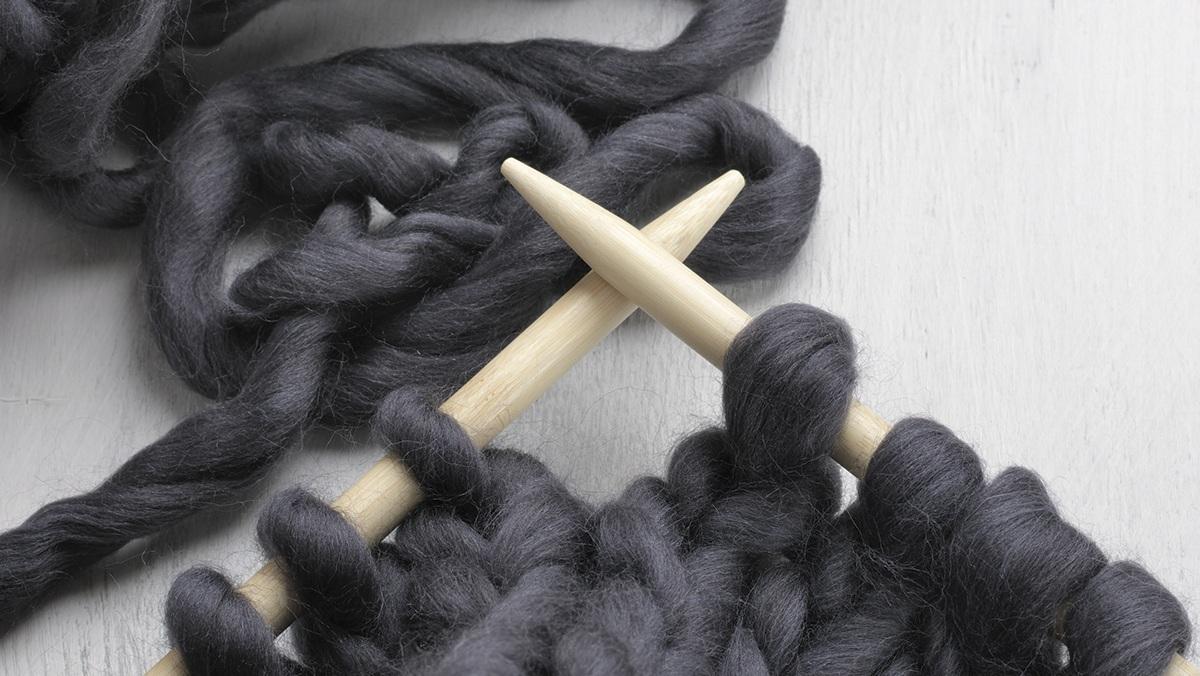
After the facilitator explains the rules, he or she asks, Would someone like to begin? and before the first voice, there is immense, unbearable silence. The whoosh of a fan unit or the hollow clack clack of the cleaner’s cart moving down the hall might filter in. Sometimes actual minutes tick by. I knit. It is something to hang onto as we wait for that first voice to disturb the emptiness.
Well, I’ll start, someone will finally say.
In the beginning, I came to group because I thought I could explain what I felt, if it was to people who already understood what it was that I was trying to say. And I thought they could tell me what I needed to do to stop needing to explain.
Never once have I been the one to say I’ll start. At first I hesitated to share at all, because I thought the depth of my loss, the level of the unfairness of my husband’s death, would make the others feel embarrassed at their own losses, a bit ashamed to think that they had been so distraught over straightforward bereavement.
But that was not how it went and that is not how it goes. Around the table, each loss is always shattering in its own way.
Finally one Thursday I attempted the simplest share: I’m so sad. Then I began to sob, and the voices around the table murmured: Sorry, we are so sorry, Hortense.
As weeks went on, I tried sharing more. Like that my children, who tell me that I should get over it and move on, are my two boys from my first marriage, the husband from which is still alive, the perennially unemployed, non-child-support-paying, ex-husband and father.
We are sorry the perennially unemployed non-child-support-paying ex-husband and father is still alive.
And that our two daughters, who are from my second husband’s first marriage, don’t tell me anything, because all communication with them has ceased now that they have their share of the estate, and most of the furniture, because it had been his mother’s and the girls were sentimentally attached.
We are sorry they have ceased all communication and taken the furniture.
I thought of the girls as my own children. I live with my husband and our four children, I wrote on my “about” entry for my 25th high-school reunion the year after we got married, even though his daughters stayed with us only during the summer and I am not sure who would care, but one does have to say something. And one misbehaving golden retriever!
Every summer, when our daughters would come to us, I would open my heart and my home to them, but they stared at me like I was speaking to them in a foreign language or was of a different species. We went camping, sang songs around the campfire, rode bikes in the campground loop. But it turns out that no one enjoyed the family camping trips except me, and that if my husband had still been married to his first wife, trips with that intact family unit would have been to such destinations as London or Paris, financed by my now-late mother-in-law. We went camping because our trips needed to include my boys and trips for them were not going to be financed by my now-late mother-in-law.
We are sorry that your now-late mother-in-law did not think of you as family but instead as a poor choice made by her son.
I had looked forward to the long sunny days of those summers, the soccer games and children’s theater performances, set to the jangling distant music of the ice cream truck that seemed always to be on the verge of arriving at our house but never actually appeared on our block. That is what I’d lived for!
We are sorry about the ice cream truck never showing up and the rest of it too, but perhaps you have strayed too far from the matter at hand.
“Sharing more” is for one-on-one counseling sessions. This may be gently suggested by the facilitator in an aside after group. After my first private session with the grief counselor, who had a voice soft as a handkerchief and the soulful eyes and general demeanor of the actor Mark Ruffalo, I began to wonder if there was something wrong with the way I was grieving and also something wrong with the way I was trying to stop grieving.
“I feel like I’m doing it wrong,” I told him.
“You’re perfectly fine,” said Mark Ruffalo. “What did your husband die of?” He asked gently, because I’d never said.
“He shut down,” I told him, and I could see that Mark Ruffalo was computing this in his head as a possible he took his own life, but I could not say the three cruel letters of his disease. Even though on the face of it, those three neutral syllables meant nothing. Yet words that did mean something, words like, My late husband was the sweetest man on earth, were also words that I could not bring myself to say.
“He didn’t kill himself,” I told Mark Ruffalo, and I could see him swiftly shifting his script to For death undetermined.
“Have you tried writing about it? Keeping a journal?”
“I’m more of a knitter. Than a writer.”
“What about writing down how you feel when you wake up in the morning and how you feel when you go to bed at night and see how those emotions stack up?”
I couldn’t see how a stack of emotions would be of any help, but dutifully, I started keeping track of how I felt when I woke up and how I felt before I went to sleep. Empty, read the notations from each morning. Exhausted, read the notations from each evening.
When I returned for my follow-up session, Mark Ruffalo asked me how I was doing. “Empty,” I said. “Exhausted.” I’d brought the notebook; I had the evidence.
But he just said, “You’re doing fine.”
“If I was fine, I wouldn’t be here. I feel like I should actively be doing something to feel better, like taking a class or joining a bird-watching group. But I don’t want to leave my house.”
“Don’t be afraid to say ‘no,’” said Mark Ruffalo.
No to whom? There wasn’t anyone telling me what to do. I was the one.
I kept going to group. It was something to do to make myself feel like I was doing something.
I began to wonder if I was one of the grief junkies, their grief itself the only energy left to propel them through each day. Drop-in sessions always attracted at least one grief junkie. It got so I could pick them out each week. Not like it was hard.
Grief junkies were never reluctant to share; they transformed, like actors, when their turn came. They were listless while enduring others’ stories, energized by their own. I couldn’t help but sense that they saw grief as a competition; who was going to win? Although what would constitute winning? Doing the most grieving, or being the most efficient at moving through it?
I thought it should be that: efficiently parceling out the actions that could help you move on. But I think it was the sheer accumulation of pain they needed.
Not that it was a competition.
There was an older woman who had lost her husband three years earlier. Most of the group members were much younger than she, individuals who had not expected to lose their spouses so early. In group the unspoken theory went that after a certain age you could expect to lose a spouse and so perhaps you should not be extracting support from those of us who might have reasonably assumed we would have our spouse with us for a few more decades. But the woman was wracked with guilt, feeling—needing, somehow, to feel—that she had been the one to kill him by forgetting to buy ice-melt pellets, and hence, when he slipped and fell on the ice in front of their house and broke a hip, which introduced his fast decline, it was all her fault. Her story was sad enough, but her focus on herself as the guilty party after a few sessions became difficult to cope with.
If only she had remembered to buy the ice melt.
We are sorry, so unimaginably sorry, that you did not remember to buy the ice melt.
Another woman had lost her wife quite young, when they were both in their forties, so in that sense she was one of us. But her stories always centered on every navy-blue Jetta she saw in traffic, which indicated that her loved one was trying to contact her from the beyond. It was an average, daily situation in which a message was hidden, and I found that hard to take. Once you started traveling down that road, the world was one of those books they made you read in English class, with symbols and foreshadowing, the kind I had never liked.
At times like these, it was easier to just be sorry.
We are so sorry you keep seeing navy-blue Jettas just like your late wife’s car in front of you at stop lights, and also sorry, secretly, that you think it is a sign, although if a sign, a sign of what?
There was a man I started to recognize. Mostly the drop-in nights were for sorrow transients, the newly bereaved who soon figured out how to move on, or discovered that they didn’t like sharing, or hearing what others shared, or that the group had no wisdom to offer, although of course that was by design, as wisdom was too close to advice and advice was off limits, and who did not need a table full of strangers to be sorry about how bad they were feeling. Like me, this man came regularly, and sat quietly. He listened to others intently, murmured his sorries with sincerity, yet said little himself. Something brief, like I was feeling low and wanted to come be with others, he might say, or just I am glad to be here. He never even said who he had lost, a husband or a wife, although I suspected it was a wife. He did not call attention to himself, but I began to wonder if he was a grief junkie all the same.
One night, the conversation finally came around to the quiet man. I was knitting, long boring rounds of stockinette in a sweater body.
The man’s sigh was mountainous. “You know I’ve been coming here for some time,” he began. He ran his fingers through his tangled hair. I continued throwing the yarn over the needle and pulling the loop through, unconsciously, rhythmically, reassuringly.
“There used to be a woman who came to this group and cried about the loss of her husband,” he said placidly, neither leaning back in his chair nor leaning forward toward us. He said that she would cry and cry and soon the rest of the table was also crying. Her sorrow was so wide and deep the group could not even tell her how sorry they all were. There was, in the end, nothing to be said.
Then one night her turn came and she began slowly to speak. “She said that her husband had appeared to her in a dream and told her that her tears were wetting his clothing in the afterworld and had caused such discomfort and so much extra weight that he was unable to leave the waiting area and move on to heaven,” he said. “The weight was such that he was drowning in his own clothing, wet with her tears. The woman told us that when she awoke she realized that her grief was too much and she needed to move on.”
He paused and again ran his fingers through his curls.
“That’s it?” someone said.
“That’s advice,” someone else objected.
“It’s not advice, it’s an old folk tale,” a third voice chimed in.
“You know how you can tell it’s advice? You can’t say ‘I’m sorry’ after it,” said the second man.
The sad, quiet, curly-haired man stood. “I have to go now,” he said. “Perhaps I’ll see you again some day.”
And he slipped out the door as deftly as if he had never been there at all.
After the curly-haired man’s story, I began thinking about how I would like things to be. On an average day I would wake, pet the dog, shuffle off to the kitchen, make my coffee, nestle in the cushions of the breakfast nook, peruse the morning paper, dunk my biscotti in my coffee, listen to the birds sing. Then I would dress, put on my sneakers, and walk the few blocks down to Main Street to the bookstore where I would say hello to the owner. I would browse the tables of new titles, and the bookstore’s resident cat would rub against my ankles, twisting herself between my legs, purring. I would leave with a new mystery and an old book of poetry and some birthday cards, and the bookstore owner would pop a fresh bookmark into each book and wish me a good day and a good read. I’d return home to transplant several seedlings I’d been nursing into my raised bed, tomatoes and peppers, which were now ready for the warm sunshine. And then I’d curl up with the dog on the glider on the porch and begin reading the new mystery.
And when I would record my feelings in my notebook, every morning I would be able to write expectant, and every evening I would be able to write satisfied.
When, at my next session, I told Mark Ruffalo that I was going to work toward making things the way I wanted them to be—like that—he looked bewildered. “You’ve been doing this or you’re going to do this?”
“Does it matter?”
“Remember, don’t expect too much. The world isn’t that perfect.”
Don’t be afraid to say no, don’t expect too much. Mark Ruffalo’s negative imperatives were more constricting than the group’s lack of advice altogether.
“I’ll let you know,” I said.
The next day I woke up, made coffee, petted the dog. There were no biscotti. I found my notebook with its list of morning emptys and wrote, for the first time, expectant. Then on a separate sheet of paper I wrote: Grocery List. Biscotti.
I found my favorite shoes, an old pair of bright yellow trail runners, and put them on to walk downtown to the bookstore. My feet seemed too bright and kept distracting me as I walked.
I picked up a bag of chocolate biscotti at the bakery, which used up exactly the number of minutes I needed until the bookstore opened at 10 a.m.
“Can I help you find anything?” the owner of the bookstore asked. She looked the part exactly, tall, with her dark hair in a messy bun, wearing a hand-knit cardigan and flowered smock dress. The template was a new mystery and an old book of poetry, but what I said was “Do you have an encyclopedia of fairy tales?”
She led me to a small alcove near the children’s section; a placard hand-written in Old English-style letters read Faeries, Legends, Folklore and Myth.
“This is where the magic happens,” she said with a quiet smile. She studied the shelves for a moment before pulling out a thick paperback. “This might be what you need,” she said. It was called The Compendium of Folktales—and it was only volume one. I flipped to the index. Death.
There were several subcategories.
Death:
—messengers of
—of a child
—of a spouse
see also: ghosts
I hadn’t realized there were so many stories people told themselves to figure things out.
I flipped to the pages for “death of a spouse.” There were a number of tales from around the globe. They followed a pattern. The hen died, the rooster cried, the farmer choked, the broom swept so hard she lost her bristles, the queen danced until she collapsed and then a tree fell on the house. Somebody died and somebody else was sad and household objects went haywire and physical activity started ramping up as though someone had increased the speed on a treadmill until some act of nature brought everything to a screeching halt.
The moral of these stories didn’t seem as clear to me as the story of the tears soaking the clothing of the dead. Grief in these tales spread like a virus; frenzy leapt from one being to another to inanimate objects. Finally, nature wiped them all out.
The Compendium of Folktales fit back easily into the blank space on the shelf. I went back to the front desk of the bookstore and told the owner: “I need a good mystery and an old book of poetry.”
Back at home I curled up with the dog on the porch and started reading the new mystery. I was not used to being able to concentrate on anything except my knitting. But putting my hand on Frieda’s head calmed me and the plot of the book distracted me.
Even so, after a few pages my eyes unfocused and I tried to pull myself back, back up to the book. It wasn’t sleep, exactly, but I couldn’t I pull myself back to full waking, either. I struggled up to consciousness and tried to reengage with the plot, but I heard the sad curly-haired man call my name from the sidewalk in front of my house.
“What are you doing here?” I asked.
“Out for an evening walk. Glad to see you.”
“I liked your story.”
“I liked yours,” he said.
“I didn’t tell a story.”
“I don’t tell that story to just anyone,” he said.
Two slanting spears of headlights startled me as a car drove loudly around the corner and I jolted awake.
I looked to the sidewalk where the sad curly-haired man had been standing. But as you’ve already guessed, no one was there.
That night before bed, I opened my notebook and considered my morning designations: Empty, empty, empty, expectant.
I considered my pileup of evening sentiments: exhausted, exhausted, exhausted. The day awaited my evaluation. Exhausted, exhausted, exhausted, ______. There wasn’t a place within me from which I could pull my goal of satisfied.
Then I realized it was Thursday night and I’d forgotten about going to grief group. I thought about what I might have missed, and that blank I could easily fill in.
Sorry, I finally wrote in my notebook. I am so sorry.