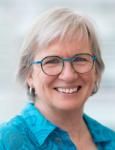

Liz Bachhuber and Jill Sebastian first met in art school in the 1970s and reconnected during the pandemic, when they embarked on a transatlantic collaboration. Based in Germany and the United States, respectively, Bachhuber and Sebastian both explore recycling and composting as metaphors for artmaking and as a way to live responsibly in two of the planet’s most powerful and environmentally ruinous consumer societies.
Arts Editor Jody Clowes spoke to each artist separately, and together, their interviews probe the global question of waste—and the follow-up that perhaps all creatives should ask themselves during this time of environmental emergency: How precious is what we create, and how can it be of service?
These interviews have been edited for length and clarity.
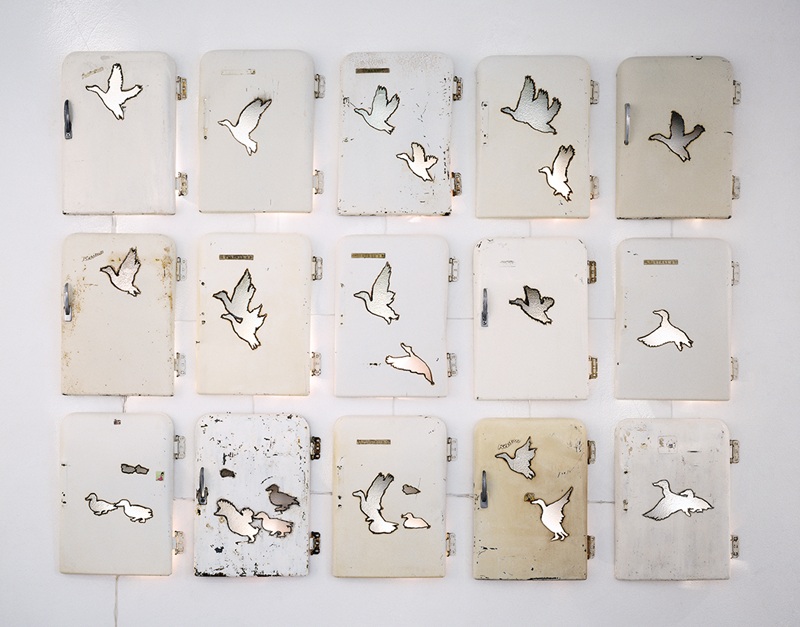
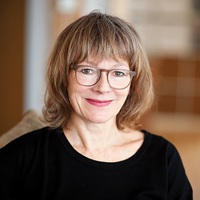 Clowes, to Liz Bachhuber (pictured, right): For your sculpture “Eisvogel (Ice Birds),” you’ve cut silhouettes of birds in flight into refrigerator doors, lit from behind in a wave that suggests movement. What inspired you to use these doors?
Bachhuber: Soon after the Berlin Wall fell, I started teaching in Weimar, and I found a great many refrigerator doors in the bulk refuse. People from the German Democratic Republic had kept their appliances in use for a long time, because there was a material scarcity. The refrigerators had been painted over, they had stickers and a patina. When the wall fell, people realized they could replace the old things with a new West German or Japanese model. And they removed the refrigerator doors so children wouldn’t climb in and suffocate. I started to collect them. That’s my way of working, I just pick things up based on my history or my interests. I see them in an archeological sense, as remnants of a lost culture.
C: Birds and nests are a longstanding motif in your work—hawks, geese, crows, swans, even flamingoes. Which birds are represented in “Eisvogel”?
B: Canadian geese. I remember driving up to Horicon Marsh with my parents to see them when I was a child. We were in awe. The geese used to pause there during their migratory process and then move on. Now I’m interested in the change that happened since: they don’t leave anymore and become a kind of pest when they clear a farmer’s field in half a day.
My work is about our culture’s intervention into natural cycles. We’re part of nature, and what we’re doing is often self-destructive. In northern Wisconsin when I was growing up, people would dump their garbage in a pit. When I made this piece in 1998, it was more about consumer culture and illegal dumping, the transition of trash into nature.
My father was a bird watcher, and I’m very interested in observing birds. I have a special feeling about their pragmatism and ability to adapt to a new situation. It’s almost like a self-portrait, too. I migrated, and I’m making the best of the situation that I’m in. That’s how the theme of nest-building began. I thought, I’m an artist traveling around a lot. Have I forgotten the art of building a home, like, where is my maternal instinct? Is it buried in me?
C: You were born in Milwaukee and studied at UW–Milwaukee. Then in 1979 you received a Fulbright grant to study at the Kunstakademie Dusseldorf, and you lived in New York City in the late 1980s before accepting a position at Bauhaus-University Weimar in 1993, shortly after German reunification. What inspired you to move to Germany in 1979 and then to return there during such a fraught time?
B: I knew that I wanted to study in Europe because of my interest in European painting, and the University of Wisconsin’s German Departments had the first publication of East German authors into English, so I got very interested also in the German Democratic Republic. At the Kunstakademie I was focused on public art, architecture, installation, and interactions in the public realm. After the wall fell, they looked for people with curiosity and a willingness to think, ‘okay, we can build something new, we don’t have to take on old structures.’ I took the idea seriously that, after having been behind the Iron Curtain for nearly 30 years, there needed to be [meaningful] international exchange in the GDR. I got really active in setting up exchange programs. It was a tremendous opening, and I was so happy to be part of that. That kind of international collaboration and connection is just so critical, especially in the arts.
C: You’ve engaged in several interfaculty collaborations between art and environmental engineering at the Bauhaus-University. Can you share a story about that?
B: I study garbage, I love found objects because of their archeological and narrative quality. A used object is much more interesting to me than a new one, because the scratches and wear tell a story. And as a sculptor, I respect the material and try to use it wisely. An environmental engineering instructor teaching waste management approached me and said, ‘why don’t we do a project together, artists and engineers?’ We worked with a large waste management company in Germany, and they had a budget for an exhibition inviting young artists to work with recycled and found material. We went on excursions together, first to Bangladesh and then to the Tijuana and San Diego border with environmental engineers, artists, and architects. We looked for solutions to real-world problems from our different disciplinary perspectives.
Since I started working with the engineers, I respect and understand materials more. As a matter of fact, during the last few years, I stopped building work to store: I rent or choose the recycled materials that I need in order to build an installation, and at the end everything gets recycled back into the system. I have great documentary photos and maybe a video of the process. I’m trying to work material-based without wasting resources.
C: How did you decide to use the surgical instruments in “Snowflakes?”
B: I was invited to do an exhibition in Tuttlingen in the Black Forest, the home of several world-class producers of precision surgical instruments. I was given boxes and boxes of seconds, the surgical instruments that have to be melted down to make new instruments because of little imperfections. My father was a surgeon, and we didn't have any normal scissors in our house, so there’s also a personal aspect to my attraction to these instruments.
I laid out patterning with the scissors on the wooden floor in a temporary installation that was like an oriental carpet, very intricate. After the exhibition ended, I asked if I could keep some of the surgical instruments, and then I had the idea that these patterns are like snowflakes, each one unique. I did the layout, and a friend welded the stainless steel. Now I have an installation that’s flexible, I’m able to work with the space in every new situation, which is the way I love to work. I think my work is associative. In the moment I’m making it, it’s intuitive. I’m just letting it happen. I get into the studio, I’ve got the stuff, and I have these ideas, and I begin to play with material until something happens.
C: What’s happening in your studio now?
B: I am working on an installation inspired by the lake near Eagle River, Wisconsin. When I was a child, we were up there every summer. There were open garbage dumps where you could go watch the bears, and in winter people used to take their bulky refuse to the lake, weigh it down with chains and stones, and in springtime it would break through the ice, and the people used to say, well, that's so the fish have a place to breed at the bottom of the lake. This was what I grew up believing.
I have some walleye and northern pike cast in plaster that I’ve used in several installations. I'm cutting them in half and integrating them with diverse plastic bottles, and they’re very odd and abstract. It will be a school of fish hanging from the ceiling, and on the floor below I’m making coral and aquatic plant forms in ceramic. I’m studying coral reefs and the effect that climate change is having on the ocean. I mean, it’s kind of a dystopian vision. Trying to find ways out of that dystopia, visualizing it—I don't know what else to do. I don't want to moralize, I’m trying to find humor and poetry in my work. It’s a balancing act. I don't know if I’m succeeding, but I have to try, you know? It’s my way of communicating my angst.

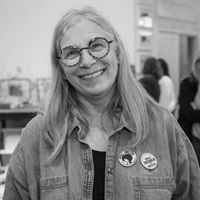 Clowes, to Jill Sebastian (pictured, left): Tell me about reconnecting with Liz Bachhuber for the collaborative piece, “Eat My Words,” and this exhibition. You met in graduate school, correct?
Sebastian: We studied with some of the same people and were in touch over the years. When I retired, the first thing I did was to visit Liz in Germany and it happened to coincide with her retrospective show. All of a sudden, I got a lot of Liz all at once. It was like we were on the same wavelength. I’ve worked with dancers and writers, and my public art is naturally very collaborative, but Liz is the first visual artist I’ve collaborated with. Liz and I have always used found objects and recycled them. We started by writing letters and trying to find common ground. She was composting her notes from her years of teaching; that was her way of making that separation. And I have been a composter for forty years. In fact, I think gardening is an excuse for me to compost! So the first round of paper that went into the worm composting box were our letters and scraps from the studio. Liz stayed with me in Milwaukee to build the clay pieces and at the same time, I was building the structure in my studio.
C: It seems that gardening is really intertwined with your art practice.
S: I've been gardening since I was five, so I don't look at gardening as a hobby, I look at it like washing the dishes. And my relationships with garden plants and weeds are pretty much the same; I don't have a hierarchy of which one I value more. In my work, I've always looked for gesture and liveliness, and all my subjects are around me. A good friend of mine, the filmmaker James Benning, said to me, “There is no difference between your life and your art. It's just always part of it.” I'm very much an urban dweller, very involved with community issues and, through public art, with the texture of the city and how we live together. My community, the neighborhood, the gardens, the city at large, are all aspects of how we are on this planet. I'm very engaged with that question of how we live.
C: For “My Garden,” which presents stacks of paper made from your garden plants, the transformation process is the heart of the piece. Do you feel moved to use these papers, or is creating the paper an end in itself?
S: One of the things that fascinates me is that a piece of paper is like the universe, like anything can happen there. But you have to go through that door of the paper.
I don't see myself as a papermaker, and I don’t have a reason to make paper to make other art. But that question is pretty central to my art in general. There is this philosophical tension. So the paper in this piece is a portrait of my garden, but it's also actually my garden because I took all the refuse from every plant at the end of the season to make it. The paper is the plants, but it's also paper, and it’s also a work of art.
The piles of papers depended on how the fibers responded to that transformation, plus the sheer quantity of refuse. For the radishes, I had to really work to get at least one piece of paper. But I have a lot of red fountain grass, so that pile is pretty high. It becomes a quantitative portrait at the same time. And I liked the idea of folding the paper into a cup as an alternative to mass produced ones. But I have not felt the urge to draw on the paper.
C: You’ve also made two pieces, “Wasteland: Weed Stories” and “Fourth Nature,” that essentially catalogue the entire plant population from an abandoned factory in Milwaukee.
S: I was a senior resident artist at Redline Studio right next to that building. It still hasn’t been torn down. It’s in terrible shape. And as a public artist, I’ve researched Milwaukee’s history along with my students, so I knew that Increase Lapham’s farm was right there. When you look at a site that textured and overgrown, you don’t see the individual plants. You just think, what a mess. I wanted to really see what's there, and I learned that Lapham, the founder of the Wisconsin State Herbarium, had documented plants there. I thought, okay, this area has changed a lot in 150 years, I wonder if there are any plants that just keep coming back. Seventeen of them were plants that came back.
For those of us who live in the city, our relationship to nature is to treat it like it’s someplace else, like it’s out there past the city border. But it isn’t. It’s right here. Part of that, to me, is to understand that dirt isn’t just nothing, you know, it’s soil. These plants can prosper in two inches of compost, soil that they made themselves. Nature is just undeniable.
C: You’re best known as a public artist. Do you have a favorite public art project?
S: My favorite public project is my least known one. It’s in Milwaukee, called Vliet Street Commons. I had some real adventures in concrete while building this thing. A group of block clubs came together and said, we don’t have any place to meet, and we have this weedy patch of grass. Could we have public art there? They went door to door collecting money, and they raised $150,000 by washing cars and holding raffles and an art auction and eventually inspiring larger donations. It’s my favorite in that it was a groundswell; we built it like a barn raising, people came and helped plant the plants and stuff like that. This is an instance where I know [the work] is going to outlive me. People care about it.
C: Is your current work also related to weeds and the urban landscape?
S: I am writing another book; it’s on house plants, but from a political point of view. It’s connected to my ongoing concern with fair housing and the unhoused. To me, weeds are a metaphor for what’s not wanted. People who are unhoused aren't wanted and immigrants are not wanted. Weeds are just as good a plant as any other, but they’re just not wanted. That’s the question of housing and house plants that I’m exploring: what’s wanted and what’s not wanted.