
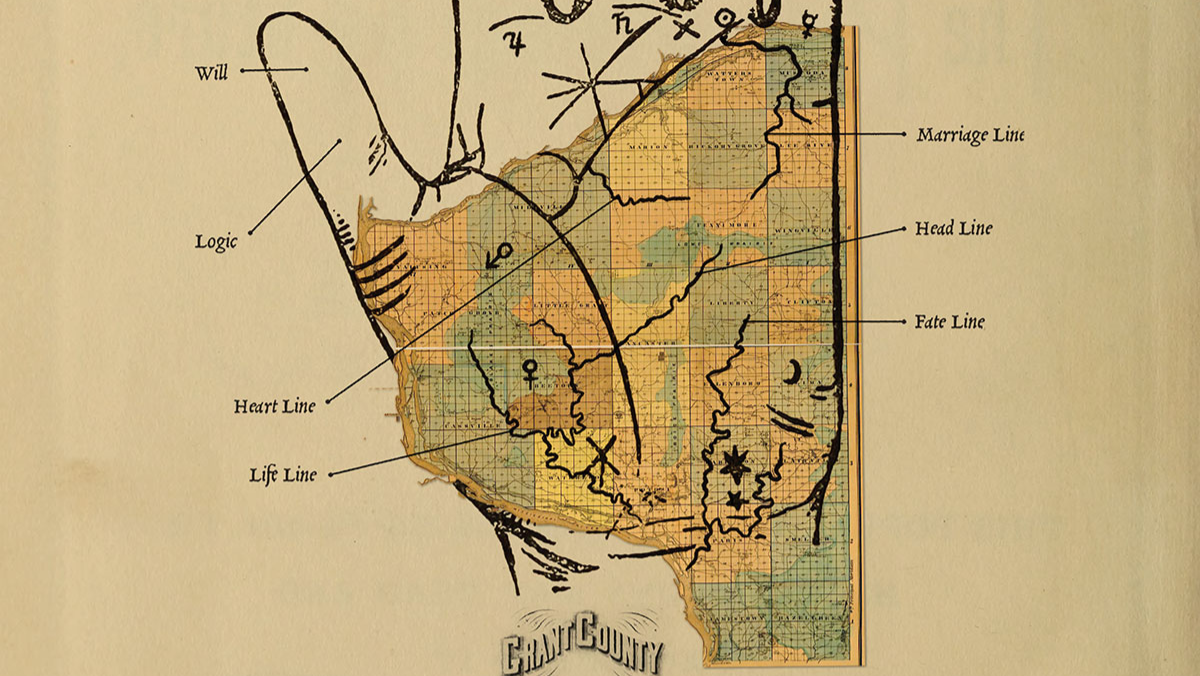
Beneath the heel pad of Wisconsin’s open palm (kitty-corner its frostbitten thumb) the bluffs of Dubuque clasp the cuff of Illinois with a rail bridge that pivots like a toggle. This has nothing to do with us: the ships that slip through that Mississippi turnstile are too wide for our rivers or creeks; and our depots are all private residences now, or farm sheds and kiosk museums. It’s Norwegian of me to begin by noting the industry of others.
I first learned of Janteloven (the law of Jante) when a marriage counselor asked which of my ancestors had emigrated from Norway. Why would he assume one had? I’m dark-haired and ruddy with nondescript cheekbones and rarely, if ever, drink coffee. “You deflect your husband’s compliments,” he said, “and respond with self-denigration.” I considered this, though I’d never felt Norwegian, and determined he must be right: my humility was overly robust, my modesty far too showy. I should tone it down. To save my marriage. And end this surly bickering.
It would be years before I puzzled out the spelling of yantah-lohven and read the unspoken code of conduct, but in a coincidence that felt like intention I saw it enacted that night.
The Holiday Folk Fair was underway in Milwaukee and Sherman Middle School was handing out tickets. Ask our children, or their neighborhood friends, and they’ll remember my husband pushing the whip down I-95 to bypass that field trip bus. Everyone knew that car, a rusted gold beast whose passenger door screeched when the hand reaching through a cranked down window lifted its latch from outside. The hooptie, neighbors called it, climbing inside it — and those who never needed or asked for a ride: that hooptie, they said, shaking their heads. When its muffler detached, with sparks and a hullabaloo of alarm, my husband stood with his hand held out, mine snaked inside my shirt, and he reattached our muffler with my bra.
The thin fabric glued to its ceiling had been droopy and loose for some time. In the wind of an open highway, it ballooned. Each time we pressed it back up it stretched and fought back. Kids on the bus, spying us trawling beside them, shot single-fingered fists out open windows. Ours would have done the same but for the struggle of hand-cranks and being battered by a shroud. Instead, a pantomime war broke out: kids pointing down at us, faux-thrashing hysteria, mine leaning back, hands behind their heads, play-acting luxury.
He took his sweet time, my husband, before pressing his foot on the gas. He understood that waving demurely, as if atop a convertible or tissue paper float, meant my heart was airborne. If this were a movie, it would be silent as my farmgirl childhood, but with intertitle placards:
“Look at Us!” — stuntin as if on the come up and altogether feelin ourselves.
“Look at You!” — mean mugging us like we play too much.
And all-of-us clownin all-of-us. “Fuck Jante!”
This was the culture I loved — bosses who owned rule eight — as those bus kids would, not twenty minutes later, flying by as we huddled at the shoulder watching my man wrestle lug nuts. Of course, it was jacked-up: that bald and lopsided tire, our electrified static cling hair, the stress of free tickets that might go to waste, our marriage. So we hollered back and knotted our fists, ever ready to laugh defiantly and with relief, as everyone did in the projects we called home for five-and-a-half months and thirty-one years.
Janteloven has just ten rules, in keeping with the number of commandments appropriated from the Jews, not the 95 complaints one might expect of Lutherans. Here it is, from Wikipedia:
1. You’re not to think you are anything special
2. You’re not to think you are as good as we are
3. You’re not to think you are smarter than we are
4. You’re not to convince yourself that you are better than we are
5. You’re not to think you know more than we do
6. You’re not to think you are more important than we are
7. You’re not to think you are good at anything
8. You’re not to laugh at us
9. You’re not to think anyone cares about you
10. You’re not to think you can teach us anything
Essentially, this repetitive kettle of fish boils down to the scalding bare-bones grunts of a salty German father that were only sometimes echoed, bland as Norwegian seasoning, by my mother.
They didn’t tell us not to do things but expected us to know when to knock-it-off or when we were gettin-too-big-for-our-britches and askin-for-a-lickin. Statements were met with silence or quitcher-bellyachin. These were the universals. Our Mom answered questions with questions. Why? Why do you think? Or riddles. Her favorite color was sky-blue-pink. Our Dad only jerked up his chin, rolled his eyes into boiled eggs, and rumbled: Git. Git-Git-Git. And so, I did.
At the folk fair we sat in bleachers and watched Polynesians dance — mesmerized to a stupor, levitating on lapping waves — then the Russians jutted in, bouncy blue threads of Greeks, crisp-legged Irish, feathered Kenyans. We held our breath, studying dances from India, swayed when Mexican girls waved be-ribboned skirts, and whistled because we recognized the Hmong. It was brilliant — the cascade of colorful sound beneath a waltzing light, the skittering, stomping, and swirling kaleidoscope of feet — until the Norwegians wandered in to loosely form a square. The women had bibbed aprons over their long-sleeved dresses. Men wore slacks and suspenders. Everything was gray, except shirts and aprons, every stocking in heavy black shoes. The fiddling was soft, but bright, as if jigging in a meadow, percussion the stomp and three taps of a stressed metronome. Sometimes the men took hold of their suspenders and shuffled from side to side. Sometimes the women fanned half their skirts and wobbled with a hand at the hip. I think there were muted hand clapping games, men on one knee tethered to orbiting ladies, and partner spins with clasped hands, arms held behind backs — as if drearily skating on ice — my people, I thought, are a monochrome: moving, but like a flipbook of pilgrims on Quaaludes.
At the food stalls we studied dumplings, empanadas, and wonton as if visiting a museum, then gave the children change for popcorn and root beer. What we wanted were souvenirs. I’m certain all three children chose something, though no one remembers what, and that my husband declined their kind suggestions by playfully feigning disdain. As for me, I came away with two things I have to this day. First, a pair of wooden shoes that perfectly fit my feet — practical, I told myself, cheap because they’re unpainted, but useful in the community garden, pointed at the toe for lifting fishing nets and probably muddy hoses, easier to put on than boots and solid enough for shoveling snow — an extravagance, but wasn’t I supposed to be practicing a less modest life? The lucky seventh time I stopped by that stall, the Dutchman cut the cost. By half. What I love most is the horse-hoof sound. Three decades later, I still feel like a bad ass on concrete.
The second thing was free: an impromptu demonstration of Janteloven.
I wasn’t lying when I said I liked it, the banquet-hall-sized painting suspended behind her table. She blinked a bit. Turned to look over her shoulder. Caught me staring at her embroidered vest. Ja-dat, she said, waving off mountains, a valley, its river and lake of sky, the elegant deer sipping with heads between delicate knees, still in the shadow of evergreens. Dat pitcher fell one time and the Danes hadda help us, dey got it up.
So what? How was this not a simple midwestern exchange? I would have dismissed it but for the burr in my head (deflection, denigration), that sharp grinding of gears swearing I was rude and genetically ruined. And what of their ratchet cousins: disparagement, deprecation, negation. Why would any culture append them to the self? Sure, she deflected my compliment and handed it to Denmark, but it’s not like self-effacement leads to self-erasement. I wanted to laugh it off — my psychiatric diagnosis as Norwegian — but I did wish she’d just said thank you.
At the time, I hadn’t yet read the Laws of Jante. They’re harshest as written by a tertiary crowd. Translated from the original by Eugene Gay-Tifft (1936), Janteloven is archaic English with clarifying italics: (sidenotes mine: for my hicks and homies),
1. Thou shalt not believe thou art something.(Fitcher-britches. Don’t front.)
2-7. Be loyal to the collective (Farm Co-op. Posse.) Thou shalt not believe thou art as good as we. Thou shalt not believe thou art more wise than we. Thou shalt not fancy thyself better than we. Thou shalt not believe thou knowest more than we. Thou shalt not believe thou art greater than we. Thou shalt not believe thou amountest to anything. (We have/got your back.)
8. Thou shalt not laugh at us. (Bullshit. Bullshit.)
9. Thou shalt not believe that anyone is concerned with thee.
(We minds its business.)
10. Thou shalt not believe thou canst teach us anything.
(We mind our business.)
Footnote: Janteloven is not special. See: Tall Wheat (Greece). Tall Poppies (Rome). Tall Poppy Syndrome (New Zealand and Australia). The nail that sticks up gets hammered down (Japan). Pull the jacket (Chile). Don’t put your head above ground level (Netherlands).
Reference: Sandemose, Aksel. A Fugitive Crosses His Tracks. New York, Alfred A. Knopf, 1936.
None of this is real. En flyktning krysser sitt spor (1933) is a work of fiction. Jante does not exist. If it did, it would be in Denmark. Aksel Sandemose, né Axel Nielsen, was a journalist and essayist, a sailor, a teacher, a lumberjack, and the author of a satirical novel. Granted, it has 3.61 stars on Goodreads, with 647 ratings and 56 reviews, but I wonder about any readership attracted by its Kirkus review: “A psychological study of a fantasy life, of morbidity, fears, perversions, love-hate motivation, abnormalities.” Who wants to spend time inside that?
Of course, I have. I read everything, peeling pages as if curing scurvy by slurping words.
The only books we had on the farm were the Collier’s encyclopedias and Junior Classics in a windowsill-high bookcase in the front room. I think of them as Mom’s wooden shoes. She was sad, the year we lived in the city, when the first boys were one and two and I was only three. Dad had a factory job making office supplies. After work, he had bowling buddies, card partners, and gas in the car. When a door-to-door salesman came to the door — free delivery, case included, choice of covers, monthly payments, practical for children when they start school — she said yes, to both sets, which qualified her for the bonus prize: a cardboard fireplace.
Every Christmas it was brought down from a crawl space upstairs, the box it came in a little more battered each year, while the half-life-sized fireplace remained, to my mind, pristine. The dozens and dozens of little tabs she had to fit into slots to shape those cartoonish red bricks with tools printed to one side, the black-matte mantle and white brick hearth, brown log on fire between andirons. She took such good care of all our fragile things, but never opened those books. If he could, Dad would’ve burned them in those cardboard flames. Being lazy, he called it, whenever he found me with one on my lap, sitting around doing nothing. Gawn-now, I said in my head — Git.
I first learned Dad might not be my father when Grant County finalized their divorce — the summer I turned forty-nine — months before what would have been their golden anniversary.
Jiggs the landlord sold the farm out from under him years and years before Mom kicked him out. By then, he’d amassed several junky rental houses in town — and a machine shop, where he slept in the rumble seat of a pink Model-T restored for car shows and parades.
So I’m told. I’ve never seen it.
I wonder why Sandermose changed his name. His father was Jorgen Nielsen. Aksel was born in Denmark. Only his mother, Amalie Jacobsdatter, was Norwegian. The name he chose is taken from her birthplace — Sandermosen Station. It’s closed now, but the depot is still there, a pale-yellow building that looks like a house. A hub for cultural activities, Wikipedia says, with a sculpture garden next to the tracks.
Funny how, when a secret pops out, people recover so quickly from the surprise they claim to have seen it all along. You look nothing like him, or your siblings, my husband and children said. I knew what they meant but hadn’t heard it before. Maybe because I have blonde and brown-haired brothers, brunette and red-headed sisters.
I didn’t have Dad’s down-turned eyes, but I didn’t have Mom’s hooded ones either. It’s the nose they were talking about. Mom’s falls flat with an overhang like a mushroom cap. I don’t have that. But his nose — and all the other kids have it — is everything. I think the medical term is fleshy, which means large. Think: russet potato.
My nose is like no one else’s because I changed it myself. For most of fourth grade I sat with an elbow on my desk pressing my nose against the heel of my hand. I wanted a ski slope nose like the girl in the next seat and was told it was possible by Amy March.
I don’t know how things written in books enter us and become real, but they do. An entire industry has materialized in Norway. International business professionals attend seminars on how not to transgress the invented laws of an imaginary town. Ask Scandinavia, or Finland. Everyone knows Janteloven is fictional, a satirical bastardization, but they claim it and live with it anyway. Never once, not ever, did I suspect my father was not my father.
Here in the heel pad of Wisconsin’s open palm, we’re named for what we lack. We don’t miss it — scraps of someplace else, bulldozed in and abandoned as drift. Being unglaciated means we are where we are and what we’ve always been: an ocean swarming with trilobites, mountains worn down by rain, and deep cut valleys between steep folds of earth. Did it seem to them then, breaking land above the Kickapoo, a welcome blue harbor — or green changeling fjord?