“Adam. It’s Fred Reed. When you come up for air, give me a call.”
Over the course of a decade, I received that voicemail more than 100 times. A project about history brought us together, and when he passed away last year, at age 87, it felt like I had lost a grandfather.
From Kinloch, Missouri, Fred moved to Milwaukee to find opportunities and start his life. A tall man with a powerful and gentle presence, Fred had a good job at Nordberg Manufacturing when Milwaukee’s Open Housing Marches began in 1967. Even though Fred intentionally avoided cameras to keep his participation in civil rights quiet, he was fired when he was seen in a photo participating in the marches. After, he fully devoted himself to service, first on the frontlines of the movement, then through a long career as a reformer in the public sector and stalwart in the community. Fred and other elders from Wisconsin’s Civil Rights Movement taught me about Milwaukee’s Open Housing Marches. I understand how fortunate I am to have had the authors of history as personal teachers and hope to keep their memories alive for future generations.
By 1967, Milwaukee’s industrial economy had attracted a burgeoning, prosperous Black middle class. However, as a result of racist policies and practices, Black workers and their families were squeezed into deficient housing options. Against this background, racial tensions boiled over. Milwaukee’s NAACP Youth Council led an integrated resistance movement, led by young Black activists and advised by a white Catholic priest named Father Groppi. They were also joined by Commandos, a group that formed as the muscle of the movement. Like many of his brothers in the movement, Fred Reed became a Commando because he was called to duty, especially to defend the children of the Youth Council from harm. A man of faith, Fred Reed lived his prayers in the world.
He and thousands of marchers took to the streets repeatedly and consistently in support of the resolution for open housing proposed by their alderwoman, Vel Phillips. Milwaukee’s youth-led fair housing movement bent the city’s norms and got the nation’s attention. Dr. Martin Luther King Jr. deeply admired Milwaukee’s movement, which he described in a telegram as the “middle ground between riots and sentimental and timid supplications for justice.” The demand in City Hall was for fair, unbiased access to housing, but it took 200 consecutive days of protest and the assassination of King for that call to be heeded. Milwaukee’s housing advocacy helped shape the US Civil Rights Act of 1968, also known as the Fair Housing Act. Six years after it was first proposed by Alderwoman Phillips, the Milwaukee Common Council approved a desegregation law for city housing policy.
Despite a dramatic storyline and a marathon effort, Milwaukee’s Open Housing Marches are now something of a deep cut in America’s Civil Rights canon. Though the names Father Groppi and Vel Phillips garner some recognition around Wisconsin, other details of the fight for fair housing have slipped between the cracks in the streets and neighborhoods where the story unfolded.
Thus, Fred and others from the movement spent their later years making sure that Milwaukee’s Open Housing Marches would be memorialized for the next generation. In 2016, I was an enthusiastic student of my city’s history. Reed welcomed me to the 50th anniversary commemoration and took me under his wing through the years. Eventually, I co-chaired an effort that became March On, Milwaukee: 200 Nights of Freedom.
Resurrecting history that has been largely cast aside is delicate task, especially when one wants to collaborate with the history-makers whose voices have been ommited from the official narrative. Nonetheless, we remained committed to searching for and telling the story. While the 50th anniversary planning was in its early stages, elders urged us not to observe their story as if behind glass, but to study it as a catalyst for how to create Milwaukee as we need it to be now. The ideas of “recognition” and “reignition” became guiding principles for a 200-day community commemoration staged throughout Milwaukee in 2017. The community response was strong, with a crowded calendar of programs introducing a new generation to the spirit of Milwaukee’s Open Housing Marches.
In the years before his death, Fred and I gave presentations about the Open Housing Marches history many times. He lit up while sharing treasured stories with the next generations, everything from the finer points of nonviolent direct action to his oxymoronic role as Santa for a 1967 holiday boycott they called Black Christmas. Whether it was in a social studies classroom, a packed auditorium, or on a city sidewalk, Reed was generous with his personal encyclopedia of Civil Rights-era wisdom and stories from the frontlines. He was masterful with students, inviting them behind the scenes and into the stakes of the Civil Rights Movement.
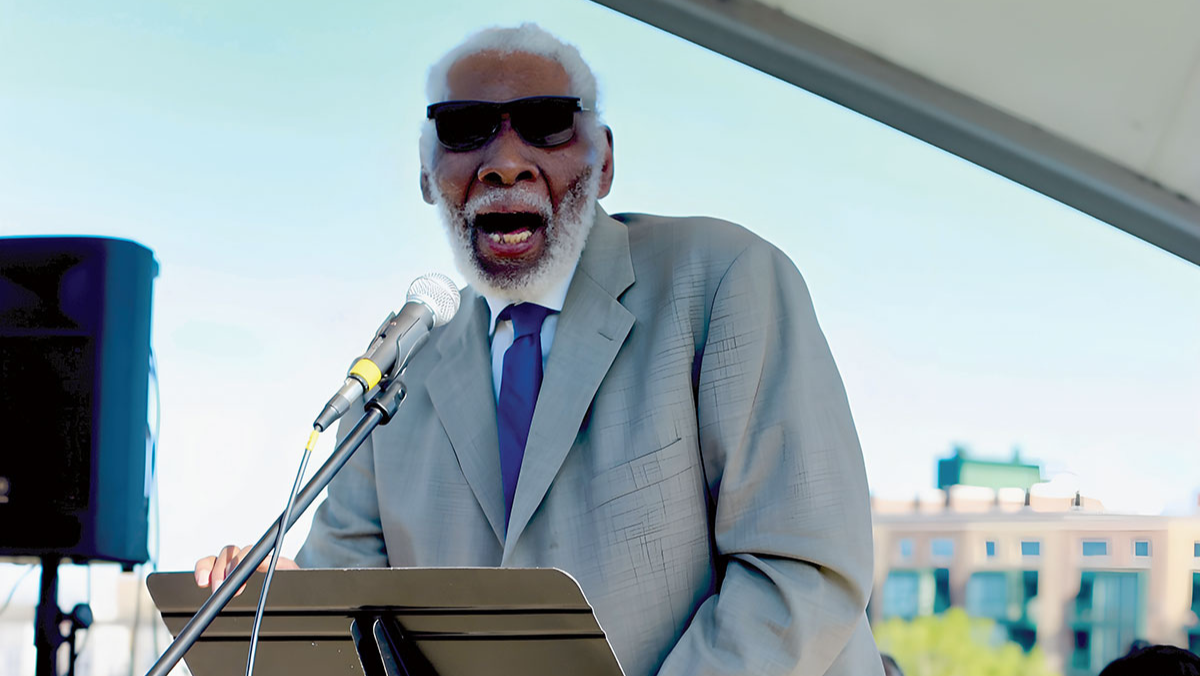
Even when his health deteriorated, Fred remained steadfast. He showed up. In addition to planning the 200 Nights of Freedom events, the March On, Milwaukee’s 50th anniversary committee worked with the Wisconsin Historical Society to plan nine commemorative markers tracing the routes of the marches throughout Milwaukee. About a year before he passed, Fred served as master of ceremonies at the Wisconsin Black Historical Society to celebrate the markers. The event closed with “Roll Call,” a ceremony inspired by the way they ended each march. It was led by Fred and two of his Commando brothers, Rev. Joseph Bar and Larry Willis. One by one, they read the long list of names belonging to those who had heroically filled the city’s streets for 200 consecutive days to demand fair housing opportunities. After each name, they shared a refrain of “present and accounted for” or “not present, but accounted for” to acknowledge those no longer with us.
The historical markers are not yet all in the ground, but they are slated for completion in 2026. It is a legacy Fred wanted. He has read his final Roll Call, but his life’s work will stand as a powerful form of resistance – both in creating history and in preserving it. His was a life of consistent care. Never hungry for the spotlight, he was not the loudest, most forceful, or flashiest, but he always knew what mattered.
I will be forever grateful for Fred’s messages, the ones on my phone and the ones imparted throughout my life.