My journey began in 2014 at the Wormfarm Institute, a working farm and hub for regenerative cultural practice in Sauk County, where I was an artist-in-residence. Since then, I have returned many times to get my hands in the dirt and my feet moving across the land. Joining me in conversation as I walk are farmers, farm workers, and families whose lives are entangled with the rhythms of soil, animals, memory, and migration. Their stories speak to me of resilience, creativity, and care. They remind me that rural is not a static landscape but a dynamic, relational space shaped by labor, kinship, absence, and return.


Walking + Talking: Stories in Motion is both a collaborative journey and a publication. The printed piece includes eight personal stories set and shared in the rural landscape of Wisconsin. Three are excerpted here.
They are narratives of finding and claiming home. As part of a landscape of contested issues involving migration, agricultural labor, and soil degradation, they place immigrant narratives within agricultural histories, foregrounding the ecological and cultural significance of soil and land.
These stories have been shared honestly — in English, Spanish, and sometimes in-between – and are the result of an ongoing collaboration with Puentes/Bridges, an organization dedicated to cross-cultural relationships in Wisconsin. The farm crisis in the United States is matched by a rural crisis in Mexico. In her 2022 book, Milked: How an American Crisis Brought Together Midwestern Dairy Farmers and Mexican Workers, Ruth Conniff explains that this has driven millions of subsistence farmers off their land, sending them into the cities and walking across the desert in search of work.
Walking + Talking: Stories in Motion is a general invitation to move through land not as an observer, but as a listener and co-learner. Personal stories move us beyond politics and into another realm — one of empathy, connection, and of elementally shared experiences. They remind us that we all walk through this world together, enriched by our contact with others, weaving together our separate strands.
In moving at a human pace, we can experience the land and its layers of migration, labor, absence, and resilience. Perhaps we can sense what has been erased and what still remains. Slowness invites perception. The land has its own tempo — listen for it. Every crack in the land is a story waiting to surface. Memory is not always spoken; it lives underfoot.
One | Nathan
I met Nathan on a sunny October day, and we spoke about his ties to Sauk County and his personal connection to the land. A descendant of German immigrants who began farming in the 1800s, Nathan continues his family’s tradition.
Five years ago, a farm accident, resulting in the loss of part of his right leg, changed Nathan’s life. Tasks he once took for granted — such as climbing ladders and navigating uneven terrain — suddenly became difficult or impossible. Refusing to step back, Nathan adapted. With his father — a skilled builder — they transformed the functionality of the farm to accommodate his new mobility needs. His father designed and welded a new metal staircase for the tall granary building, replacing the narrow, vertical side ladder typical of conventional grain structures. Now Nathan can access it without help. The broad, even steps and sturdy handrails reflect both form and function. It is an understated but elegant solution that balances accessibility with rural pragmatism.
Together we toured the pastures in a rover — an exhilarating and practical ride that offered insight into the farm’s design and daily rhythms. The cows, friendly and curious, approached as we arrived. “They like to be touched on the forehead,” Nathan told us and, sure enough, they leaned in gently for a moment of mutual recognition.
On Nathan’s farm, we see a living landscape: a site of thoughtful reinvention which reminds us that we can make lives more livable, one step, one ramp, one pasture at a time.
Two | Ramón
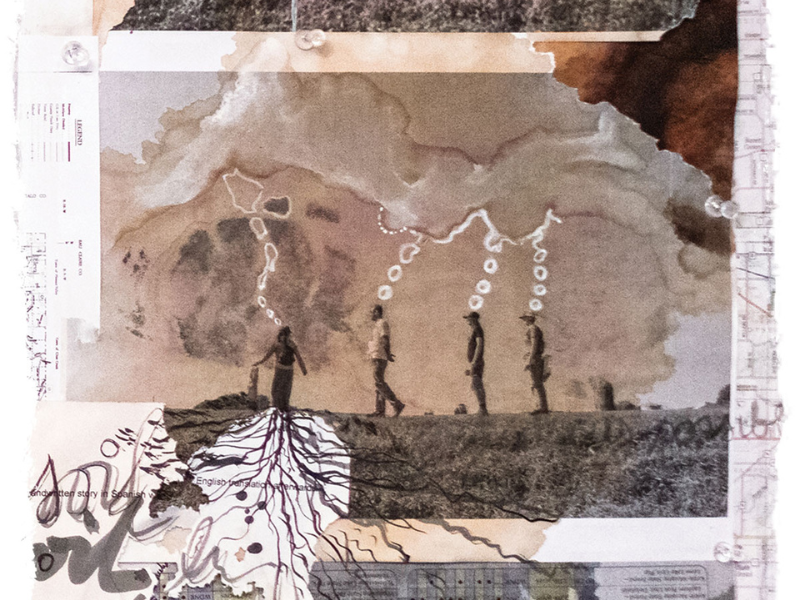
Ramon’s story emerged during several conversations. In English class, he chose to draw a picture and tell a story in response to the question, “How do we create a sense of home in a place where we didn’t grow up?”
¿Cómo creamos un sentido de hogar en un lugar donde no hemos crecido?
En mi pueblo, Tepepa, la gente se preocupa por construir una casa y una cocina. Buscan pareja, se casan, y empiezan a plantar árboles como durazno, manzana, ciruela, pera, aguacate y capulín. También tenemos nopales, verduras, pollos, y ovejas. Plantamos frutas y verduras y criamos animales para nosotros mismos o para vender, para tener un ingreso. Nos gusta hacer esto para no tener que comprar tanto, y a veces intercambiamos lo que cultivamos con otros en nuestro pueblo.
Translation: In my village, Tepepa, people focus on building a house and a kitchen. They find a partner, get married, and start planting trees like peach, apple, plum, pear, avocado, and cherry. We also have prickly pear cacti, vegetables, chickens, and sheep. We plant fruits and vegetables and raise animals for ourselves or to sell, to earn an income. We like doing this so we don't have to buy so much, and sometimes we trade what we grow with others in our village.
Three | Jacque and Dan
Jacque and Dan approach the land as a question: “What else is possible here?” Their farm is a space to test new ideas.
Their work honors the land by approaching it as a living text, not a finished one. For decades, their family focused on commodities production — alfalfa, corn, soy, and milk — following established methods to sustain the operation.
In 2020, amid the uncertainty and upheaval of the pandemic, they planted organic vegetable gardens and built a roadside stand. It wasn’t only about starting a business, but also about discovering what could grow from inherited land when given permission to reimagine it.
Their attitude is evident in the camaraderie that permeates the farm — in both small and large details that acknowledge the workers who help it thrive. Marvin, one of their employees, shares about many moments of apprenticeship, where knowledge moves freely between people, and spaces where admiration is mutual.
The milking parlor is pristine. Directly outside, a bulletin board displays photographs of their team — not as ID badges, but as portraits of individuals, each engaged in the fullness of their lives.