
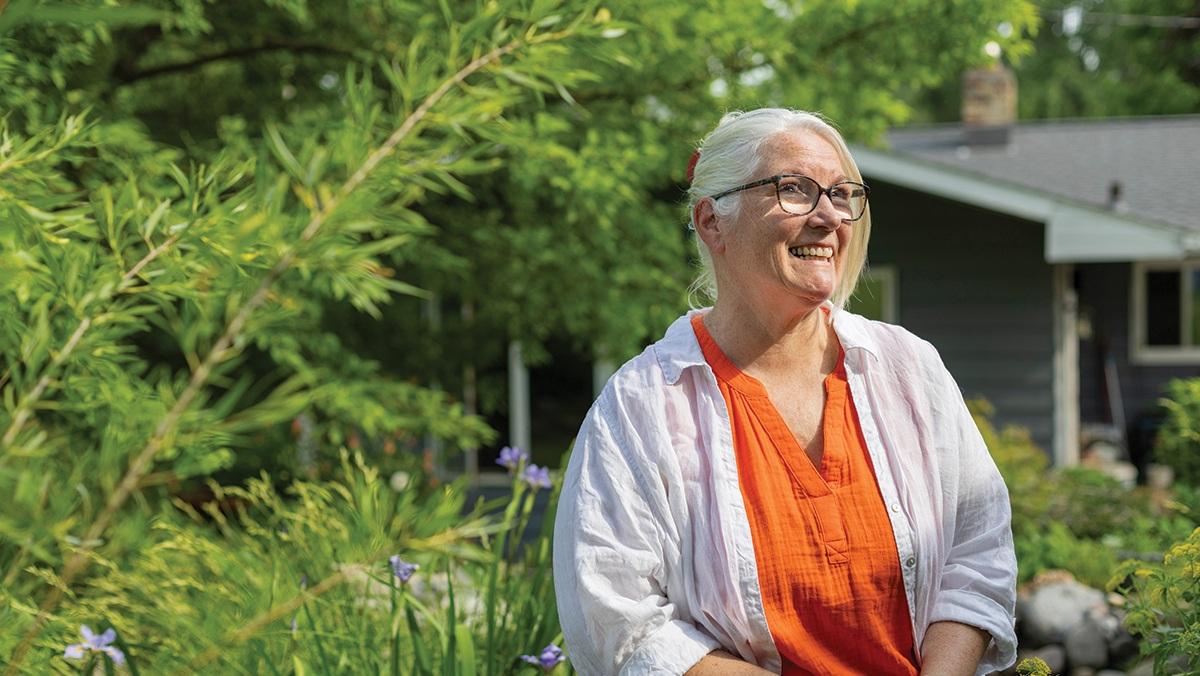
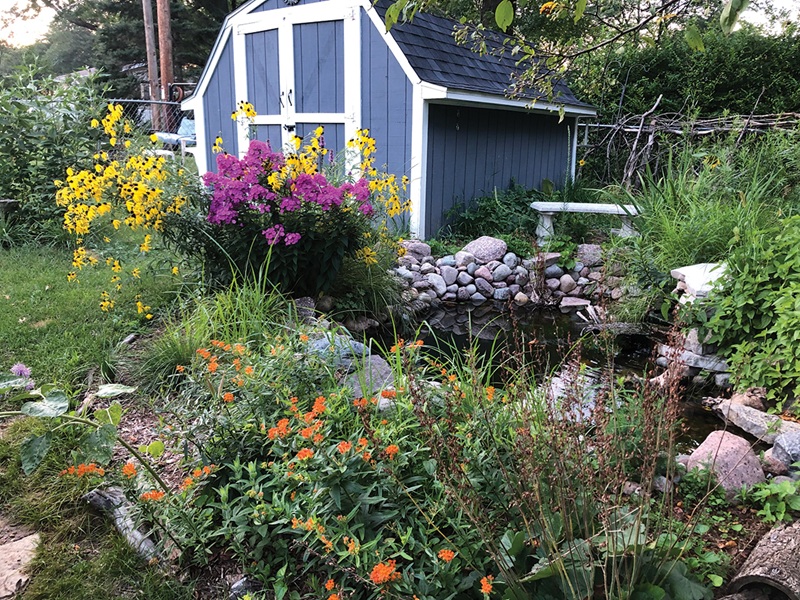
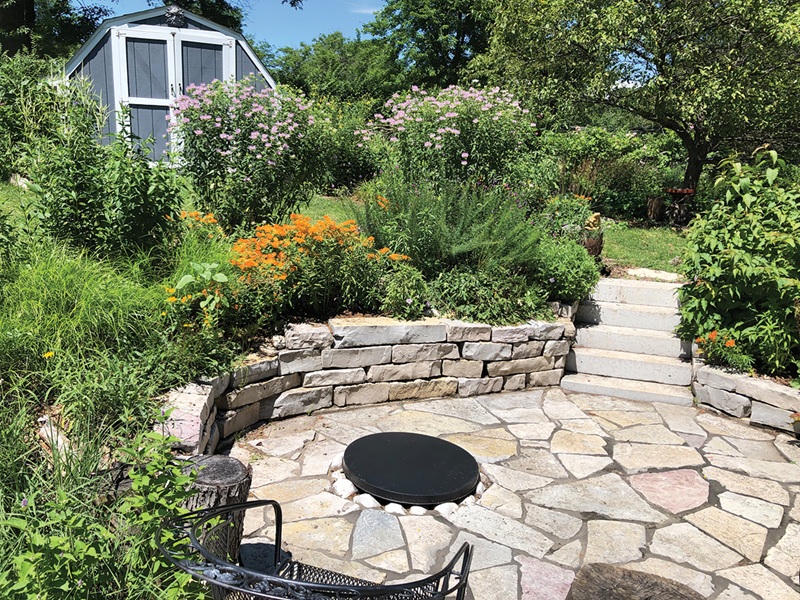
In midsummer, Amy Yocum’s Madison garden is a riot of color. The blues and purples of the wild geraniums, anise hyssop, blue sage, and violets contrast with the bright orange of the butterfly weed and the spectacular red of the royal catchfly. Butterflies flit throughout, accompanied by the sound of buzzing bees and birdsong. Her garden community includes toads, opossums, raccoons, squirrels, rabbits, chipmunks, and voles, the latter serving as an important food source for owls, hawks, foxes, and coyotes.
Yocum is a former hospice nurse who changed careers as her concerns about the environment grew. She’s now a master gardener and horticultural assistant at a local hospice, and in her spare time, she’s the president of the Madison chapter of Wild Ones Natural Landscapers, a national nonprofit organization headquartered in Neenah, Wisconsin, which promotes the use of native plants in landscaping. Yocum’s native garden is a far cry from a stereotypical suburban carpet of lawn, where the only birds are those visiting a bird feeder and the only sound might be that of lawn mowers and leaf blowers.
The seed for Wild Ones was planted in 1977, at a workshop on natural landscaping given by Lorrie Otto at the Schlitz Audubon Center in Bayside, just north of Milwaukee. After listening to Otto’s speech, attendees Gini Lindow, Ann Hill, Theresa Kloehn, Carol Beger, Rae Sweet, Renee Gardner, Eileen Roeder, Sally Meyer, and Rosemary Cowan were inspired to give native landscaping a try. The Wild Ones Gardening Club began in 1979 and was incorporated as Wild Ones Natural Landscapers, Ltd. in 1990.
Today, Wild Ones has expanded to thirty-six states, with ninety-four chartered chapters and thirty-six “seedling” chapters, which are those still gathering members and resources. Wisconsin alone has fourteen chapters, and the national headquarters is located on a sixteen-acre ecosystem in Neenah. Recent growth has been “phenomenal,” according to Jen Ainsworth, the national organization’s executive director, as U.S. membership grew from 4,300 in 2020 to over 12,000 by the end of 2024.
Below are some of the organization’s key lessons for learning why—and how—to rewild at least part of your lawn to help more native species thrive.
The case for growing wild
According to entomologist and ecologist Douglas Tallamy, a Wild Ones Lifetime Honorary Director who co-founded a similarly minded nonprofit based in Massachusetts called Homegrown National Park, our lawns cover forty million acres in the United States, an area the size of New England. As a result, native natural areas are disappearing, with an area the size of a football field lost every thirty seconds. As diverse wild ecosystems are destroyed by development, pavement, and lawns, it falls to individuals and communities to help restore ecological balance with native plants, he says.
In North America, native plants are defined as species found in an area prior to European settlement, but Ainsworth points out that “humans had a lot of influence over where plants were grown for many years” before that. In their native ecosystems, plants are part of a complex web of life, providing food and shelter to a variety of animals that live in them. Birds that migrate through the area also rely on food they obtain from native plants and the insects that feed on them. When native plants are added to a traditionally landscaped garden, they can become an integral part of the local ecosystem instead of mere ornaments.
Once established, native plants require little watering or fertilizing. In contrast, Americans use nine billion gallons of potable water on lawns and gardens every day, accounting for a third of all residential water use. A typical lawn of turfgrass has roots an inch or two deep but some native plants can have roots up to sixteen feet deep, making them resistant to drought. Pesticides, weed killers, and fertilizers used on lawns find their way into local waterways. Native plants can eliminate the need for chemical treatment and reduce erosion, runoff, and flooding. Native plants improve the quality of air, water, and soil. As we know, plants remove carbon dioxide from the air, but they also store carbon above and below the soil surface, helping to mitigate climate change. A diverse community of native plants is more resilient in the face of climate extremes than a lawn made up of just a few species of nonnative turfgrass.
Native pollinators thrive best on native nectar
Native plants are adapted to their biological environments, and a native plant will grow best where it co-evolved with other plants, animals, fungi, and soil microorganisms. By nurturing a diverse patch of native plants, gardeners can support the animals with which the plants evolved. Native pollinators, for example, feed best on the nectar and pollen of plants to which they are adapted: their host plants. Nectar provides energy in the form of carbohydrates, and pollen provides protein. In a mutually beneficial relationship, bees pollinate plants so that the plants can produce seeds, while bees feed pollen to their developing larvae. Unlike nonnative honeybees, many native bees are specialists, using the pollen of just one or two species to feed their young. The native sweat bee (Dufourea monardae) and bee balm fairy bee (Perdita gerhardi), for example, rely on the pollen of native flowers of the genus Monarda, including spotted bee balm (Monarda punctata) and wild bergamot (Monarda fistulosa). The endangered rusty patched bumble bee (Bombus affinis) is a generalist and an important pollinator for crops like cranberries and apples.
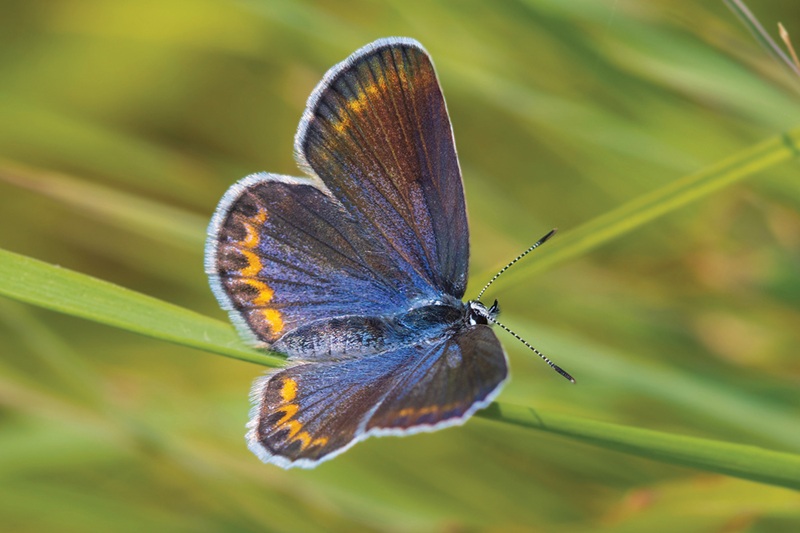
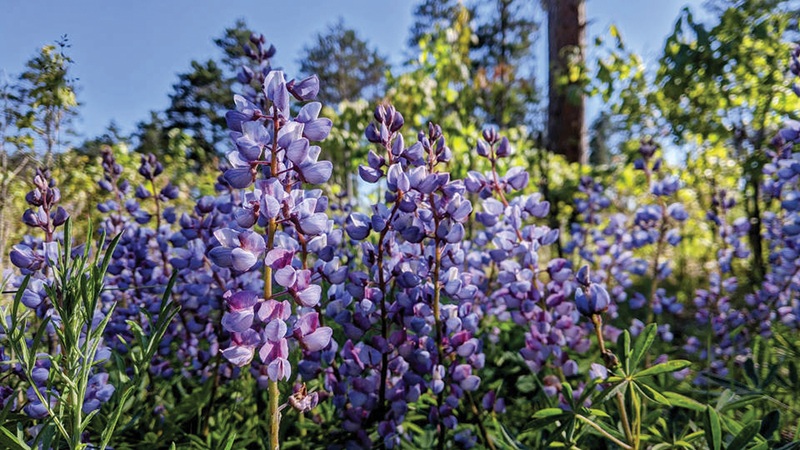
Similarly, butterflies and moths will lay eggs only on their host plants, and the caterpillars that hatch and eat the host plant are an important source of food for the animals in that ecosystem. Some butterflies and moths can use many different plants as hosts, but others are more specialized. The monarch butterfly uses milkweed (Asclepias) species, and fritillary butterflies can use several species of violets (Viola). The endangered Karner blue butterfly can use only the wild blue lupine (Lupinus perennis).
The Wild for Monarchs program is a collaboration between Wild Ones and the Monarch Joint Venture, a nonprofit partnership of federal, state, academic, and business entities that promotes conservation of monarch butterflies and other pollinators via outreach efforts to educate communities about the importance of native plants and pollinators. The program offers guidance on restoring native habitats to home gardens and public areas. Participants are encouraged to monitor their native gardens for pollinator activity and to share their findings and photographs.
Plant carefully to protect native species from competitors
Nonnative plants can be disruptive when introduced into a native ecosystem—even to a home garden. Butterfly bush (Buddleia davidii) is a striking example. Often planted by homeowners for its showy purple flowers that resemble lilacs, butterfly bush does indeed attract butterflies. It evolved in Asia, however, and when planted in North America, butterfly bush can become invasive. Each flower spike of a butterfly bush can produce 40,000 very lightweight seeds, which can travel great distances on the wind. The seeds germinate effectively, and the invading plants grow quickly, crowding out native species in faraway natural areas. In fact, butterfly bush nectar is so attractive to butterflies and other pollinators that they may ignore native plant species, depriving them of pollination. While butterflies can sip at the nectar of a butterfly bush, there are no North American butterflies whose caterpillars can feed on its leaves. It looks pretty and attracts butterflies, but this imported alien does not support their life cycle.
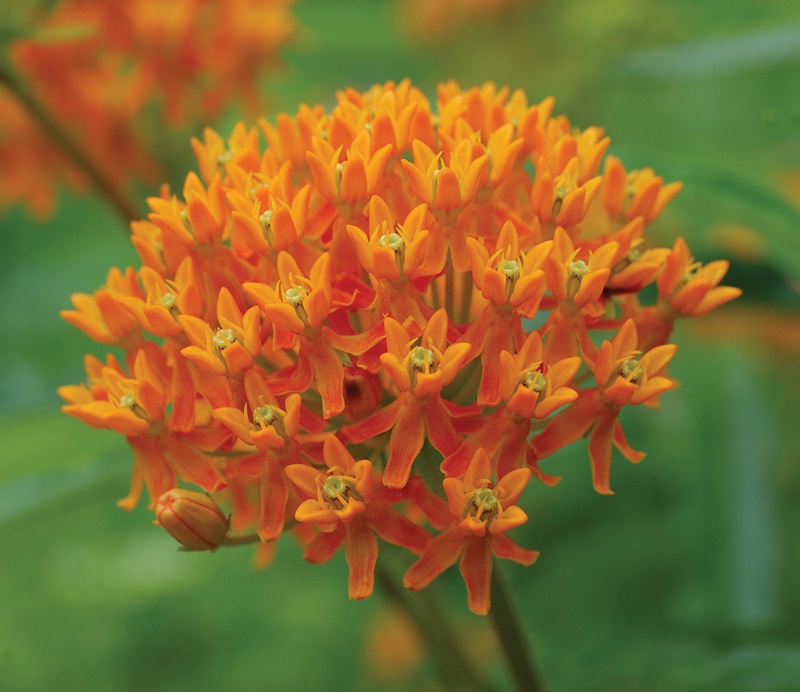
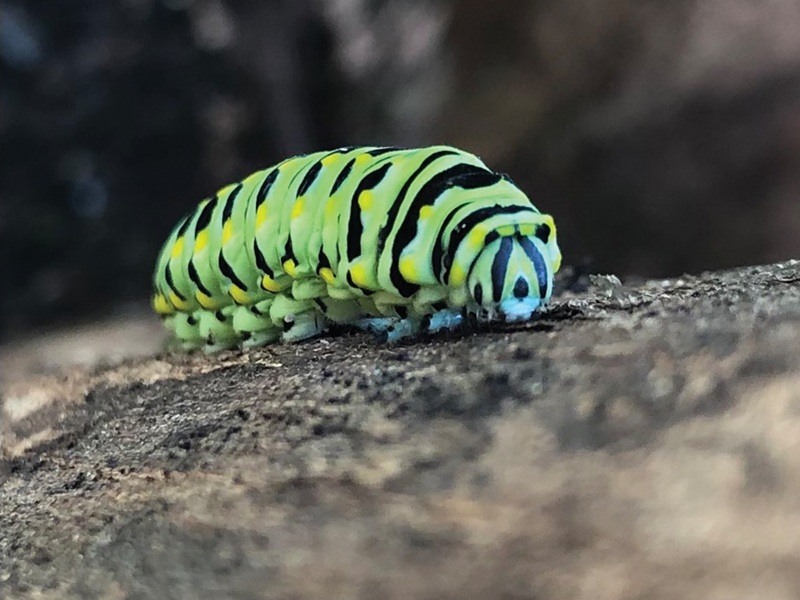
According to Wild Ones, a better choice for butterflies is butterfly weed, or orange milkweed (Asclepias tuberosa). Native to much of the United States, including Wisconsin, the bright orange flowers of butterfly weed attract butterflies, bees, and hummingbirds. It also serves as a host for three species of butterflies whose caterpillars can feed on their leaves. These well-fed caterpillars are an important source of food for birds, especially during nesting season. Chickadees, for example, will gather 6,000 to 8,000 caterpillars to feed a clutch of chicks in the sixteen days until they leave the nest. Butterfly weed is one of over 1,800 plant species native to Wisconsin, ranging from trees and shrubs to flowering plants to grasses and sedges.
Converting a sterile lawn to a diverse ecosystem of native plants can be a daunting task. One goal of Wild Ones is to help novice gardeners dip their toes into the soil of native landscaping. Another is to engage more experienced native planters. Says Ainsworth, “The person who’s been doing it for thirty years already, they’re the ones giving away seeds and helping other people learn about what is going to thrive in a certain area.”
There’s a place for turf grass— just make it a smaller part of your yard
Despite being referred to in The New Yorker as “the nation’s first grassroots anti-grass movement,” Wild Ones leaders say they don’t aim to do away with lawns completely. Lawns serve a purpose, as a place for children and pets to play, for example. But turf grass needn’t take up the entirety of a yard. The time and energy used to mow, maintain, and manicure an expansive, sterile lawn that doesn’t serve a purpose might be better used to create habitat for animals and insects to thrive, even if it’s just a corner of the yard.
To help homeowners start creating natural areas on their property, Wild Ones offers free downloadable native landscape designs, including one for Milwaukee. The designs provide guidance based on both the ecological region and the microclimates on a particular site. They advise homeowners to consider where their yard is shadiest and sunniest and to assess the soil. If an area is particularly wet, or prone to runoff, perhaps a rain garden would be appropriate.
One landscaping strategy is to eliminate an area of turf completely and design a native garden from scratch. Another strategy is to work slowly, in phases. Replace a few plants in an existing bed. Plant some woodland species under a tree, where grass won’t grow. Add some native shrubs around the perimeter of the property. Then wait and see how they do before investing more time, money, and sweat. You may find that small changes to the landscape will attract new wildlife visitors.
Ask your local Wild Ones chapter for help
The USDA’s hardiness zones can tell a gardener if a plant will survive through a long, cold Wisconsin winter, but temperature is not the only consideration. Factors such as precipitation, geography, and soil type can affect a plant’s ability to thrive, and broadly speaking, Wisconsin can be divided in half, with northern forest in the northeast and prairie-forest in the southwest. As many as twenty-seven more localized divisions, called ecoregions, take even more of these environmental factors into consideration.
It’s a lot to learn, so to help beginners who may be feeling overwhelmed, many Wild Ones chapters curate lists of local native plants and nurseries that specialize in native landscaping. Some even hold plant sales of their own, such as the Fox Valley chapter, which holds a very popular native plant sale each spring. “It’s like having a party. Everybody stops by,” says chapter president Shannon Davis-Foust, a senior biology and environmental studies lecturer at the University of Wisconsin-Oshkosh and the coordinator of the Clean Boats, Clean Waters initiative. “We’re all right there itching to talk to people about the plants.”
While specifics vary, Wild Ones chapters offer a mix of in-person and virtual talks by experts, garden and greenhouse tours, workshops, and work projects. For example, the Fox Valley chapter offers native ecology classes that can be taken individually or as part of the Wisconsin Native Plant Certification. Fox Valley Wild Ones also hosts the annual Toward Harmony with Nature Conference. The Wolf River chapter received funding to plant native shrubs in Heritage Park in Shawano. The Kettle Moraine chapter holds hummingbird banding and monarch tagging events. Wild Ones Northwoods Gateway installed a Butterfly Garden in Antigo. The Central Wisconsin chapter has worked with the City of Stevens Point and UW–Stevens Point to create a program called “Lawn Gone Native,” which encourages native-planted landscapes in the city.
For Wild Ones members who are working toward a landscape that is at least 75 percent native, the organization offers the opportunity to qualify as a Certified Native Habitat. This program recognizes and celebrates the efforts of native gardeners and helps educate neighbors and the community about the value of native ecosystems.
However, the organization recognizes that going completely native is not for everyone. “I really think that any effort is honorable and any effort is worthy of doing,” says Ainsworth. “It’s important that we do any little thing that we can. What might seem like individual insignificant actions really do stack up.”
“If you have a million people plant one square foot of native plants, we’ll have a million square feet of native plants.”
Lorrie Otto, a force of nature
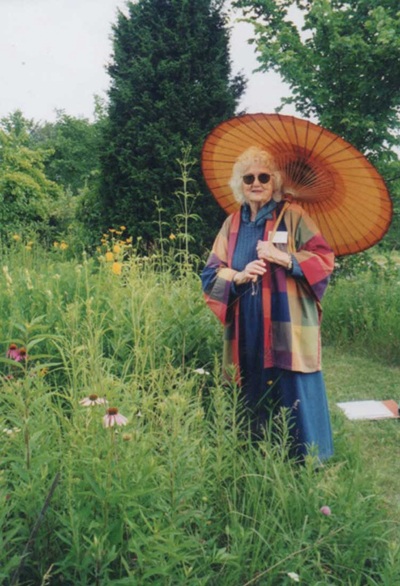 In the 1940s, Lorrie Otto planted a prairie of native plants in her yard in the Milwaukee suburb of Bayside. Her neighbors complained and one day, while Otto was folding laundry in her basement, the city mowed her prairie down without her permission. She didn’t sue; she educated, by inviting officials on a tour of what was left of her prairie.
In the 1950s, Otto heard of plans to develop a twenty-acre natural area in Mequon called the Fairy Chasm. Her advocacy was largely responsible for the sale of the property, not to developers, but to The Nature Conservancy. Today, the Fairy Chasm is a State Natural Area.
In the 1960s, horrified by the convulsions of dying robins and inspired by Rachel Carson’s Silent Spring, Otto worked to get the pesticide DDT banned, often showing up at community meetings with a basket of dead robins. Wisconsin banned DDT in 1970, and a federal ban was instituted in 1972.
Until her death in 2010, Otto traveled throughout the country to promote natural landscaping. She was honored by the National Wildlife Federation and the National Audubon Society. She was inducted into the Wisconsin Conservation Hall of Fame and was selected to be a Lifetime Honorary Director of Wild Ones. In 1996, Wild Ones created the Lorrie Otto Seeds for Education Fund. The program offers grants to support projects that engage young people from preschool to high school in planning, planting and caring for native plant gardens.
Otto once wrote, “If suburbia were landscaped with meadows, prairies, thickets or forests, or combinations of these, then the water would sparkle, fish would be good to eat again, birds would sing and human spirits would soar.”