
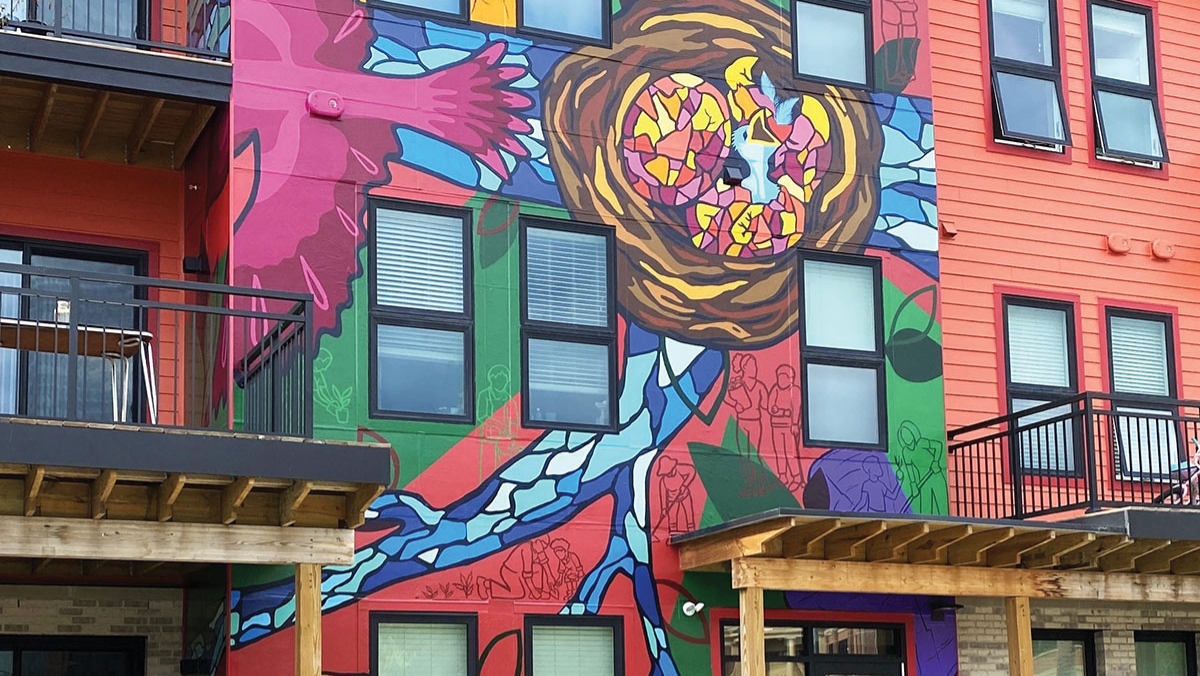
You can’t miss it. Standing just blocks from the state capitol in downtown Madison, Bayview’s townhouses and apartment units announce themselves with vibrant colors: peacock blue, poppy red, burnt orange, earthy green. A three-story-tall mural entitled Hope Finds a Home brightens the busy, urban intersection southeast of the university campus. On the façade facing a popular shoreline park, a second mural, Memory and Future, seems to draw all who pass by into the outstretched arms of a central figure. That mural’s elements of water, animals, and people invite a kind of conversation between the land that Bayview sits on, its original inhabitants, and the remarkably diverse cultures of the people who live there.
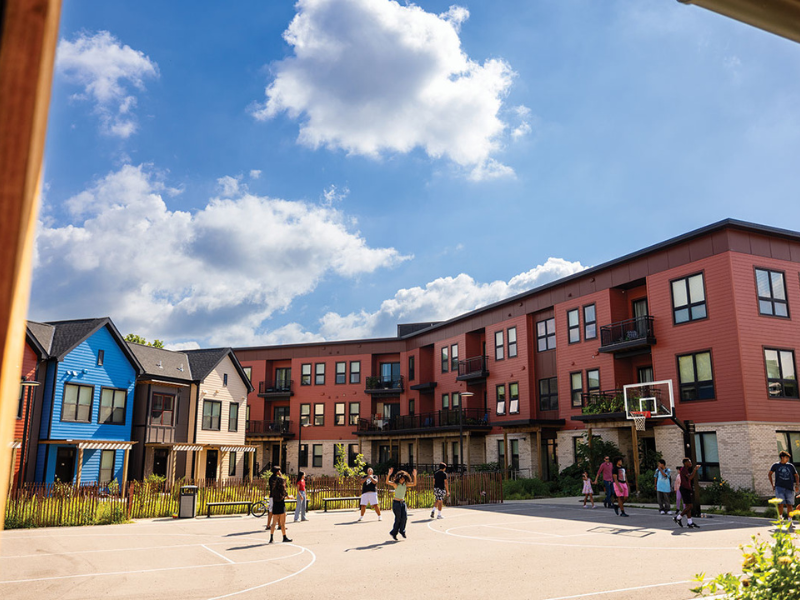
Bayview has always been different. The Bayview Foundation was formed by civic activists during a time of deep division over issues of affordable housing and race in the United States. The housing visionaries opposed the kind of gentrification that too often displaced people into lackluster housing. They designed the initial 102 housing units with the goal of seeding a vibrant community. The first residents moved in in 1971 and soon benefited from in-house programming, especially for kids. When the community center opened a decade later, it quickly became a hub of activities and resources for residents, a large proportion of whom were immigrants or refugees.
Half a century later, Bayview’s community was thriving and vibrant, but the buildings were old. The need for renovation provided a chance to update the housing units and align the Bayview campus with larger objectives. Bypassing the standard and more expeditious approach to development planning, the Bayview Foundation turned to the residents themselves for direction.
“There’s a negativity around low-income housing,” says Alexis London, executive director for the Bayview Foundation who oversaw the recent ambitious rebuild. “Bayview residents told us they wanted their home to be celebrated,” she emphasizes. She hoped Bayview’s redevelopment project could represent a more positive and community-focused “path forward” for Madison and for urban housing projects nationwide.
London and her team embarked on a process known as “design justice.” It’s an inclusionary approach that welcomes the people who are most impacted into the heart of the project. Beginning in 2018, Bayview leaders and city planners worked with The Kubala Washatko Architects and hosted feedback sessions in multiple languages to learn how residents use and experience their own space. They also trained a handful of residents to conduct door-to-door surveys and paid them to ask neighbors about their hopes, worries, and needs for such an extensive redesign. “All contributions were taken into consideration,” London says.
“People need to feel integrated, to see themselves in their homes,” London says of the residents’ buy-in. “Trust is built over time, step by step, meeting by meeting.” As the project design team asked for more input, community members understood that their feedback was being taken seriously. In the end, some 70 percent of Bayview’s residents participated in the development planning.
Not surprisingly, safety was top on the list, along with the kinds of things that make any place healthy for families to grow and thrive. Green spaces. Play spaces. A culture of cooperation. A sense of support and pride. Also on the list: built-in elements that “cultivate a social fabric.” Simply said: when people feel connected to one another, their neighborhoods naturally become stable and safe.
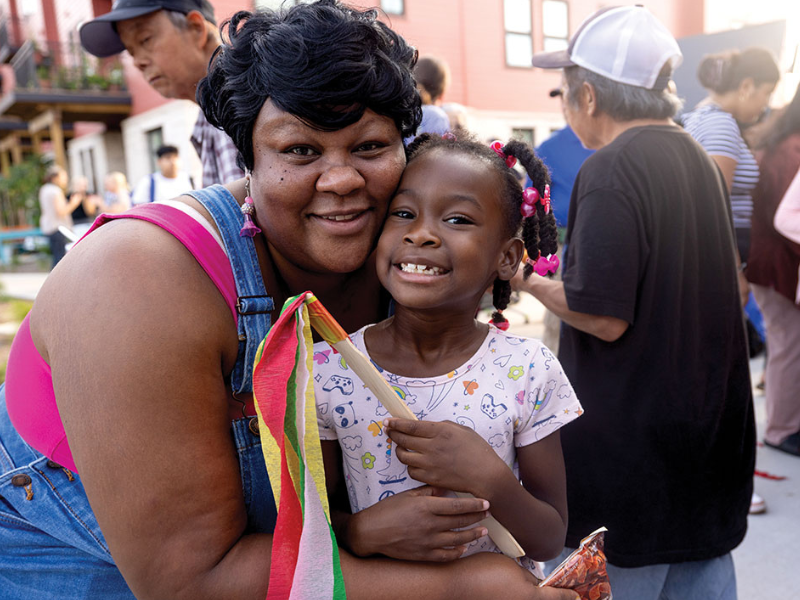
Bayview residents tend to put down roots in these homes, and families often encompass multiple generations, explains London. That makes Bayview a unique housing community. Senior residents regularly gather for lunch and stay for a round of bingo in the central community center until the school kids pile off buses and stream through the building, some to find their grandparents. “There’s an understanding that we all share this space,” says London. ‘I know you, you know me, we’re neighbors.’”
The entire city block of Bayview’s property has now been designed to increase this kind of familiarity. In the courtyard, the new sidewalks meander along townhouses and green spaces instead of charging from one spot to the next. Generously sized porches and balconies on the new buildings make it easy for neighbors to exchange a smile and a wave. Apartment units overlook basketball courts and playgrounds. The result? Informal, daily interactions that support residents’ commitment to being actively engaged in their surroundings.
But Bayview’s redevelopment was not just about designing new housing. At its heart is the desire to incorporate elements that help families build a supportive network and break the pattern of intergenerational poverty. These include services that not only meet their needs today, but also help them gain the skills and confidence to, say, become leaders in their jobs, advocates for their families, and eventually homeowners. Some, like the on-site food pantry and a fitness center, were obvious. Others took more imagination.
London says Bayview’s 11,500-square-foot community center, centrally located within what she refers to as the campus, sets the tone for Bayview’s culture and neighborly interactions. The space is warm, open, bright, inviting — and intuitive. “When you walk in, it’s easy to figure out where to plug in, where to just sit and relax with a coffee, where you might find the services you’re looking for.” Those services are a big part of what makes Bayview — and its residents — succeed.
More came to fruition thanks to the collective design process, including new programming for children ages birth to three and their parents, after-school programs for younger grades, and youth employment programs for older kids. They added paid internships for teens, summer school classes, summer camp, art classes, bike safety courses, and even swimming lessons. Eighty percent of Bayview’s kids participate in the after-school programming, a statistic that makes London feel good.
For adults, there are classes for English language learners, workshops on money management, and computer literacy classes that offer pathways for economic prosperity, while other classes provide opportunities for self-care. London says some 30 percent of people who live in the surrounding neighborhood benefit from Bayview’s philosophy of inclusivity, attending classes and joining social activities. The mural is more than advertising; it’s the Bayview way.
Equally important, London says, is the emphasis on art and creativity that fills the campus. More than mere decoration, “It’s those moments of nature, color, and intuitive design that elevate people’s everyday experience.”
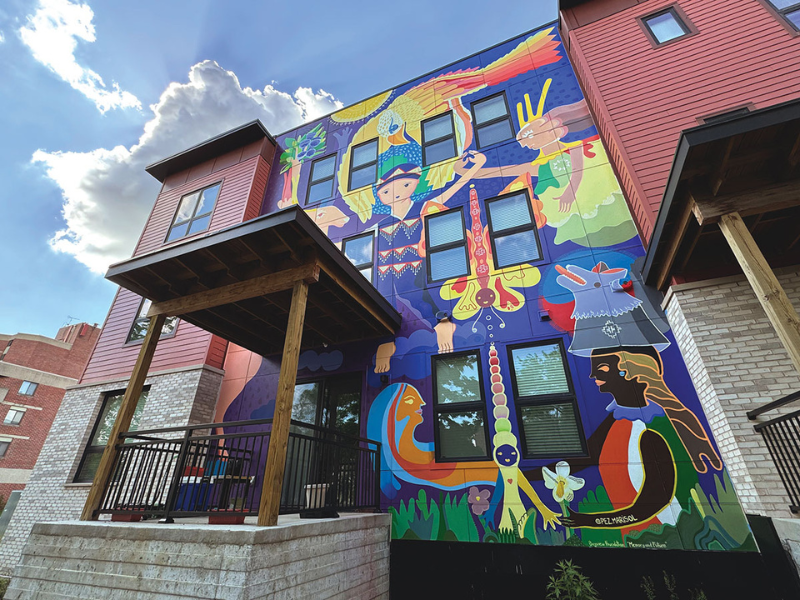
The design process revealed that some residents wanted to be surrounded by bright colors that showcase the diversity and vibrancy of the people who live there. Others wanted to see gardens, sculptures, mosaics, and murals that reflect who they are. So common spaces were landscaped with native plants and public art was created in partnership with professional artists. The sculptural element, Nest, for example, incorporates an arc populated by cardinals that reinforces a sense of home and welcomes visitors to the community center. The murals, which have quickly become landmarks in the neighborhood, were envisioned and painted by Bayview’s residents with the guidance of visiting artists. Attention to details like these is what designers call “placemaking.” The result is a cozy enclave with flashes of inspiration that galvanize people’s sense of ownership and pride.
Today, Bayview is home to around 450 people, nearly twice the number pre-renovation. About 170 of those residents are kids, and nearly a quarter are over the age of 55. It continues to be managed by the Bayview Foundation, a small nonprofit community organization with a big vision. What hasn’t changed? The mission that Bayview’s founders first envisioned in the 1960s: Housing that creates stability, community, and social connection. It’s what everyone looks for in a neighborhood.